
Environmentalists petition New Jersey over horseshoe crab bloodletting
The horseshoe crab’s blood helps test the sterility of medical products.

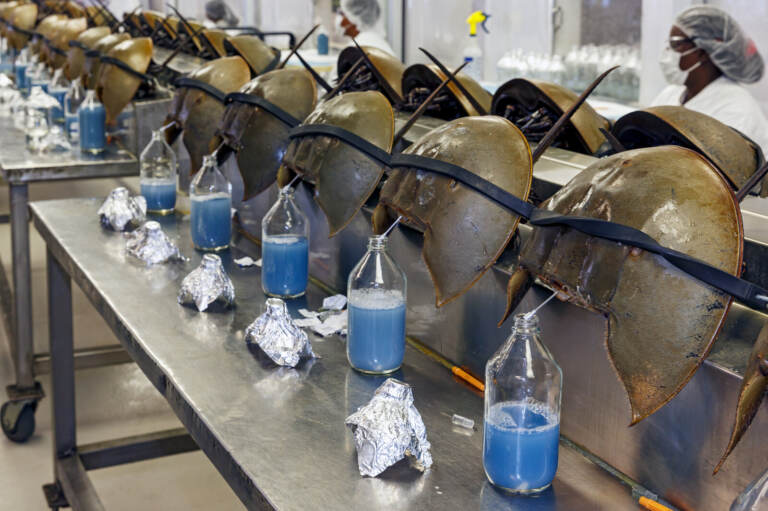
Horseshoe crabs are bled at a facility in Charleston, S.C., in June 2014. (Ariane Müeller)
This story is part of the WHYY News Climate Desk, bringing you news and solutions for our changing region.
From the Poconos to the Jersey Shore to the mouth of the Delaware Bay, what do you want to know about climate change? What would you like us to cover? Get in touch.
Environmentalists are calling on regulators in New Jersey to take enforcement action against a biomedical company that they accuse of killing hundreds of horseshoe crabs.
The Center for Biological Diversity and other environmental groups last week petitioned the state’s Department of Environmental Protection to determine whether Limuli Laboratories’ horseshoe crab practices meet state harvesting regulations.
The nonprofit said the Cape May County biomedical company injures thousands of horseshoe crabs each year, and that hundreds perish, according to documents it received through a records request from the state. The environmentalists said that New Jersey’s law requires horseshoe crabs to be released unharmed from the same waters in which they were collected.
“On paper, New Jersey is one of the best state protectors of horseshoe crabs, but look under the hood and you’ll find it’s actually allowing a company to kill and injure horseshoe crabs in huge numbers,” said Danny Waltz, a senior attorney at the Center for Biological Diversity, in a statement. “New Jersey must act quickly to fulfill the promise of its own laws and protect these highly imperiled animals and the endangered birds who depend on healthy crab populations.”
WHYY News called and emailed a number and address associated with Limuli Laboratories, but it’s not clear if the email address and phone number are still in use.
Related Content

Aravind Krishnan is developing technology that can test for bacterial toxins using a plant-based alternative to horseshoe crabs.
3 years ago
Listen 1:19The impact of harvesting horseshoe crabs
Horseshoe crabs have existed for more than 400 million years, surviving several mass extinction events.
However, their populations drastically reduced in the 1990s, partly because they were overharvested and used as bait for eels and whelk.
Today, commercial fisheries are regulated in an effort to protect horseshoe crabs. But increasing numbers of the so-called “living fossils” are being injured and killed over their valuable blood, which can test the safety of various medical products, like vaccines.
That’s bad news for the now federally threatened red knot bird, which relies on horseshoe crab eggs for sustenance during their migration from South America to the Arctic. Populations of the sand pipers dropped by about 75% from the 1980s to the 2000s because of limited access to horseshoe crab eggs, according to the U.S. Fish and Wildlife Service.
The Atlantic States Marine Fisheries Commission, which manages fishery resources, recommends a male-only harvest of horseshoe crabs to protect the female’s eggs that shorebirds rely on.
According to data from the ASMFC, populations of Delaware Bay horseshoe crabs, including females, have increased over the last two decades since the fishery harvest has been limited. However, conservationists say egg availability remains low, meaning red knots still face food shortages.
In recent years, horseshoe crabs have been in greater demand for their bright blue blood. Valued at $60,000 per gallon, it responds to bacterial toxins by clotting and helps determine the sterility of vaccines and other biomedical materials and devices.
It’s estimated that up to 1 million horseshoe crabs in the U.S. are harvested each year for the biomedical industry. Though horseshoe crabs are returned to the water after being bled by lab technicians, it is believed 15% to 30% of those eventually die.
The ASMFC estimates that 1,073,329 horseshoe crabs were collected from the Atlantic coast in 2024 for biomedical purposes — about a 53% increase from 2021. The commission estimates that about 17% of those crabs died.
New Jersey has a moratorium on the harvesting of horseshoe crabs for bait, but has an exemption for the biomedical industry. The Center for Biological Diversity’s petition asks DEP to review Limuli’s activities under the moratorium and issue a declaratory ruling as to whether Limuli is violating the law.
The nonprofit’s petition alleges Limuli’s owner has publicly acknowledged that her company picks up horseshoe crabs by their tails, despite the understanding that this practice can cause life-threatening harm.
A spokesperson for the DEP said Limuli Laboratories must apply annually to DEP’s Bureau of Marine Fisheries for a permit to collect horseshoe crabs for biomedical purposes.
“Conditions of the permit include area restrictions, daily take limits, data collection, and mandatory reporting,” the spokesperson said in an email. “These conditions are consistent with requirements established by the Atlantic States Marine Fisheries Commission Interstate Fishery Management Plan for Horseshoe Crabs.”
Related Content
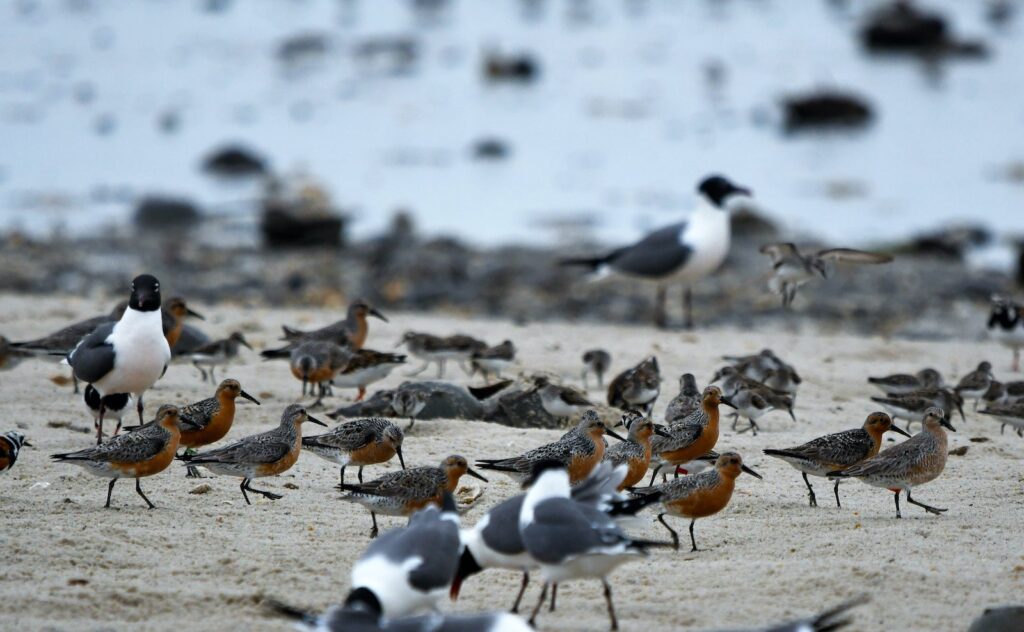
Red knot populations improve slightly along Delaware Bay, but remain fraction of historic levels
Biologists in New Jersey and Delaware spotted more red knot birds this year, but levels remain significantly lower than before the 2000s.
3 months ago
Listen 1:18A synthetic alternative
In 2023, the U.S. Pharmacopeia, a scientific nonprofit that sets standards for medicines, announced a proposal to simplify the use of synthetic alternatives to horseshoe crab blood. Although a synthetic alternative was developed decades ago, U.S. drug companies had faced regulatory hurdles when trying to use it.
Drug maker Eli Lilly has been using a synthetic alternative since 2016, and says it’s more cost-beneficial and effective. Until 2023, the pharmaceutical company was required to get additional approval from the U.S. Food and Drug Administration because at the time, the U.S. Pharmacopeia failed to recognize the use of a synthetic.
The Parenteral Drug Association, which advances pharmaceutical and biopharmaceutical manufacturing, science and regulation, said in a statement it supports the use of recombinant Bacterial Endotoxin Testing, which uses cloned DNA to replicate the protein found in horseshoe crab blood.
“PDA has long supported the adoption of new technologies, and specifically recombinant endotoxin testing, which replaces the need to rely on a wild animal for endotoxin testing while improving product quality, global supply chains, and the industry’s ethical position,” said Jay Bolden, a member of the PDA who works for Eli Lilly and Company, in a statement.
“The use of rBET for bacterial endotoxin testing for injectable medicines is a scientifically proven, sustainable alternative to the horseshoe crab-sourced testing reagent, LAL,” he said. “There are multiple peer-reviewed studies that have evaluated and established comparability using both standard and environmental endotoxins. PDA has served as a medium for this work, supporting recombinant endotoxin testing through peer-reviewed articles, poster and podium presentations, and working groups.
The PDA would not comment on the petition against Limuli Laboratories.
Environmentalists have been calling for a complete ban on the use of horseshoe crab blood.
“All of them are going to convert [to synthetic alternatives], but it’s just a matter of time,” said Steve Cottrell, president of the Delaware Audubon Society. “So the race is, will the conversion be before certain shore bird species face risk of extinction?”
Biologist Larry Niles, formerly with New Jersey’s Fish and Wildlife division, said horseshoe crab egg availability is the most important factor when evaluating the health of the red knots. He believes banning the harvesting of horseshoe crab blood would make a significant impact.
“Delaware Bay is an important stopover, but it’s not drawing international tourists anymore,” he said. “All of our local businesses have lost out — and why? For a few [pharmaceutical] companies on the Atlantic coast.”
Populations of red knots along the Delaware Bay saw slight improvements this year, with biologists tracking more than 30,000 red knots during a daily peak count. However, populations haven’t returned to historic levels, when scientists surveyed the birds as many as 95,000 during peak counts.

Get daily updates from WHYY News!
WHYY is your source for fact-based, in-depth journalism and information. As a nonprofit organization, we rely on financial support from readers like you. Please give today.
Part of the series
Watershed
Preserving Our Water: How we use our Delaware Watershed.
The project is funded by The William Penn Foundation.
Part of the series
EPA announces new plan to clean up arsenic contamination at Vineland chemical site
The Vineland Chemical Company produced arsenic-based herbicides and fungicides for 45 years, causing widespread contamination.
2 weeks ago
Listen 0:53
Nor’easter scoured Jersey and Delaware beaches, causing erosion and flooding
A 2025 beach-replenishment project in Atlantic City cost about $40 million, while work this year in Sea Isle, Strathmere and Ocean City had a $41 million price tag.
3 weeks ago
Vineland residents have pushed back against the data center, citing noise and air pollution.
4 weeks ago
Listen 1:00