
For Philadelphia’s Heavenly Bodies, music is more than a passion. It’s a necessity
Built on family ties, lifelong friendship and a shared musical obsession, the trio has become a fixture of Philadelphia's experimental music scene.
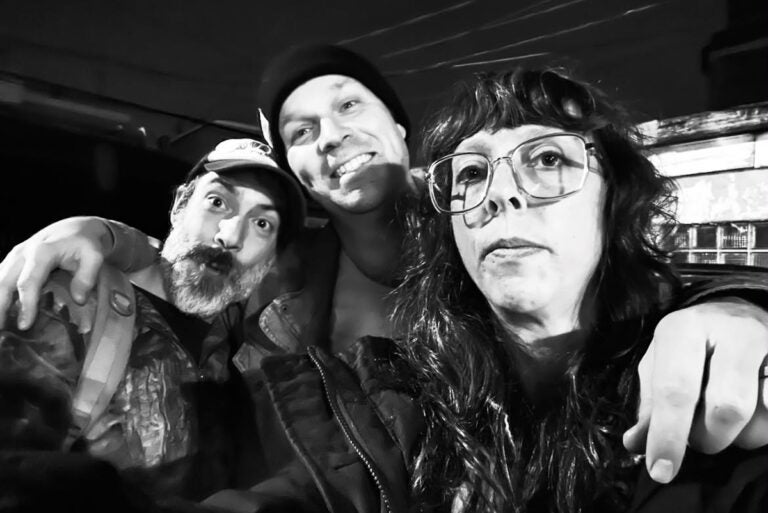
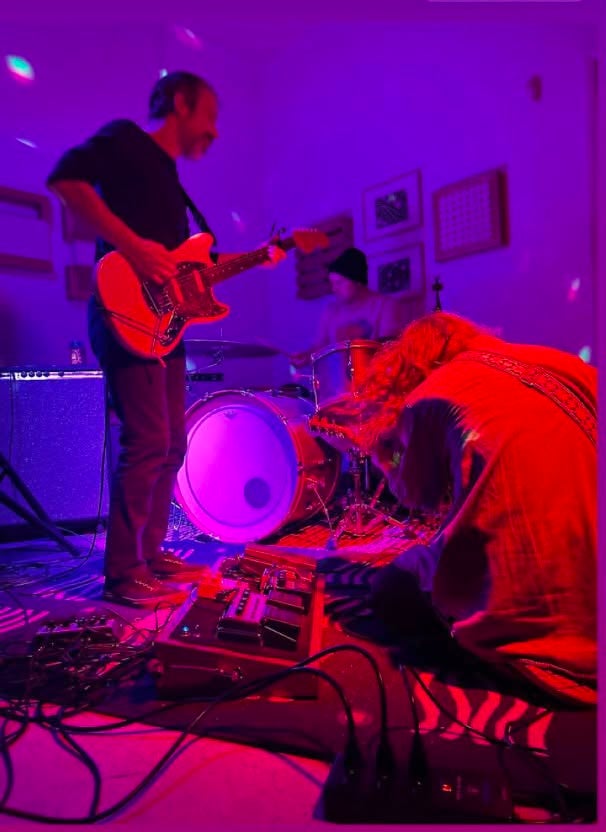
Since forming in 2018, Heavenly Bodies have been mainstays in Philly's underground music community. (Courtesy of Heavenly Bodies)
From Philly and the Pa. suburbs to South Jersey and Delaware, what would you like WHYY News to cover? Let us know!
From the beginning, Heavenly Bodies has had one simple rule.
“We’re not going to play songs, right?” said drummer Shaun Bailey.
Sitting in a crowded bar, Bailey, along with siblings Dustin and Ashley Burrows, recalled the formation of the band’s central philosophy.
“We had a mission statement,” said guitarist Dustin Burrows: Abandon traditional songwriting.
The experimental trio is known for its richly textured sound and sprawling improvisational pieces that build from quiet repetition to towering crescendos.
For musicians who had spent decades in structured bands, the shift toward immersive freeform psych rock was not easy.
“Every band we’ve been in, particularly me and Dustin, in our first band, it was all very composed,” Bailey said, “with a lot of different parts, and a lot of different changes.”
But Heavenly Bodies was never intended as a conventional rock band.
Overlapping orbits
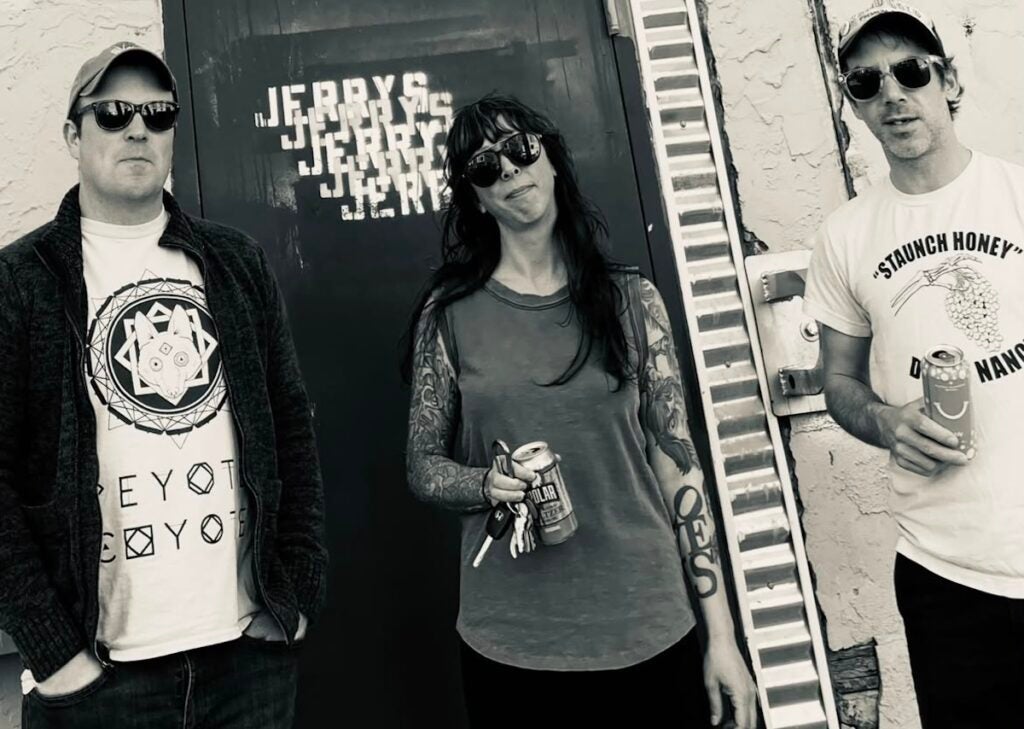
These days, Heavenly Bodies are a fixture of Philadelphia’s underground music community. They routinely share bills with artists such as Emily Robb and Blues Ambush, forming an informal constellation of performers, DIY venues, independent labels, college radio shows and experimental cassette tape releases.
Outside of Heavenly Bodies, bassist Ashley plays in the experimental motorik pop duo Stiff Curls, while Dustin mans the drum kit for post-punk band Lo Fives, and plays an integral role as a guitarist with Robb’s ER Band. The siblings also regularly cross paths in collaborative projects, benefit shows and one-off performances that knit together Philadelphia’s avant-garde music community.
In fact, it’s rare to see one of them playing without seeing the other somewhere nearby, hauling gear, cheering from the audience or dancing right up front.
They drift between projects, share rehearsal spaces and trade ideas with their peers. But for Dustin and Ashley, that’s not networking; it’s something much more fundamental.
For them, music isn’t simply something they do. It’s something they can’t stop doing.
A friendship built on a shared language
Some bands are born from chance meetings at record stores, bars or concerts. Heavenly Bodies took shape in the public school hallways of Salem County, New Jersey, over 30 years ago.
Growing up together in the shadow of Philadelphia, they navigated the same small-town, working-class environments and came of age as alternative and underground music was exploding.
As classmates in the 1990s, Bailey and the Burrowses spent their time obsessing over records, trading mixtapes and chasing the new sounds that would shape the rest of their lives.
“I remember seeing Dustin walk down the halls of school,” Bailey, who is slightly older, said. “This third grader with a homemade Mudhoney shirt. He wrote ‘Touch me I’m Sick.'”
Ashley traces her own musical awakening to seventh grade, when an older kid gave her a mixtape packed with Mudhoney, Beat Happening, Black Flag and Nirvana b-sides. She said the music opened new worlds for them.
“It really does send you on a trajectory,” Ashley said.
That path led toward increasingly psychedelic and adventurous music.
“My favorite bands back then were things like Spacemen 3 and Velvet Underground,” she said.
Related Content
The scorched guitar fuzz and reverb that define Robb's experimental sound anchor Jessica Kourkounis' surreal film.
8 months ago
Bailey and Dustin began playing together in 1995, with Bailey on drums and Dustin on guitar. What started as middle-school jam sessions evolved through a succession of noisy punk and post-punk bands, forging a musical bond that would last decades.
Ashley, despite spending years around musicians, didn’t pick up an instrument herself until 2018, when she bought her first bass.
Yet, when the three finally played together, something clicked immediately.
“The first time I played the guitar with Ashley, and she played bass, it was a pretty big milestone in my life,” Dustin recalled. “We actually just started laughing out loud at each other.”
From that moment, Bailey said, the pieces seemed to fall into orbit.
“I think because we’ve known each other for so long, there was no feeling-out period. We didn’t need to figure out how it would work personality-wise,” he said.
Their shared obsession with music had become a shared language years before they ever formed a band.
“It’s almost like something that I feel like we gravitated toward without knowing,” Ashley said.
Playing without a map
That familiarity allows the band to embrace uncertainty in ways many groups cannot. Instead of carefully mapped-out compositions, Heavenly Bodies developed a process built around trust, repetition and patient listening.
“We just made it a point to say, ‘Let’s play to all of our strengths and just play,’” Dustin said.
Much of the band’s music unfolds slowly and organically. Performances often begin with a simple pulse — a repeating bass figure, a guitar phrase or a drum pattern — before gradually expanding.
During the more ambient and spacey stretches, each musician finds ways to add small details, building layers around the others rather than competing for space.
Dustin often sways slightly, with his eyes closed, coaxing exploratory themes from his guitar. Bailey also often closes his eyes, while Ashley drops to her knees as the band settles deeper into its freeform sound.
Eventually, a steady bassline and drum beat emerge. The tune gathers momentum until Dustin drives it forward with waves of distorted feedback and heavy, flame-throwing riffs.
The effect of those moments can be cathartic, as what began as a heady pulse arrives 10 minutes later as an ecstatic wall of sound.
Related Content
Philly psychedelic folk rock band Henbane edges toward the spotlight after years underground
The five-piece band channels the adventurous spirit of early British folk-rock while forging a distinctly Philadelphia sound.
3 months ago
Why they keep playing: ‘I can’t not’
The band records most rehearsals and performances, creating an archive of spontaneous moments that might otherwise disappear.
“We don’t really get a chance that often to go into a nice studio with prepared material. We’re usually more off the cuff in our rehearsal space,” Ashley said.
Years of documenting those sessions have produced a steady stream of releases. Their LP “Universal Resurrection” grew out of a single session that the band recognized as something special.
“It was a product of one of our practices that, for 40 minutes, just really kind of hit,” Bailey said.
Occasionally, the band does make it into an actual studio — like last year, when they recorded “Mechanics,” an LP slated for release on Carbon Records. Dustin describes it as the band’s “most deliberate offering up to this point.”
Over the years, support from Philly’s psychedelic music community has helped Heavenly Bodies shed many of their inhibitions as performers.
“When we play live, we have allowed ourselves now to not get hung up on how we are viewed by others and instead allow the music to reverberate or move somebody instead,” Bailey said.
For Ashley, making music serves an even more personal purpose.
“We all need to do things that make us feel good or positive, even though negative things are happening to us,” she said. “Music. That is what it’s like. I’m not doing it because I don’t know that bad things are happening. I’m doing it because it keeps me sane.”
Dustin said the band’s goal is to create moments of refuge from the anxieties of everyday life. The trio rarely pauses between songs and keeps on-stage banter to a minimum. They would rather let the music speak for itself.
Sitting together in the bar, swapping stories of their youthful adventures, excitedly interrupting each other and finishing each other’s sentences, one thing becomes perfectly clear.
This family, accidental and chosen, is bound by a shared commitment to music and to each other.
Dustin noted that most people have a hobby or interest they’re passionate about.
“There is another word for how we feel about what we do,” he said. “We’re not passionate about it.”
Bailey immediately offered an alternative word to describe their drive.
“I can’t not,” he said. “It’s a disease.”

Saturdays just got more interesting.
WHYY is your source for fact-based, in-depth journalism and information. As a nonprofit organization, we rely on financial support from readers like you. Please give today.
Three-day passes for the festival start at $295. Alternative music icon Kim Gordon and electronic duo Bicep will headline.
3 months ago
The seven-track EP serves as an introduction to the brother-sister duo, who are two of Philadelphia’s most ambitious songwriters.
3 months ago
Philly psychedelic folk rock band Henbane edges toward the spotlight after years underground
The five-piece band channels the adventurous spirit of early British folk-rock while forging a distinctly Philadelphia sound.
3 months ago