

The U.S. Forest Service wants to move west and close regional offices, including 4 in Pennsylvania
Scientists, foresters and some in the lumber industry are concerned about losing important programs that only the Forest Service can do.
Listen 1:48
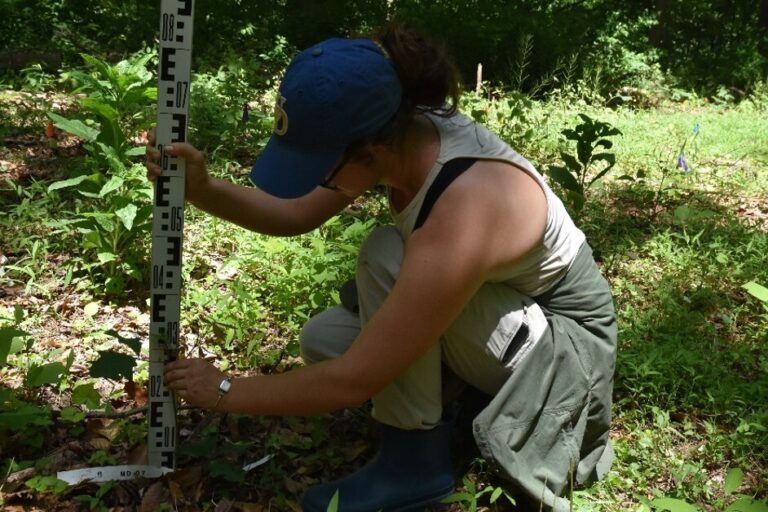
Graduate student Kendall McCoach measures the height of an oak seedling. (Tara Trammell)
From Philly and the Pa. suburbs to South Jersey and Delaware, what would you like WHYY News to cover? Let us know!
The U.S. Forest Service plans to move its headquarters from Washington, D.C. to Salt Lake City, Utah, and will consider closing regional offices around the country, including four in Pennsylvania.
The Forest Service says most of the land it manages is in the western U.S., so leadership should be physically closer to the forests, and wildfire zones it oversees. The agency also wants to boost timber production to make lumber more affordable.
Scientists in Pennsylvania, New Jersey and Delaware worry that the move, and change in focus, could impact East Coast tree-planting initiatives, remove vital resources and hamper research efforts.
Forest Service ‘absolutely critical’ to research efforts
Tara Trammell, an ecologist and professor of urban forestry at the University of Delaware, said if the agency were to relocate employees from the East Coast, a lot of local knowledge and research on how to manage the forests on the East Coast would also be lost.
“Losing that knowledge base and that ability to manage our lands in the eastern part of the U.S. would be very detrimental to our forest system in general,” she said.
She also takes issue with the agency’s stated reason for relocating, pointing out that more forests are located in the eastern part of the U.S. than the west, which the Forest Service’s own 2022 Forest Atlas shows.
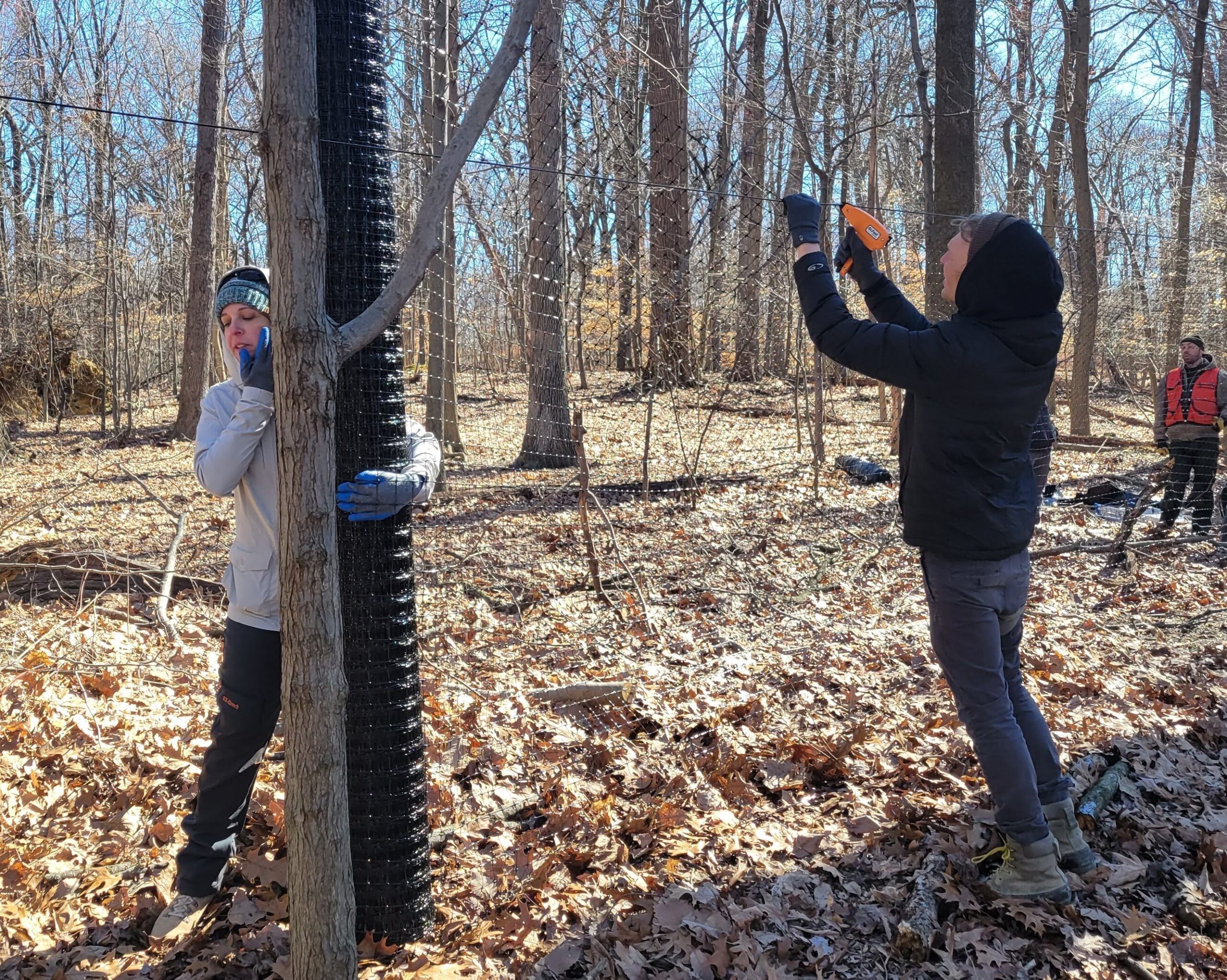
Trammell said the Forest Service is vital to support local research. For instance, for years, she has worked with scientists at the Forest Service and various universities and cities to plant thousands of oak trees along the East Coast from Baltimore and Philadelphia to western Massachusetts. The idea behind this initiative is that oak trees are drought-tolerant, and could survive the conditions that climate change would bring to the East Coast. The researchers want to monitor how the oak trees fare in these cities, and how foresters could help them thrive in cities. With the Forest Service’s planned move and potential closure of local offices, she said the future of this work hangs in the balance.
“None of us could do what we have managed to do with this one project where we planted 8,000 seedlings, unless we’d had everyone working together. But the Forest Service was absolutely critical to that even occurring,” Trammell said.
She added that the project would not have happened without Forest Service researchers helping to coordinate it across multiple states.
In a statement, a spokesperson for the U.S. Department of Agriculture, which the Forest Service is under, said the reorganization does not eliminate scientific positions, cancel research programs or reduce our national research footprint.
Related Content
New Jersey’s wildfire season is underway. Here’s what you need to know
New Jersey’s wildfire season, which runs through mid-May, occurs in some of the most fire-prone forests in the country. Climate change is increasing the risk.
7 months ago
Researchers, Forest Service employees and industry concerned about the future of the tree census
Several researchers and foresters also said they were worried about what would happen to the Forest Inventory and Analysis program, which some call the “tree census.” The Forest Service workers in this program regularly collect data on forests across the U.S., which is useful to governments, companies and scientists.
For example, Myla Aronson, assistant professor of ecology at Rutgers University in New Jersey, said she relies on this data to study how forests change because of storms, droughts, pollution and the expansion of nearby cities.
“We wouldn’t be able to understand the trajectories of forests without this long-term data,” she said.
She said the program is already strained from budget cuts in 2025, which led to thousands of Forest Service workers being fired, resigning or retiring.
Michael Hoppus has retired from the Forest Service, but used to work on the Forest Inventory and Analysis Program as a research forester based in Pennsylvania. He said there are a handful of staff in York who work on the program, but the agency is thinking about closing that office.
“Of these people that are still hanging on in this area where I live, they have been given letters saying, ‘You might have to move, you might not have to move. We’ll let you know,'” he said. “So, very unclear what’s going to happen.”
He added that he has talked to many current Forest Service employees and none are pleased with the plan.
“I just talked to a high-level state and private forestry employee who is livid at what she considers to be very unwise elimination, essentially, of the good work,” he said. “I was a high-ranking officer in the Navy. I quit the Navy [at] 32 years old to become a forester. And I was bound and determined that I was going to work for the Forest Service and I was lucky enough to do just that. I don’t like it being messed with.”
The USDA said part of the point of reorganizing is to support U.S. timber production. However, that industry also uses data from the Forest Inventory and Analysis Program, said Dallin Brooks, executive director of the National Hardwood Lumber Association, a trade organization that represents hardwood sawmills in the U.S. and Canada.
Brooks explained that the industry relies on this “critical” inventory data to decide where to build mills, and whether to expand specific locations.
He also said the industry is concerned about the plan to close an office in Starkville, Mississippi, where the Forest Service tests the durability of wood as part of a network of sites around the country.
“The durability of a piece of wood in Louisiana is different from one in Chicago. And so we need these different sites to do this,” he said. “We just don’t have answers to what’s going to happen with these test sites. But the industry is funding a lot of this research with them, providing samples, and we don’t want to see that research disappear.”
He said that companies will always support the government being good stewards of taxpayer funds, but the current uncertainty around the future of the Forest Service is bad for business.
“You can’t make long-term investments if you don’t know how things are going to change. And so the uncertainty, which is across the board the number one concern of the industry, is something that was very much on everybody’s mind,” Brooks said.
Related Content
NOAA is rolling out an experimental tool to help emergency planners predict extreme rain events in 60 cities, including Philadelphia and Dover, Delaware.
5 months ago
Listen 1:08Forest Service says important work will continue
There are some who are not worried about the U.S. Forest Service reorganization plan. Matt Carney, who owns a timber harvesting company in northeast Pennsylvania, said he does not think the agency’s staff reductions or office closures will have much of an effect on how his company operates.
“Some of the stuff that the Forest Service does is a little bit redundant from what private entities do and different colleges do,” he said. “So … even if they closed up shop completely, I really don’t feel it’d have that huge of an impact on the state of Pennsylvania and our timber harvesting daily operations.”
And Kyle Hoyd, chief of the Delaware Forest Service, said the U.S. Forest Service has been “very transparent” about the reorganization process. He added that a lot of their work with the U.S. Forest Service already happens virtually, so he does not foresee much impact if regional offices close.
Pennsylvania State Forester Seth Cassell said in a statement that the Pennsylvania Department of Conservation and Natural Resources “remains engaged with the Forest Service as federal updates and operational changes are announced and implemented, with a continued focus on ensuring Pennsylvania’s forestry programs, research capacity, and land management efforts remain strong and uninterrupted.”
USDA spokesperson Lisa Bryant said in a statement that it is too expensive to keep running all of the Forest Service’s current facilities.
“We are taking a hard look at the cost of each facility, its utilization, and its deferred maintenance needs while supporting our people. These decisions are about facilities and upkeep — not jobs or programs. In all cases, the research and the research staff will continue their important work, including maintaining and overseeing important scientific collections,” Bryant said.

Get daily updates from WHYY News!
WHYY is your source for fact-based, in-depth journalism and information. As a nonprofit organization, we rely on financial support from readers like you. Please give today.

Light pollution, wildfire smoke threaten view of the stars in the Philly suburbs
Light pollution and consecutive summers of Canadian wildfires have made it harder to stargaze in even the most remote places in Philadelphia’s suburbs.
2 weeks ago
Listen 4:57
Pa. residents revive colonial-era practice by growing a ‘square yard’ of flax
The PA Flax Project promotes the revitalization of the industry as a climate-friendly crop that could be used to make the sustainable plant-based fiber linen.
4 months ago
Listen 1:01
Anglers help stock White Clay Creek with trout, celebrate improvements to water quality
Pennsylvania has awarded more than $17 million in grants to 89 state projects to improve water quality and support trout.
6 months ago
Listen 1:17