

Epstein files show Haverford donor Howard Lutnick stayed in touch after claiming he cut ties, sparking calls to rename library
Students are calling for Lutnick Library to be renamed after documents revealed the U.S. commerce secretary maintained contact with Jeffrey Epstein years after his conviction.

File - Commerce Secretary Howard Lutnick listens during an event with President Donald Trump in the Oval Office of the White House, Monday, Feb. 2, 2026, in Washington. (AP Photo/Alex Brandon)
From Philly and the Pa. suburbs to South Jersey and Delaware, what would you like WHYY News to cover? Let us know!
Students at Haverford College are calling on the school to rename its library and sever ties with one of its biggest donors after newly released Epstein files revealed continued contact between U.S. Commerce Secretary Howard Lutnick and convicted sex trafficker Jeffrey Epstein.
Lutnick’s contributions to the college amount to $65 million. The largest gift was a $25 million donation in 2014 to renovate the campus library, which now bears his name.
Lutnick, a Haverford alumnus, had claimed to have cut ties with Epstein in 2005. However, documents released Jan. 30 confirm that the pair continued to communicate after 2008, when Epstein was convicted of soliciting sexual acts from a minor. In a U.S. Senate hearing in February, Lutnick testified that he had visited Epstein’s private island in 2012 with his wife and children. In February, a previously redacted image from the files was recovered, which shows Epstein, Lutnick and three other men on the island together.
On March 3, the commerce secretary agreed to sit for an interview with the House Oversight Committee regarding his relationship to Epstein. The committee has said it welcomed his cooperation but has not yet announced a date for the testimony.

‘What now?’ Haverford students ask
Members of the Haverford community have expressed outrage at the revelation and have since called for the library to be renamed. According to The Bi-College News, the student newspaper of Haverford and Bryn Mawr colleges, posters have appeared around campus reading “Howard Lutnick is in the Epstein files — What now?”
Students had long been aware of Lutnick’s public profile, Ben Fligelman, co-president of Haverford Students’ Council, told WHYY News. But the revelations about his continued association with Epstein changed how many viewed his relationship with the college.
“Even before the Epstein files came out, we were aware of Lutnick’s history and his behavior in the business world and in the political world. But, in so many ways, that’s just life,” he said.
But for Fligelman and co-president Sarah Weill-Jones, the revelation of Lutnick’s association with Epstein, and the fact that he had previously lied about it, was a breaking point.
“I was nothing short of horrified,” Weill-Jones said. “To know that someone so closely tied to Haverford as an institution directly associated with Epstein even after his conviction is something I found extremely disturbing.”
Haverford Survivor Collective, a group advocating for victims of sexual violence, released a statement in response to the files urging the college to re-evaluate its ties to Lutnick.
“At what point will the college confront its relationship with this individual? At what point will it say, unequivocally, ‘enough is enough’? At what point does a reluctance to do so extend beyond mere negligence into a moral failing?” the statement read, in part.
Paeton Smith-Hiebert, one of the founders of the group, had been following the news about Epstein survivors and their families for some time, but when the Haverford alum’s association was publicized, she said, “It became a lot more real. It hit me in a wave. Now I’m walking around [campus] and seeing a name everywhere that’s also mentioned countless times in the Epstein files.”
Lutnick’s name appears across Haverford’s campus. In addition to the central library, he is a major donor to the college’s Cantor Fitzgerald Gallery. The track and tennis center bears the name of his brother, Gary Lutnick, who was killed in the Sept. 11, 2001 attacks. And the fine arts building is named after his mother, Jane Lutnick.
Related Content

Justice Department publishes missing Epstein files involving uncorroborated claim about Trump
President Donald Trump has consistently denied any wrongdoing in connection with Jeffrey Epstein.
2 weeks ago
Haverford students disappointed by slow response
On Feb. 12, Haverford President Wendy Raymond sent a message to the college community. “We recognize that association with Epstein raises ethical questions,” the statement reads, in part. “While Secretary Lutnick’s association with Epstein has no direct bearing on the College, as an institution, we are committed to our core values and cognizant of broader ethical implications raised by these disclosures. The Board of Managers and I will continue to monitor the situation.”
For many students, the college’s response was disappointing because it did not include resources or spaces where students could seek support.
“There [was] no acknowledgement of the emotional toll that this was taking on some of the student body, and we wanted to create a space where students could air their grievances,” Smith-Hiebert said.
In turn, Haverford Survivor Collective collaborated with campus organization E-Haus to host a public forum on Feb. 18. The event, organized by Smith-Hiebert and Milja Dann, introduced an open letter addressed to Raymond and the Haverford College Board of Managers, calling on them to begin the process of renaming the library.
“I do understand that as president, you can never please [everyone] and there are a lot of complicated factors that go into these decisions,” Dann said, echoing Smith-Hiebert’s concerns. “But the language she’s using and the lack of care and compassion towards students is upsetting.”
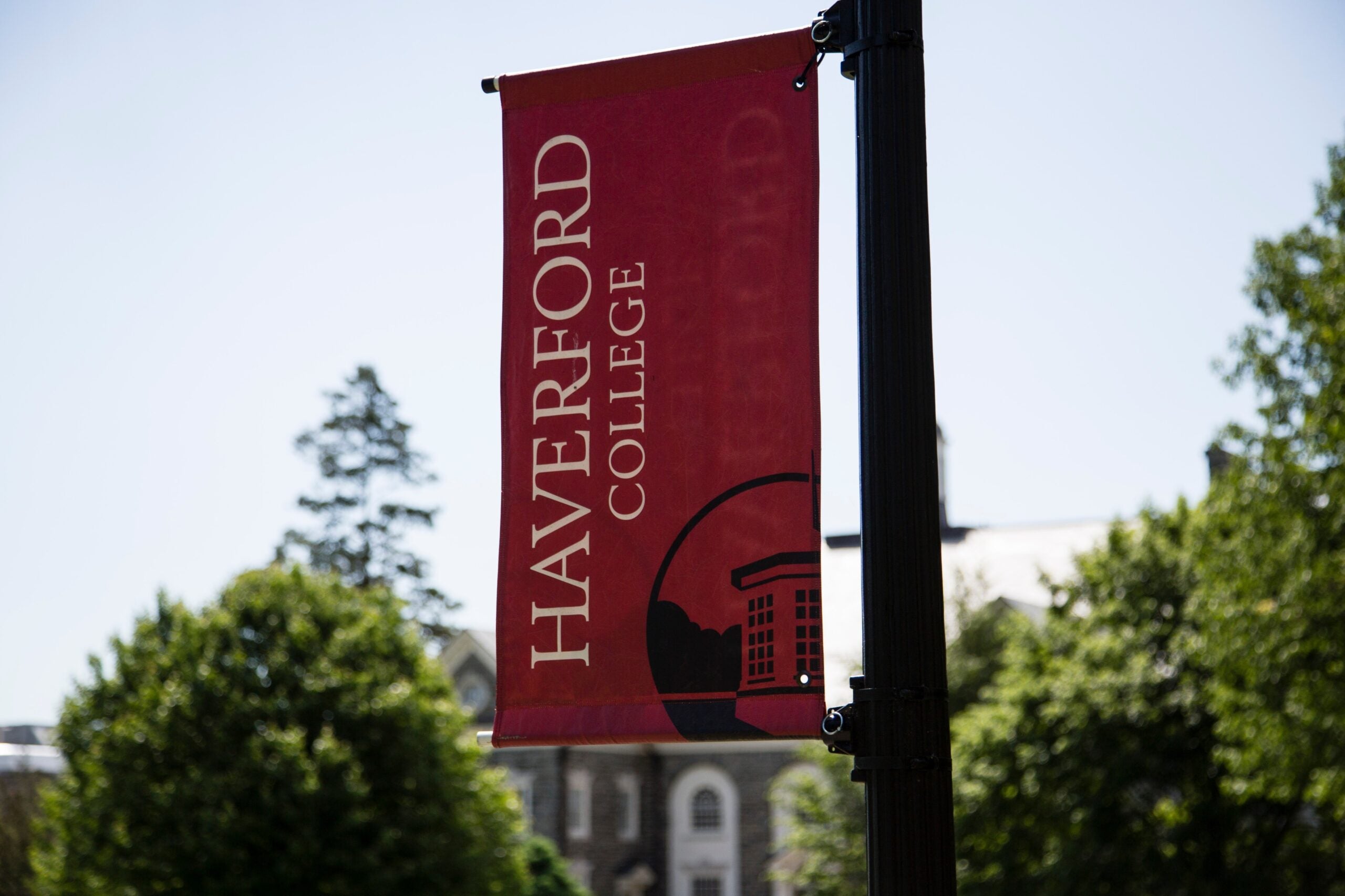
Smith-Hiebert said the situation has been distressing for survivors of sexual violence on Haverford’s campus. As a sexual assault survivor herself, Smith-Hiebert said, “I have to go into that building if I need to print something or get a book for my thesis. It’s unfortunately an unavoidable part of being here. It’s not a place you want to be in, but sometimes you just have to be there, and it’s uncomfortable and frustrating.”
Fligelman noted that the library is a stop on the tour of Haverford’s campus given to prospective students.
“Something I found striking was hearing what one student had to say about being a tour guide,” Fligelman said. “What they said was, ‘How can I urge someone to come to this institution when I am trying to sell it to them from a building with the very name of someone who associated with Jeffery Epstein?’”
Related Content

GOP lawmakers berate Haverford College president for not discussing discipline for antisemitism
Wendy Raymond appeared with two other college presidents in D.C. on Wednesday but was singled out for not detailing student discipline in the wake of pro-Palestinian protests.
10 months ago
Haverford students start to take action
The Haverford Students’ Council structure offers students a great degree of influence on college life, including the ability to present plenary resolutions each semester for students to vote on changes the body wishes to see at the college.
Jay Huennekens and Ian Trask have introduced such a resolution, urging the college to convene a renaming review committee. They presented the resolution to President Raymond in February.
“Overall these discussions have been quite supportive of the resolution. However, the administration’s support does not guarantee action, even if the resolution is approved, because as students we are limited in the capacity in which we can require action from the administration through Plenary resolutions,” they wrote in a statement to WHYY News.
Haverford’s naming policy states that a review committee to rename a building can be convened if “continued use of the name may be deemed detrimental to the College.”
Haverford’s spring plenary is set to take place on March 29. If passed, the resolution would go to Raymond for signing.
“While we hope that we can actualize change, at the very least we intend to show that the students, administration, senior staff, and Board of Managers of Haverford College stand with the survivors of sexual assault and disavow the actions of Howard Lutnick and Jeffrey Epstein,” Huennekens and Trask wrote in their statement.
A second town hall was convened on March 1 to discuss the college’s response, both publicly and in meetings with members of the Survivor Collective and E-Haus. During the forum, Smith-Hiebert and Dann outlined their interactions with college administrators, including meetings with Raymond. They stated that the president encouraged them to “find the light in every individual.” Addressing that comment, a slide presented at the town hall stated they felt those words were a weaponization and commodification of Quaker values “as a means of skirting responsibility.”
Smith-Hiebert told WHYY News that she felt the statement “mirrored a lot of the conversation that survivors are told after disclosing an assault. It felt dismissive in an incredibly familiar way.”
Raymond sent an email to the community on Feb. 19, stating, “I will take the time necessary to continue to reflect and to engage with thought partners before determining whether to activate a review committee.”
In the meantime, as Lutnick prepares to be interviewed by the House Oversight Committee, doubts and concerns linger in the Haverford community. Weill-Jones said the student council plans to host a viewing of the interview, should the hearing occur before the end of the school year, and allow students to “talk, process and learn together.”
On the ultimate decision whether or not to rename the library, Fligelman said he does not feel the outcome of a trial should be the deciding factor. “I think if the committee finds that he has behaved in a way that is unbecoming of the kind of person we would want to have honored by name on the central library on our campus, then the review committee can make that recommendation,” he said.
Members of the college’s community say this is a chance for the school to take action and reaffirm its values. Smith-Hiebert remarked, “The fact that he donated money to the college should not be an insulation from accountability. There’s nothing that can be done to change the fact that the money was gifted. But we have the option to reconsider continued association.”

Never miss a moment with the WHYY Listen App!


WHYY is your source for fact-based, in-depth journalism and information. As a nonprofit organization, we rely on financial support from readers like you. Please give today.
Part of the series


Philadelphia School District proposes $225 million in budget cuts. Here’s what it means
The cuts, proposed to go into effect 2026-27 school year, begin the process of eliminating a $300 million deficit.
4 days ago
The literature included a scope’s crosshairs placed over a photo collage of the board of managers. A spokesperson said expulsions are rare.
3 weeks ago
Listen 1:13
At Thursday night’s Board of Education meeting, community members and advocates gathered to voice their critiques and defend their schools from closures.
2 months ago