

‘I think we’re being lied to’: Delaware Gov. Meyer offers fierce criticism as Delmarva Power plows ahead with utility rate increases
Public Service Commission members, who approved Delmarva Power’s interim rate request, questioned the scope of its oversight authority.
Listen 0:52
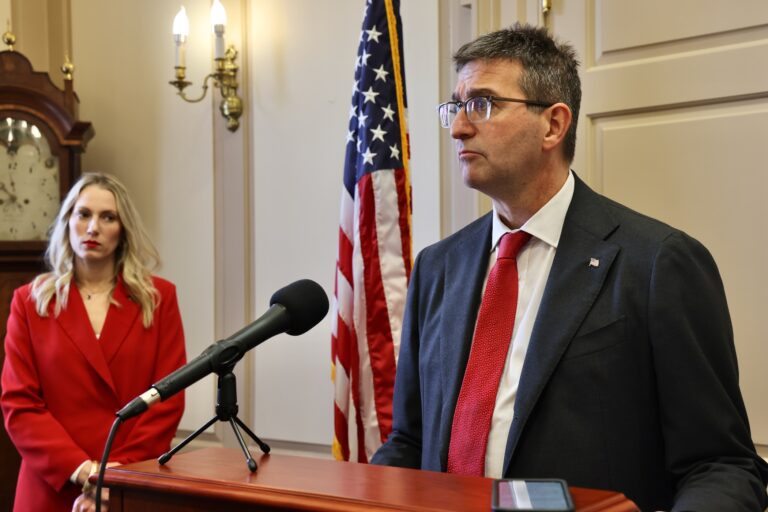
Lauren Meyer stands by as her husband, Del Gov. Matt Meyer fields questions from the media after his first State of the State address. (Emma Lee/WHYY)
What are journalists missing from the state of Delaware? What would you most like WHYY News to cover? Let us know.
The Delaware Public Service Commission punted on officially approving Delmarva Power’s interim rate increase Wednesday, after a commissioner and the group’s counsel said they disagreed on whether state law allows them to revise or even refuse rate increases.
Commissioners capped the interim rate increase to 50% of Delmarva Power’s total rate increase on July 1, consistent with Senate Bill 326, which was passed by state lawmakers the day before. The rate hike took effect July 9.
Using the legislation as a guide, the 50% cap limited the interim rate to $34.3 million, adding about 67 cents to the average utility bill. The total rate hike requested from Delmarva Power was about $68 million.
A written form of the oral order was included on the commission’s agenda for its Wednesday meeting. But once the meeting started, Commissioner Regina Iorii and the commission’s attorney said they had amended and competing proposed written orders.
While both said the amount of the interim rate increase stayed the same, it was unclear what the exact changes were because neither document was made public.
PSC Executive Director Matthew Hartigan said the new proposed order will be linked to the commission’s meeting agenda once it’s finalized.
Gov. Matt Meyer recently appointed four new members to the PSC, including Iorii. He has been calling for the commission to reject Delmarva Power’s rate increase all year. Delaware’s Public Advocate Jameson Tweedie has argued to the commission that it has the legal authority to review and adjust utility rates.
“Certainly, in the past, when a utility has sought an interim rate application, it’s generally been approved,” David Crumplar, attorney for the Delaware public advocate, said during the July 1 meeting. “But what we are saying in our papers, and I think what the governor’s office has also said, is that you’re not required to do that.”
Some commissioners indicated their support for that position. One section of the state code allows the PSC to conduct a hearing to make sure a rate is reasonable, and to reduce rates if excessive.
But Iorii argued the commission lacked the necessary authority to deny the utility’s request for interim rates, which convinced most of her colleagues to vote with her on issuing the oral order.
Meyer told reporters this week he believed the commission had gotten it wrong.
“The Public Service Commission has the legal ability to stop any increase in rates, and I cannot urge them stronger to use that power in this case,” he said.
Related Content
Delmarva Power is downplaying its recent request to raise electricity rates, arguing supply price hikes are responsible for customers' higher costs.
7 months ago
Listen 0:56Delmarva Power objects to applying legislation to interim rate
The debate among commissioners over the breadth of their oversight on utility rates comes as the company has pushed back on the group, limiting its interim rate increase to half of its total request, even while it faced criticism from commissioners that it is “cruel” and “tone deaf” for continuing to press for rate hikes.
Delmarva Power, an investor-owned utility, serves 344,000 residential and nonresidential customers in the state. Its parent company, Exelon Corporation, is the nation’s largest regulated electric and gas utility.
Its customers pay a supply and a delivery charge for gas and electricity. The supply of energy comes from PJM Interconnection, a regional grid serving Delaware, Pennsylvania, New Jersey and several other states. Delmarva Power profits through the distribution fee.
Delmarva Power Region President Marcus Beal said they need to file rate hike requests to recoup money it spends on improving and maintaining the infrastructure.
“Our equipment is extremely expensive, the items that we buy, the transformers, they’re very large, complex things to build,” Beal said. “Even something as simple as a treated pole of a certain size can be very pricey, so we spend a lot of money on the grid itself.”
Under Delaware law, interim rates can be approved seven months after a rate case is filed, while the full petition is being considered by the commission. Prior to the legislation, 100% of the rate request could be implemented. The bill caps interim rates at 50% and allows 75% of the ask to go into effect after 12 months. The bill also puts limits on Delmarva Power’s infrastructure spending.
Delmarva Power spokesperson Matt Ford said the commission overstepped its authority to cut the interim rate as much as they did and the company has argued in its PSC submissions that SB 326 did not apply to the rate increase request filed in December because it had yet to be signed into law. Meyer said he signed the bill Monday.
“Delmarva Power further reserves its objections to the applicability of the legislation, should it become effective, including its impermissible retroactive application,” the utility company said in comments filed Monday afternoon with the commission.
In addition, Delmarva Power has objected to halving $23.2 million in distribution system improvement charges as part of the interim rate commissioners approved. The fee allows utility companies to recover project costs and depreciation between full rate case proceedings.
“My suggestion is, if you don’t like it, appeal it,” Iorii said.
It’s unclear whether the utility plans to appeal the order. Ford said they were reviewing it and its implications.
Tweedie said he hopes they decide not to appeal.
“If they appeal this, what they are essentially saying is, ‘We want to extract more money from our customers than the commission intended to allow,’” he said.
Related Content

Delaware lawmakers aim to make data centers pay higher rates
The legislation would require data centers to take financial responsibility for their impact on the grid.
5 months ago
Listen 1:15Customers continue to voice frustration over high bills
Delmarva Power argues that the supply price hikes are responsible for customers’ higher costs, not the delivery fee. Beal said they are “literally trying to do everything” to try to keep prices low.
“We absolutely understand that every dollar matters to our customers and we’re offering as many programs as we can to help offset those higher costs when we have increased usage,” he said.
But Meyer said he isn’t buying that argument.
“I think we’re being lied to by Delmarva, our utility company,” he said. “Every time I talk to them, they mention affordability. But if you look at what they’re actually doing, it doesn’t speak to the affordability crisis that Delawareans are facing.”
Related Content
How to save a few dollars on your electricity bill in the Philadelphia region
From switching to LED light bulbs, to turning down your hot water heater, here are a few things you can do to save on your electricity bill.
6 months ago
Listen 6:08Commissioners question Delmarva Power’s affordability claim
Delmarva Power customers have been taking to social media to complain about skyrocketing bills for at least the past two years, reaching a fever pitch during a cold snap last year. This winter produced below freezing temperatures and customers have struggled to cope with 100-degree days this summer.
Commissioner Michael Richard asked the company if it would be willing to delay the implementation of the interim rates to give ratepayers a break.
“This is happening right after we’re about to have a huge heat wave,” he said. “It’s particularly cruel, I think, for people to not only wonder how are they going to survive this and stay comfortable, but then also think about that electric bill that’s about to come.”
Exelon attorney Zi-Xiang Shen said not being allowed to do an interim rate increase would hurt customers.
“Ultimately there is harm to customers by prolonging or delaying costs that ultimately increases costs for the company to access capital, it increases costs for borrowing,” she said. “Those are not imaginary costs.”
Iorii said Delmarva Power would have withdrawn its request for interim rates — and even the entire rate case — if it was really concerned about its customers.
“You say you’re not blind to consumer issues or consumers’ problems, but I find you to be incredibly tone deaf on this issue,” she said.
Beal said Delmarva Power has several programs available to help customers struggling to pay their bills, including a customer relief fund for individuals who meet certain income requirements.
The PSC’s next meeting is scheduled for Aug. 5.

Get daily updates from WHYY News!
WHYY is your source for fact-based, in-depth journalism and information. As a nonprofit organization, we rely on financial support from readers like you. Please give today.
Part of the series

El gobernador de Delaware, Matt Meyer, afirma que la factura anual promedio de Delmarva aumentó casi $400 en los últimos cinco años.
2 weeks ago

Delaware necesita unas 24,400 viviendas adicionales para el año 2030 a fin de satisfacer la demanda prevista, según un informe estatal.
2 weeks ago

‘Slowly poisoned’: Neighbors protest controversial Delaware port project over health concerns
Neighbors living near the Edgemoor site say they’re concerned about truck exhaust, noise and harm to local wildlife.
4 weeks ago
Listen 0:49