

Delaware legal aid groups request $3.2M to fund low-income eviction prevention program
The program started in November 2023. The majority of the cases were for clients who were below the federal poverty level.
Listen 0:53
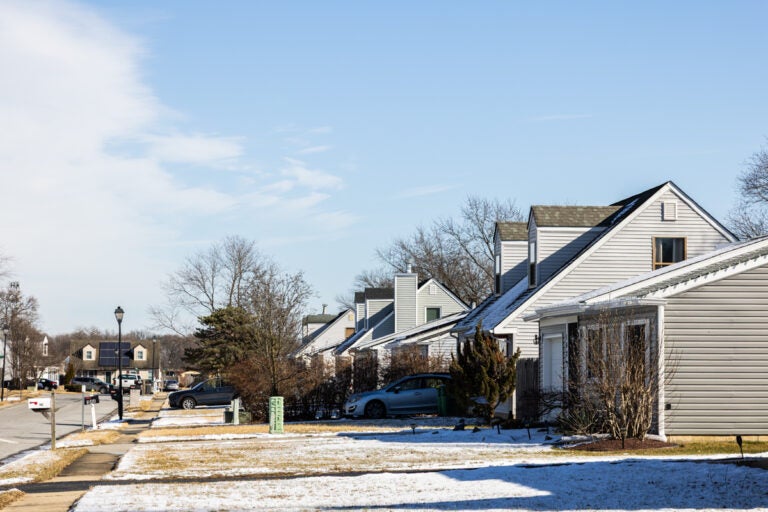
Homes in Newark, Del. (Kimberly Paynter/WHYY)
What are journalists missing from the state of Delaware? What would you most like WHYY News to cover? Let us know.
Delaware resident Victor Elbaz said he was on the edge of being evicted from his home in Sussex County when he successfully applied for low-income legal assistance through the statewide Right to Representation program. He said the help prevented him from becoming homeless and ruining his credit.
“I’m forever grateful,” he recently told state lawmakers. “There are many cruel, heartless landlords who take advantage of the tenants knowing that they can’t afford lawyers. Please keep legal aid available to tenants like me. They have no other option to afford a lawyer.”
Three legal aid groups, Community Legal Aid Society, Inc., Legal Services Corporation of Delaware and Delaware Volunteer Legal Services, operate the Right to Representation program. It provides needy tenants with free legal work to keep them in their homes and help them find resources to ensure housing stability. The program started in November 2023.
The organizations helping low-income Delawareans are making their case for the funding before the state Legislature’s budget drafting committee. They’re requesting $3.2 million to provide services for fiscal year 2027. Gov. Matt Meyer’s recommended fiscal 2027 budget also includes another $739,700 which would go to fund the court residential eviction diversion program, making the total cost around $3.9 million.
CLASI handles the public housing cases, LSCD takes on private housing cases and DVLS manages the overflow to ensure coordinated statewide coverage.
According to the Eviction Lab at Princeton University, which tracks evictions nationwide, there were 10,975 eviction filings in Delaware over the past year, down 14% compared with the average of filings for 2023 and 2024. The state’s eviction rate stands at 10%.
The groups say prior to 2023, more than 80% of landlords were represented in housing cases, compared to only 3% of tenants. While evictions between 2019 and 2025 have dropped 40%, CLASI Deputy Director Sarah Rhine said they’re still seeing about 200 eviction cases a week filed in court. She said there’s a human cost plus one to the state when a family is evicted.
“We recognize that eviction is not only loss of housing, but also loss of stability for the household,” she said. “Children face disruption in schooling. Individuals with medical needs experience disruption in medical treatment.”
Rhine said the program works with landlords to reach a repayment plan. Clients, who are low-income and struggling financially, are also screened to see what resources they need to maintain housing security.
“Money is often the cause for eviction, and so we want to ensure that that landlord is paid moving forward,” she said. “And so we’re working with the household to find different resources to be able to do that.”
The budget request of $3.2 million does not include settlement funding that would go to pay a tenant’s back rent or other expenses to keep them in their homes.
Related Content
Under the bill, once an eviction is shielded from a person’s record, they can act as if there had never been an action filed against them.
1 year ago
Community Legal Aid Society Executive Director Daniel Atkins said the Delaware State Housing Authority said they are working to secure funding to keep people in their homes. He said New Castle County has approved $300,000 and the city of Wilmington and the Delaware State Housing Authority are considering similar requests.
“We need to get landlords paid,” Atkins said. “Tenants need landlords. We need them to be making a living from this. We don’t want to drive them out of the business. This is a delicate ecosystem, and if it’s out of whack, it’s not going to work and we need to keep that balance.”
Wilmington landlord Don Farrell said he had a positive experience with the program and sees its benefits to both sides.
“I can honestly say that it works when both parties work it,” he said. “The tenant that I had the issue with, we worked it out. He’s still my tenant, and I was made whole. So I urge you to continue to support this.”
Tenants are represented through the program by attorneys and also by Qualified Tenant Advocates, who are trained to help renters. According to the National Low Income Housing Coalition, in 2022, Delaware became the first state in the U.S. to allow nonlawyer representation for residential tenants in eviction proceedings.
Atkins said the program currently employs about 12 attorneys and seven Qualified Tenant Advocates across the three legal aid groups.

Get daily updates from WHYY News!
WHYY is your source for fact-based, in-depth journalism and information. As a nonprofit organization, we rely on financial support from readers like you. Please give today.
Part of the series


‘Slowly poisoned’: Neighbors protest controversial Delaware port project over health concerns
Neighbors living near the Edgemoor site say they’re concerned about truck exhaust, noise and harm to local wildlife.
6 days ago
Listen 0:49
Laurel plans Meadow View community to expand affordable housing access in Sussex County, Delaware
Delaware needs an estimated 24,400 additional homes by 2030 to keep up with projected demand, according to a state report.
6 days ago
Listen 1:06
Delmarva Power’s rate hike request slammed as ‘largest in Delaware history’
Delaware Gov. Matt Meyer says the average annual Delmarva Power bill went up nearly $400 over the past five years.
2 weeks ago