
Delaware to establish its first medical school in partnership with Philadelphia-based Jefferson University
The state says the four-year school will train doctors in Delaware and help address provider shortages, particularly in rural communities.
Listen 0:49
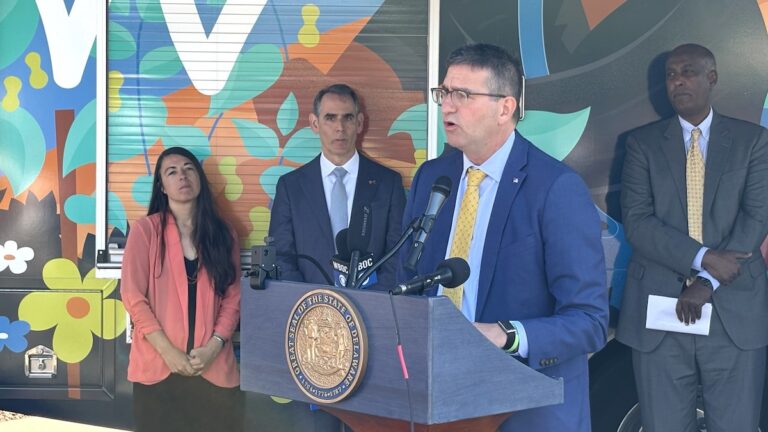
Delaware Gov. Matt Meyer announces a partnership with Thomas Jefferson University to establish a medical school inside the state to help allievate provider shortages in rural areas. Behind him are (left to right) Delaware Department of Health and Social Services Secretary Christen Linke Young, Delaware Health Care Commission Chair Neil Hockstein and Jefferson University CEO Joe Cacchione. (Sarah Mueller/WHYY)
What are journalists missing from the state of Delaware? What would you most like WHYY News to cover? Let us know.
Delaware will soon have its own medical school, a first in the state’s history.
The state is partnering with Philadelphia’s Thomas Jefferson University to establish a regional campus of Sidney Kimmel Medical College. It would create a four-year medical school that would accommodate 40 students when it opens in 2028.
The school will be housed on the University of Delaware campus in Newark until a long-term home is found.
Delaware is one of only a handful of states without a medical school. Gov. Matt Meyer has advocated for one as a way to combat health care provider shortages, especially in rural areas in southern Delaware and meet the needs of an aging population.
Meyer said one of the goals is to increase the pipeline of doctors choosing to practice in Delaware.
“This medical school is about training physicians here, keeping talent here and delivering better care in every corner of our state,” he said. “Especially in those communities that need it the most.”
Delaware already has a partnership with Jefferson through the Delaware Institute of Medical Information and Research program, known as DIMER, which was created in 1969 as an alternative to a state-supported medical school. Through the collaboration, Sidney Kimmel Medical College has reserved 20 admission slots for applicants from Delaware each year. Ten spots are reserved at the Philadelphia College of Osteopathic Medicine for Delaware students.
Jefferson CEO Joe Cacchione said with this new investment, they are committed to helping make sure all Delawareans have access to primary care and specialists.
“It’s a turning point for students who want to become physicians without leaving their home state, and it’s a turning point for Delaware as it takes a decisive step toward building a stronger, more sustainable health care workforce,” he said.
Related Content
Delaware lawmakers advance school funding overhaul amid pressure from civil rights leaders
Civil rights activists say state leaders need to give multilingual learners more resources or face immediate legal action.
5 months ago
Listen 1:06Delaware officials said medical students will start their classroom instruction at UD and then do their clinical training at offices and health care systems in Kent and Sussex counties, where the shortage of doctors is most acute.
However, ChristianaCare, which has its own partnership with Jefferson, is not participating. The state’s largest health care system was part of Philadelphia College of Osteopathic Medicine’s unsuccessful bid to operate the school. In a joint statement from ChristianaCare and PCOM, the two organizations expressed disappointment with not being part of the consortium of higher education institutions and healthcare organizations.
“The path forward raises genuine questions about whether the school’s goals can be fully realized without ChristianaCare’s meaningful participation in its clinical training mission,” it said. “The success of any four-year medical program depends not just on an academic institution, but on a true and committed partnership with its clinical partners — one built on shared mission, mutual investment and trust developed over time.”
Students in the first class can get their tuition subsidized, covering all of their education costs, in exchange for an agreement to work in rural Delaware for five years.
Running the medical school is expected to cost Jefferson $78 million over the next five years. The money is from a federal rural health grant through the Rural Health Transformation Program, which congressional Republicans created in the so-called “One Big, Beautiful Bill Act.”
The program will give $50 billion to every state over five years, though exactly the total each will eventually receive is unclear. Half of the money is to be distributed equally to states and the other half is awarded by the Centers for Medicare and Medicaid Services based on a variety of factors.
The state applied for $1 billion late last year to improve health care in Kent and Sussex counties. The Trump administration has so far allocated Delaware $157 million. Delaware is expected to receive at least $500 million over the life of the fund.

Get daily updates from WHYY News!
WHYY is your source for fact-based, in-depth journalism and information. As a nonprofit organization, we rely on financial support from readers like you. Please give today.
Part of the series
Thomas Herlihy raped the girl in Atlantic City in 2016 and, authorities say, sexually abused her through 2018 in Delaware.
2 months ago
Listen 2:01
Los activistas de derechos civiles afirman que los líderes estatales deben proporcionar más recursos a los estudiantes multilingües o enfrentarse a acciones legales inmediatas
4 months ago
Delaware lawmakers advance school funding overhaul amid pressure from civil rights leaders
Civil rights activists say state leaders need to give multilingual learners more resources or face immediate legal action.
5 months ago
Listen 1:06