


A proposed crackdown on corporate landlords could threaten Philly-area homes for people with intellectual disabilities
The bill aims to lower single-family home prices. But it would inadvertently endanger companies that provide housing for some people with disabilities.
Listen 1:49
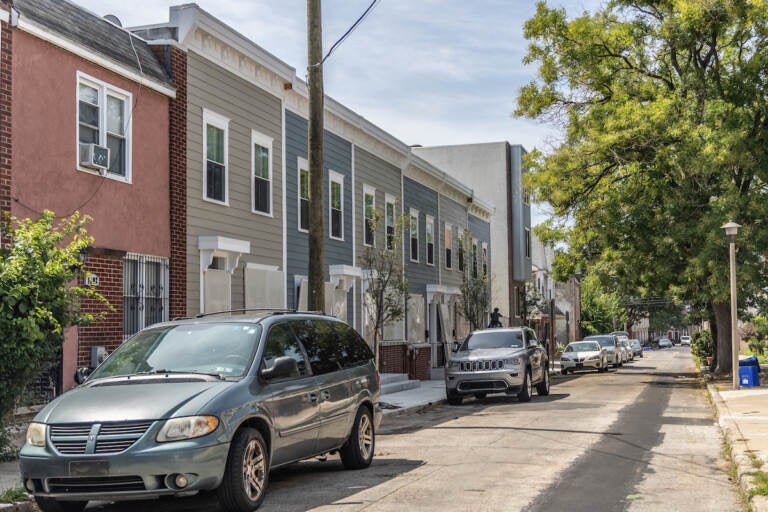
Six single-family homes built by Habitat for Humanity on the 1600 block of Page Street in North Philadelphia receive finishing touches on August 22, 2023. (Kimberly Paynter/WHYY)
Have a question about Philly’s neighborhoods or the systems that shape them? PlanPhilly reporters want to hear from you! Ask us a question or send us a story idea you think we should cover.
Providers in the Philadelphia area say that legislation moving through Congress could destabilize housing for intellectually and developmentally disabled residents by sweeping certain group home landlords into a ban aimed at Wall Street-style investors.
About a month ago, the U.S. Senate passed the Renewing Opportunity in the American Dream to Housing Act, a bipartisan package aimed at increasing the country’s housing supply and making the market more affordable amid an ongoing crisis.
One provision would effectively bar large corporate landlords from purchasing single-family homes. These properties are routinely used for licensed group homes and leased to care agencies that coordinate critical services for people with Down syndrome, cerebral palsy and some forms of autism.
These constituencies argue the federal legislation will upend the delicate ecosystem serving this vulnerable population — in Philadelphia and across the country. And they’re urging the House to amend the legislation before taking it up.
If the package passes in its current form, many of these companies would no longer be able to purchase more properties to lease to care providers. In Pennsylvania, it is common for individuals to wait months to secure a spot in such a group home, in part because there isn’t enough supply to meet the demand.
“That will certainly make it impossible to raise more capital and it will over time … make it very difficult if not impossible for us to continue operating the portfolio of homes we have,” said Andrew Parker, CEO of Nestidd, which owns 900 group homes across the country, including in Delaware County.
Related Content

Philly is unlocking $400M for housing. Here’s what that means for renters and homeowners
Mayor Parker's H.O.M.E. plan is entering a critical new phase. Advocates hope it helps the city's most vulnerable residents.
6 months ago
Listen 6:00What’s at stake for Philly-area tenants?
The ROAD to Housing Act defines a large corporate landlord as a company with 350 or more single-family homes in its portfolio.
Proponents of the ban argue that these companies, which make up a small percentage of buyers, contributed to a surge in housing costs following the COVID-19 pandemic. They say that barring them from this segment of the market will help lower prices.
However, companies like Nestidd are not considered the target of the legislation. That’s why Parker has been meeting with lawmakers with hopes of getting an amendment introduced that would spare him and others from the ban without undermining the bill’s broader intent.
“Without exception, they all tell us, ‘Yeah, you guys weren’t intended to be swept up in this thing. That’s not what we’re going for.’” So we say, ‘OK. Great. So, can we change it?’ and that’s what’s a little more complicated,” said Parker, who grew up near Valley Forge in Chester County.
The ball is currently in the House’s court. Lawmakers must decide whether to simply adopt the version of the legislation sent over from the Senate or open the door to amendments. Passage might be delayed if a flurry of changes were to be proposed.
Like Parker, Patricia Menszak hopes the House chooses the second option. She’s an administrator with Catholic Charities of Philadelphia, an arm of the Archdiocese of Philadelphia that operates 25 licensed group homes in the area, most of them in Delaware County.
About a third of the nonprofit’s properties are leased, leaving those tenants at risk of being uprooted if the legislation passes unchanged.
“The impact for the individuals is quite simply, ‘Well, then where do they go?’” Menszak said.
Forcing anyone to move from their home is exceedingly disruptive. Disbanding a group home is even more complicated.
Roommates in a group home are carefully selected for compatibility, and it is common for these individuals to live with the same people for years on end, meaning they effectively become like family to one another. They also maintain daily routines that are centered on the home, including meals, appointments with support staff, and trips back and forth to jobs and day programs.
“That would be so emotionally difficult,” Menszak said. “They would certainly have the potential of having some sort of regression or perhaps even depression. That would not be good.”
Related Content

Philly landlords escalate fight over legislation aimed at protecting city renters
A motion filed Monday seeks to add new allegations to a rare lawsuit that alleges a City Council committee violated state law.
6 months ago
Listen 1:05Why is the single-family home ban bad for buyers?
While some agencies own property, many lease from companies like Nestidd. The arrangement, which dates back decades, enables agencies to focus on providing social services to tenants, while allowing developers and property owners to focus on the real estate side of the business.
For example, these properties often require specialized retrofitting so they are wheelchair accessible — work that calls for a level of expertise that care agencies lack.
“Though it may sound a little upside-down, what I’ve learned is the banks don’t actually want the agencies to own a lot of real estate, because it ties up the cash flow and they need that for all kinds of other things,” said Barbara Hammer, a veteran acquisition manager for group homes.
Care providers tend to rent these properties for long periods, but keeping these portfolios going requires real estate companies to satisfy lenders and raise capital from investors.
Both of these things can become challenging if a company is unable to grow through acquiring more properties, Parker said. In other words, he can’t simply sit on the existing portfolio and collect rent if he wants to keep the business going and ensure these tenants are housed.
“My lenders may not feel comfortable allowing me to refinance our debt. In that case, I’m going to be forced to sell the houses. And I’m certainly not going to be able to raise capital from investors to continue refinancing the houses and the investors that we already have eventually want to make a return,” Parker said.
If the legislation passes without an amendment, Hammer said, more investors would have to get involved in this space, which she argues has a number of positives. They include steady rent and not having to deal with the broader tenant market, where landlords can end up with tenants who are disruptive or destructive.
One of the biggest hurdles, she said, is that there continues to be a stigma around this population, making it imperative that existing real estate providers aren’t lost to this legislation.
“There’s just a lot of people who are scared of this population. They don’t understand it,” Hammer said.

Saturdays just got more interesting.
WHYY is your source for fact-based, in-depth journalism and information. As a nonprofit organization, we rely on financial support from readers like you. Please give today.
Brought to you by PlanPhilly

PlanPhilly
In-depth, original reporting on housing, transportation, and development.

Laurel plans Meadow View community to expand affordable housing access in Sussex County, Delaware
Delaware needs an estimated 24,400 additional homes by 2030 to keep up with projected demand, according to a state report.
1 week ago
Listen 1:06
Philadelphia Housing Authority set to bring 85 affordable homes to Strawberry Mansion
The project includes a mix of rentals and homes for sale, as well as a large community park with a picnic area and stage.
4 weeks ago
Listen 1:09
North Philly development will bring 129 affordable rentals to Temple University area
The six-story project represents the final phase of a yearslong effort to redevelop Norris Homes, a traditional public housing site that was demolished between 2011 and 2019.
1 month ago
Listen 1:04