
Pennsylvania researchers, parents are shaping autism science as founders of new independent committee
Founders of the new Independent Autism Coordinating Committee say they will act as an alternative body to a federal advisory group under RFK Jr.
Listen 1:20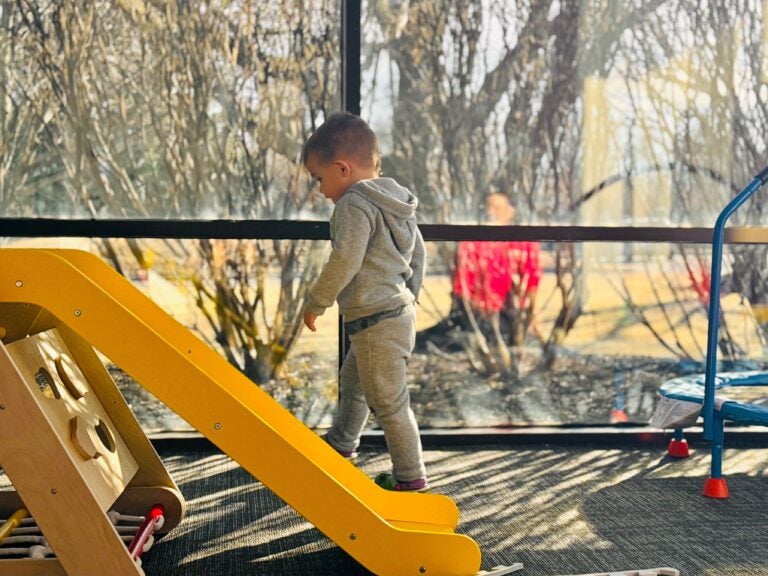
File: Children 6 and younger with autism spectrum disorder engage in play-based behavioral and development therapy at the CHOP-Soar Autism Center in Newtown, Pa. The site is part of an initiative to expand specialty care in the Greater Philadelphia area. (Nicole Leonard/WHYY)
From Philly and the Pa. suburbs to South Jersey and Delaware, what would you like WHYY News to cover? Let us know!
Researchers, parents and health care providers from Pennsylvania are central to a national effort to depoliticize autism research and guidance.
Together with experts from across the country, they have formed an independent committee dedicated to providing recommendations on issues related to autism spectrum disorder, including scientific study.
The Independent Autism Coordinating Committee is set to hold its first public meeting on March 19. Its goal is to function as an alternative body of experts to a federal advisory committee under the U.S. Department of Health and Human Services.
Historically, the federal autism committee has been influential in charting a course for autism scientific review and giving input on where federal dollars should be allocated.
U.S. Health Secretary Robert F. Kennedy Jr. reformed the committee earlier this year and appointed new members who share some of his most controversial viewpoints about autism causes and treatments, including disproven theories about vaccines.
That raised an alarm and drove researchers and autism specialists like David Mandell, professor of psychiatry at the University of Pennsylvania, and others to quickly form their own independent body in response.
“There seems to be no space in this administration for dissent,” he said. “And given what they’re putting out is antithetical to what we know the science tells us and given that they are empowering people who have a clear agenda that isn’t about advancing autism science, we thought we really had no choice but to become a dissenting voice and an alternative voice and source of information.”
Kennedy has made autism a priority during his leadership of the federal agency and has championed a greater focus on investigating causes, treatments and support systems. But he’s also promoted debunked theories linking Tylenol use in pregnancy to autism.
Several members he appointed to the federal autism advisory committee also support these theories. Others uphold discredited ideas like facilitated communication, a technique that requires one person, the facilitator, to hold an autistic person’s hand, arm or elbow to help them “speak” by touching letters on a keyboard or letterboard.
The technique was largely proven ineffective by the mid-1990s as studies showed that the facilitators influenced the choice of letters and words, even subconsciously. The method did not improve communication abilities among nonspeaking autistic individuals and even proved harmful.
“So, this is a huge chunk of this federal committee that’s going to be advising NIH on how to spend their autism research dollars, and that to me is extraordinarily concerning,” said Amy Lutz, a historian of medicine and senior lecturer at the University of Pennsylvania.
Related Content

Children’s Hospital of Philadelphia has partnered with Soar Autism Center to open new early-intervention sites for kids 6 and younger.
8 months ago
Listen 0:59Lutz joined the new independent committee as a parent advocate. Her son Jonah, 27, is profoundly autistic. She has conducted research into the history of debates, policy decisions and developments surrounding autism.
She acknowledged that prior autism advisory committees have often led to infighting and, at times, unproductive disagreement on which directions autism research and policy should take. But she added it was still better than the current federal committee under Kennedy, which she criticized for its political ideology.
“That’s why this new independent committee is kind of laser-focused on research,” Lutz said. “Because the need for evidence-based interventions, for good research to understand the causes of autism, the best interventions for the most intractable problems facing people on the spectrum, this is something we can all agree on.”
The independent committee has 12 founding members, including former U.S. Representative Jim Greenwood, a Republican who represented Pennsylvania’s 8th District. He was a sponsor of the Pediatric Research Initiative Act of 1999, which first created the federal autism advisory group.
The committee also includes former directors of the National Institute of Mental Health, an autistic doctor and autism researcher, and parents and leaders from national organizations like the Autism Society of America, Autism Science Foundation, Aligning Research to Impact Autism, American Academy of Pediatrics, American Academy of Child and Adolescent Psychiatry and the Coalition of Autism Scientists.
More members will be added, Mandell said, to be as inclusive as possible of representatives and experts from different specialties, organizations and subpopulations within the autism community.
“I hope that there is plenty of opportunity within this independent group for disagreement, for smart people with good intentions to come to the table and share both the directions they think science should be going and the interpretation of results of rigorous scientific experiment,” he said.
The independent committee will not directly advise federal agencies, but Mandell said the group can help guide funding decisions and priorities by gaining the attention of lawmakers in Congress and private organizations that invest in autism research.
He expects the new body of experts to also serve as a future resource for families, parents and autistic individuals seeking reliable, evidence-based information.
Related Content

Trump promotes unproven ties between Tylenol, vaccines and autism
Some studies have raised the possibility that taking acetaminophen while pregnant might up autism risk, but many others haven’t found that concern, says a Penn autism expert.
12 months ago
As the independent committee moves forward, Lutz hopes more national autism advocacy organizations and groups get involved. She said that could add more weight and gravitas behind their efforts, which include depoliticizing autism.
“Autism is definitely having a moment and, in some ways, you would think that would be good to bring a lot more awareness to this issue. But I don’t think it’s been helpful,” she said. “I think that both political parties just use autism to kind of advance particular agendas, and nobody is seeing the suffering that is happening all over the country. We want to see that and we want to help that.”
The federal Interagency Autism Coordinating Committee was also scheduled to hold a public meeting on March 19, its first since 2024. However, the Department of Health and Human Services on Monday announced in a post on X that the meeting has been postponed and will be rescheduled. No other explanation was provided.

Get daily updates from WHYY News!
WHYY is your source for fact-based, in-depth journalism and information. As a nonprofit organization, we rely on financial support from readers like you. Please give today.
A federal advisory panel recommended stopping hepatitis B vaccines in newborns immediately after birth, the standard protocol for more than 30 years.
9 months ago
Listen 1:26
Some families say they remain frustrated at the overwhelming attention on causes of autism rather than on systems and supports to help kids today.
12 months ago
Listen 1:33
What we know about autism’s causes and any potential link to Tylenol
Autism isn’t a disease. It’s a complex developmental condition better known as autism spectrum disorder that affects different people in different ways.
12 months ago