


How Latinos have become especially vulnerable to diabetes, and one reporter’s 'wake-up call’' managing the disease
How a reporter began to investigate diabetes risk, and along the way, made a startling discovery about his own health.
At the Mexican Consulate’s monthly health fair in Oklahoma City, community organizations have tables set up with information on nutrition, exercise, and various health issues.
The main attraction, though, is a quick check-up meant to catch early signs of type 2 diabetes.
“For any adult clients, we’re doing free health screenings in regards to height, weight, BMI, blood, blood pressure, cholesterol and glucose,” says Benjamin Canizales, a health manager with the local Latino Community Development Agency.
The effort, Canizales says, is meant to educate and advise Latinos in Oklahoma about diabetes, and to help them identify and treat it, for free.
Diabetes is a growing concern in the state, and even more so in the Latino community.
The latest state and federal data — published between 2020 and 2022 — shows Hispanic Oklahomans have the lowest reported rates of diabetes when compared to other ethnic and racial demographics, but they have worse outcomes – mainly disproportionately high mortality rates from the illness.
Canizales says the poor outcomes among Latinos can be attributed to a few consistent factors.
“A lot of times there’s the barrier of just the language, and they’re not going to know who to ask,” he says.
Another issue, especially for low-income families and the elderly, is finding time to take care of their health at all, and getting to and from doctor visits.
“If I go home and I go to work and that’s all I do, it’s going to be really hard as well for me to figure out what health community resources exist,’” Canizales explains.
Taking the test
At the last table sits physician Carmen Romo. She’s in charge of the diabetes test – pricking people’s fingers to get their blood sugar.
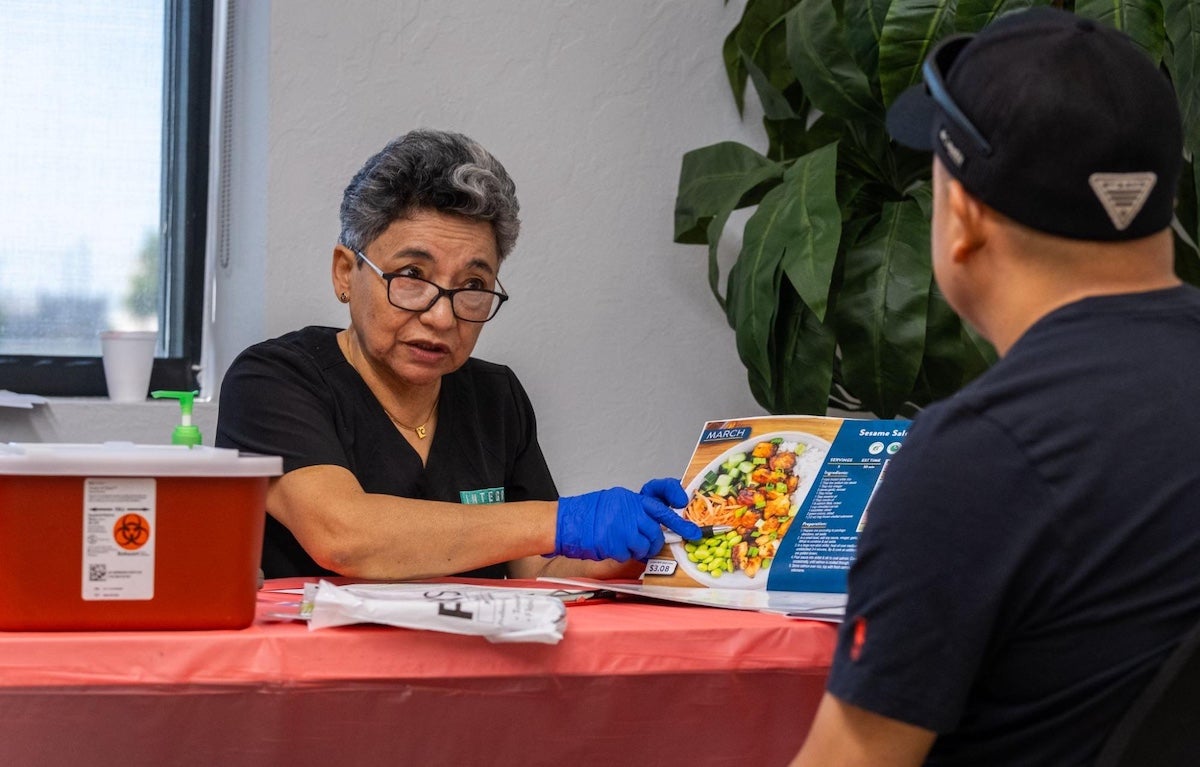
Romo says the reality on the ground shows that the rates of diabetes among Latinos are likely much higher than available data suggests, as is the rate of poor outcomes.
“The worst of it is, for example, just within this room … Probably 60% of the people in here are either diabetic or prediabetic and they don’t even know,” said Romo. “That’s the worst part. They don’t even know.”
State and federal data only reflect the people who’ve gotten a diagnosis – and Romo says from what she’s seeing in her practice, the prevalence of diabetes among Latinos in Oklahoma is rising. And, it’s affecting younger people.
“We are starting to see more children under 12 with type 2 diabetes,” she says.
Type 2 diabetes is related to risk factors like obesity, diet and lack of exercise.
Of the 31 people who stopped by her table that day, 24 people showed signs of being diabetic or prediabetic.
She says I should take the test – so I do.
“What finger do you prefer?” She asks me.
“It really doesn’t matter,” I respond. “Hit me on the left.”
“Wait a moment …” she says, rubbing my index finger and quickly following up with a poke. “That is all it’ll take to know your numbers.”
My results come back instantly. Romo is not pleased.
I’m 5’3” and was weighing 143 pounds. My blood sugar is 102 milligrams per deciliter. I’m prediabetic. But that’s not all.
My ‘bad cholesterol’ is very high, as is my blood pressure – clocking in at 151 over 99 (151/99), with a pulse of 101 beats per minute.
Romo forgets about my reporter role and jumps right into a consultation. She tells me I have to change my diet and reduce greasy foods.
“Your cholesterol is high.” She says, “247 … normal values are up to 200. You have to reduce your greasy foods … No more butter, if possible. … Exercise regularly.”
“Stay away from bread and other starches, or, if not, it could be that you need to eat more food with fiber in it. So, your diet should look like this …”
She tells me to imagine a plate on the table between us.
“If you split the plate in half …”
Now she’s sectioning the imaginary plate in quadrants with her hands, and I’m having flashbacks to elementary school lunchroom posters.
“This should be fruits and vegetables. Consider a tomato, an apple, I don’t know …”
She points to another section.
“This should be carbohydrates. And this should be your protein … Go like this with your hand …”
I mimic her fist.
“That should be your portion size of carbohydrates. That amount of rice, pasta, whatever …”
My fist is tiny. I think to myself that the suggested amount of rice seems like nothing.
“If you eat tortillas, you should only eat two,” Romo continues. “And if you eat tacos, don’t eat tortillas … because what we tend to do often is eat both …”
I laugh out loud at her final instructions.
“Wow,” I muster.
“You’re laughing. Let me tell you, this is the cause of diabetes. Yep,” she says.
Should I have expected to be prediabetic?
In truth, I left the health fair that day shocked.
I’ve grown up an athlete. From being born into a circus family and practicing acrobatics, to competing in high-level gymnastics as a teenager, and recently, training mixed-martial arts at a club in Oklahoma City.
Those were my first thoughts, anyway.

Subscribe to The Pulse
Then it occurred to me that perhaps I shouldn’t be surprised at all. I actually haven’t trained martial arts in the past year. It’s been hard to manage with the fast-pace of my job as a reporter.
I thought about my family, my great aunts and uncles, many of whom have passed away because of diabetes, or relatedly, heart disease. I thought about my cousin, whom we called ‘cachetes’ because of the size of his cheeks.
It dawned on me that I’d grown up believing that if I didn’t look like my cousin, I was in the clear, as far as diabetes was concerned. Talk about a wake-up call.
It took me one year of very little physical activity compared to what I was used to – and no change in diet – to develop prediabetes and dangerously high cholesterol.
When I asked Romo how things get so bad — so fast, she said my reality – and the epiphany that comes with it – is common among Latinos she serves, and really, people with diabetes in general.
She says for many Latinos, it comes down to a lack of education and a reluctance to care about seemingly distant health concerns, when getting food on the table is a pressing day-to-day matter.
And even people with health insurance and access to care have difficulty changing their habits long term, Romo said.
“We’ve seen people here who have health insurance and don’t use it,” she said. “We don’t go because it’s not a practice, or habit of ours to visit a doctor once a year.”
Romo’s goal is to break the cycle – and help people take charge of their health.
“Because if your grandma or your uncle is diabetic, my intention is to give you the tools so that you won’t be diabetic,” she said.
There is no ‘cure’ for diabetes, Romo said, only management.
And hosting health fairs and awareness campaigns is only as effective as people are willing to learn – and then act on their own behalf.
Ain’t that the truth.
Since getting those results at the fair, I’ve tried to make changes in my own life. I’ve monitored my weight and blood pressure, and I think I’ve done pretty well. But it’s been really hard in certain ways.
For starters, when I am stressed out, I eat more and move less, and eventually tend to spiral into depression. That happened after the health fair, which was in early June. By the end of that month, my weight had jumped from 143 pounds to 156 pounds.
Working out often gets me unwound from myself, so that’s where I started.
I’ve been hitting the gym near my house, focused on just getting back into the habit of exercising. I try to do it at least three times a week, ideally four, but sometimes – often – work bleeds into the evenings.
Other days, I squeeze in a bike ride.
And probably the biggest change, and among the hardest to make, I’ve been eating less and more nutritious foods. I’ve been cooking more, too. Simple stuff like grilled chicken and mashed cauliflower. And I’ve tried my best to follow Romo’s guidance on portion sizes.
I managed to cut out bread and tortillas completely for almost all of July, which probably helped with the weight loss during that period.
Now, I’m 137 pounds, which is normal for me, historically. I’m still hypertensive and still have high cholesterol.
What I’ve noticed is this: I can eat better for a while, and work out too, but really, where I struggle the most is consistently doing either of those things for a meaningful period of time — much less both at once, all the time.
And while it’s comforting to know that I am not alone in that particular struggle as it relates to diabetes management — it’s disconcerting too. These days, when I look around at my community and many of the people I love, I see a lot of sickness — or impending sickness.
And not a lot of initiative to do anything about it. With some exceptions.
How one Latina manages her diabetes
Monica Montes works at the Latino Community Development Agency. We met at a community health walk the agency hosts every couple of Fridays each month, around the south end of Oklahoma City’s Scissortail Park.
She has diabetes, and I asked her when and how she found out about the disease.
“Around two years ago,” Montes said. “It was also here at the office. Sometimes we start testing each other.”
Montes’ blood sugar was over 200 milligrams per deciliter, she said, above the range for what’s considered dangerous.
Her A1C, a number representing blood-glucose levels over three months, was around 8.2, also too high for comfort. The person administering the test told her to go see a doctor as soon as possible, she said.
Montes hadn’t experienced any symptoms by then. And she says she doesn’t know how long she’s had diabetes before she found out; she can only assume at least three months back, based on the tests.
I shared with her the shock I experienced shortly after finding out about my health. And the difficulty I experienced in accepting the immediacy with which I should start making changes.
“That’s what happened to me too, at least the part that I had trouble accepting it, “Montes said. “We say, ‘if I don’t want this bad thing today, then tomorrow I should be fine.’ It took me two weeks to finally make a doctor’s appointment.”
By the time she accepted she was diabetic and needed to see a doctor, a new anxiety had set in for her.
“When people do make a call to the doctor, the appointments are always so far away,” Montes said. “The Good thing is my doctor saw me the next day, and that gave me confidence.”
More confidence led to regular doctor visits, some changes in her diet, and regular morning walks.
But Montes has a sweet tooth, and fighting the temptation of sugar is a daily struggle for her, she says. So consistency is crucial.
“And even more so when I’m telling myself, ‘I can’t eat this,’ that’s when I want it that much more,” she said.
Monica said she’s noticed the hardest habits to change are the ones we do to start our day, to comfort ourselves and to relieve stress.
“For me, it’s my morning coffee and nicotine pouches throughout the day,” says Montes.
Monica plans her meals ahead of time to help her resist temptation.
“What I do is, let’s say at the store, I buy vegetables and other ingredients I’m going to need to cook for the next three days,” she said. “That way, my fresh food doesn’t spoil.”
She sometimes includes a sweet or sugary fruit, she says, just not in excess.
Eating less processed food helps a great deal in reducing unnecessary sugars and fats in your blood. Another way to reduce processed sugars is to just eat smaller portion sizes.
Like me, though, Montes struggles with the same consistency she is painfully aware of.
There’s a negotiation I and so many others make with ourselves at that juncture — the choice between long-term health and short-term satisfaction.
We often lose the haggle and convince ourselves that the short-term deal is the better one, even though we know that, surely, it isn’t.
WHYY is your source for fact-based, in-depth journalism and information. As a nonprofit organization, we rely on financial support from readers like you. Please give today.
Brought to you by The Pulse


When Should Patients Decide for Themselves?
Stories about patient autonomy, and what happens when self-advocacy overrides the opinions of doctors.
Air Date: December 19, 2025
Listen 49:34
Community-led diabetes programs in Cumberland County are closing gaps in care for Latino residents with education, support and prevention.
9 months ago

Drugmakers hiked prices for hundreds of drugs in early January
January is a big time for drugmakers to hike prices. This year saw higher prices for 575 medications so far, including Ozempic, drugs for HIV, cancer and many others.
1 year ago