


A planet, an observatory and the first public reading of the Declaration of Independence
A lost Philadelphia observatory once used to track the transit of Venus may be the place where the Declaration of Independence was read publicly for the first time.
Listen 10:50
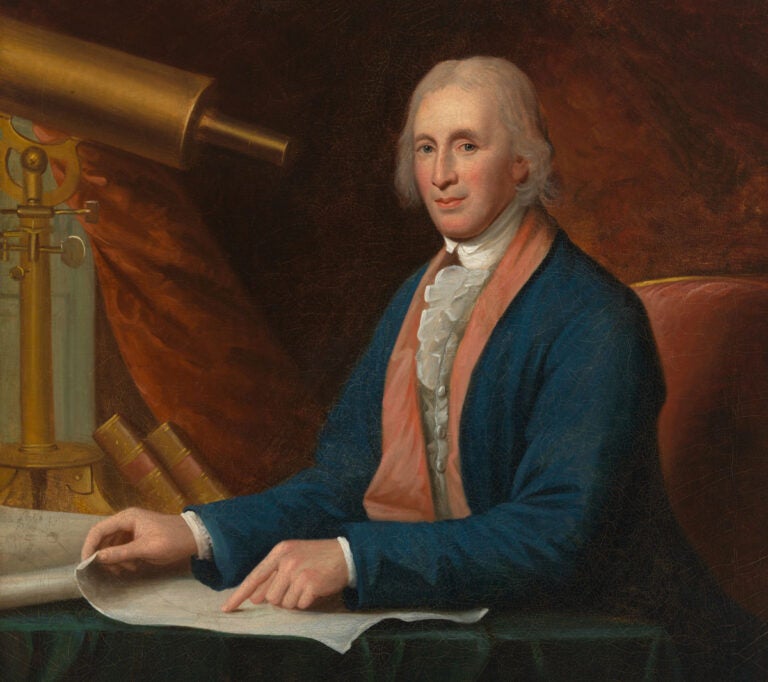
A portrait of David Rittenhouse with his telescope painted by Charles Wilson Peale in 1796. (National Portrait Gallery)
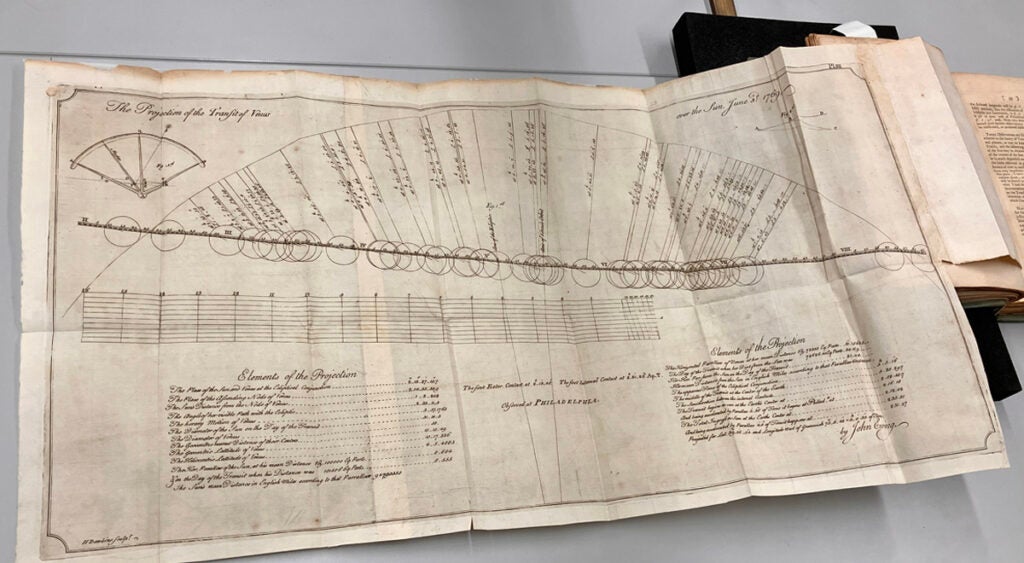
On June 3, 1769, astronomers in Philadelphia were anxiously awaiting a moment they had spent years preparing to witness and capture. Their telescopes were set up in strategic locations in and around the bustling colonial city. Their colleagues across the globe were doing the same thing, from Russia to Tahiti, all to witness a rare celestial event: The transit of Venus, a moment where Venus passes between the Earth and the Sun.
Outside of what is now known as Independence Hall, David Rittenhouse, a Pennsylvanian polymath, instrument maker and self-taught astronomer, stood ready at an observatory, which had been constructed for this very moment. He had invested a lot of time and effort to be prepared, because the stakes were extremely high. There would not be another transit of Venus until December 1874.
“Rittenhouse was so stressed by the work that was done with the transit that he actually passed out at the beginning, when he was first looking at the dot going across the sun,” said David Gary, associate director of collections at the American Philosophical Society, or APS. The organization was founded in 1743 by Benjamin Franklin to promote useful knowledge.
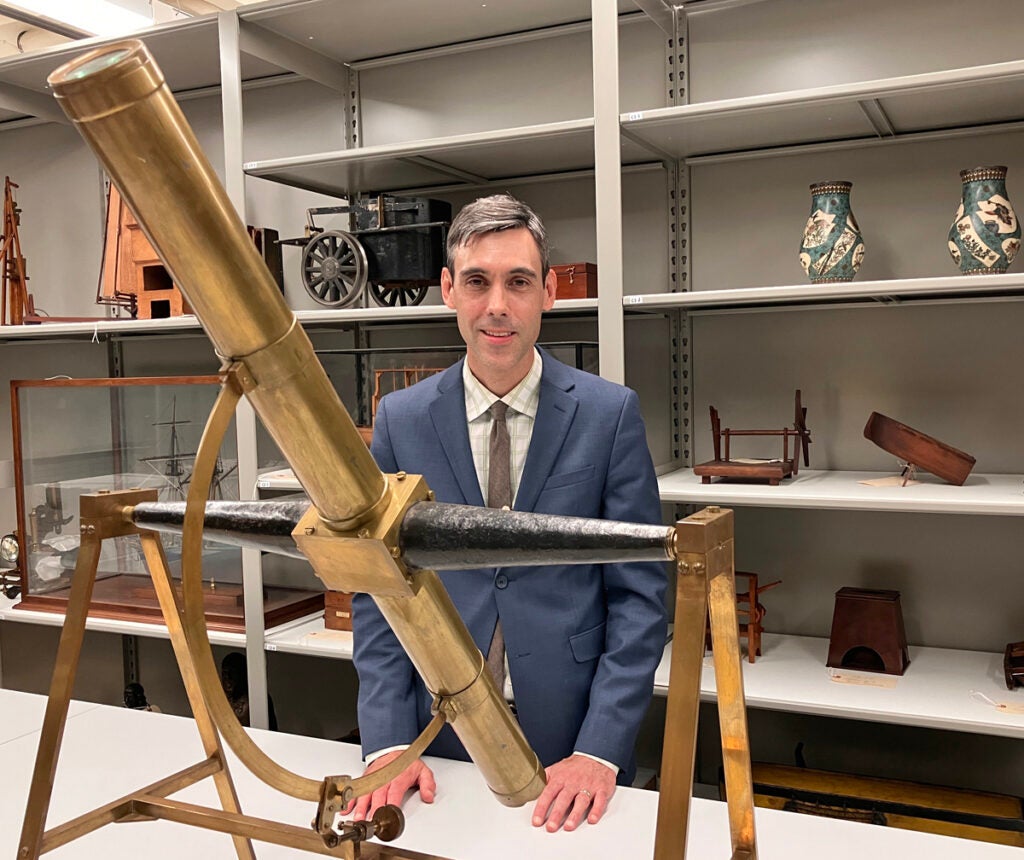
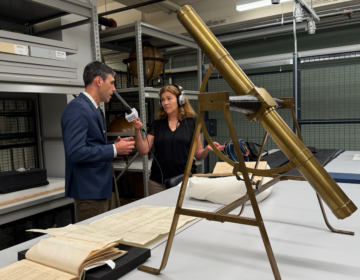
APS has Rittenhouse’s telescope, which he built himself.
“He’s a pretty astounding homegrown genius using books and soaking in the enlightenment milieu,” Gary said.
The telescope is small compared to today’s instruments, about the length of an arm, and the width of a soda can with a slightly weathered brass cylinder, but clearly built with precision and great care.
“It’s likely the first telescope made in America,” Gary said. “It’s an amazing tool that we have in our collection.”
The importance of tracking the transit of Venus
Astronomers hoped to harness this celestial event to push knowledge a giant step forward — to unlock the scale of the solar system. By taking careful measurements of Venus’ path across the Sun from vantage points around the globe, astronomers compared slight differences in timing and position, known as parallax, and combined their observations using geometry and complex calculations to determine the distance between the Earth and the Sun, what we now call the astronomical unit.
Astronomers had attempted to take these measurements in 1761, during a previous transit, but it had only been a partial success, hampered in part by bad weather. But this time, the stars aligned, and Rittenhouse and other American astronomers in and around Philadelphia were able to capture great data.
“They took very, very detailed drawings and measurements during the transit,” Gary said.
The minute book of the APS from June 1769 reflects the monumental accomplishment of this day in dry, understated language:
“The committee appointed to observe at Philadelphia, the transit of Venus, made the following report: That they had met frequently before the day of observation to adjust their instruments and to remove every local obstruction that might hinder their seeing the transit. On the day of the transit, they assembled at the observatory in the morning and took the passage of the sun’s eastern and western limbs over the cross hairs of the transit,” it reads.
The findings were later published in the organization’s first journal, Transactions of the American Philosophical Society, in 1771.
Astronomers around the globe were impressed, said Gary, and offered glowing feedback.
“‘This is really good work. We were really happy about this.’ Everyone was very pleased with the Americans,” he said.
Gary added that this achievement, which happened seven years before the United States even existed, is what put American science on the map.
How science connects to the founding of America
Science wasn’t just a casual pastime for influential early Americans, something they were interested in as a hobby. They saw it as a way of understanding the world itself — a belief that beneath what we see lies a set of rules, universal truths and natural laws. Laws that don’t just describe the motion of planets across the sky, but could help explain how human societies work, how knowledge spreads and how a new world could be built.
“This is what makes the 18th century such a remarkable moment in the history of science,” said Caroline Winterer, a professor of history and American studies at Stanford University. “On the one hand, there’s these tremendous discoveries that are actually occurring in the physical world, like the transit of Venus. But there’s an equal scientific revolution that is going on in the view of humanity and the view of society.”
The founders described ideas like innate human rights, progress or the purpose of societies with the idea that humans could decode the mysteries of the world around them, and thus govern themselves.
“It becomes its own total world,” Winterer said. “If I understand the natural world, then I have reason. And, if I have reason, I can also understand myself. And then therefore, it is legitimate for me to organize a government and then govern.”
The connection between the observatory and the Declaration of Independence
After the transit of Venus was tracked from the observatory outside of what is now Independence Hall, the structure was used again to track the transit of Mercury a few months later.
“But then essentially it doesn’t get used anymore,” Gary said. A few years later, the APS decided to get rid of the observatory. “They actually end up selling it to their janitor, William Rediger, and Rediger probably tore it down in order to sell it for firewood. So it was probably burned up in the fireplaces of Philadelphia in 1784.”
Gary said there are limited descriptions of what the observatory looked like, and no images.
But, the observatory made a comeback in a history book published in 1830, “Annals of Philadelphia and Pennsylvania, in the Olden Time,” by John Fanning Watson. In it, Watson writes that the very first public reading of the Declaration of Independence, which happened a few days after the signing, took place at the observatory.
“The declaration of independence was read publicly on 8 July from the platform of the observatory before erected there by Rittenhouse to observe the transit of Venus. Captain Hopkins, who read it belonged to the Navy. It was about 20 feet high and 12 to 15 ft. and 50 to 60 feet south of the house and 15 to 20 feet west of the main walk. It seems to have been used occasionally as a stand for public addresses. It being referred to as such by Stansbury and his militia poem,” the book reads.
Gary said this account, written almost 50 years after the Declaration, took off.
“This sort of takes a life of its own. One person cites it, another person cites it, and it just keeps going and going and going,” he said.
The problem is that there is no real evidence that this event Watson described actually happened. What we do know is that the observatory existed, and that the Declaration was read out loud to a crowd on July 8.
One potential clue is contained in the German-language newspaper Der Pennsylvanische Staatsboote, which described the first public reading of the Declaration. It stated that the document was “auf einem erhabenen Gerüste öffentlich verkündigt,” which translates to “read out loud, from an elevated scaffolding.”
“So the word is very vague, elevated scaffolding. What is that?” Gary asked. “Was somebody building a scaffolding around the observatory? We don’t know. What is this actually saying? Is it a raised stage because it’s high? I just don’t know.”
But, many feel less ambivalent about the historical importance of the observatory.
“I’m thinking I could calculate the spot on the Earth where the Declaration of Independence was read publicly for the first time,” said Todd Babcock, a professional surveyor who has been trying to locate the observatory’s remnants and exact location for years.
The hunt for the lost observatory
Babcock has done a lot of detective work. He found historical records about the exact locations of the other observatories that were used to track the transit of Venus in and around Philadelphia. The distances between all of them had been documented, which helped him zero in on the location of the one near Independence Hall. He got closer and closer to marking the exact location, which he says is a few feet away from the bronze statue of Commodore John Barry behind Independence Hall.
But even if he found the exact spot, the observatory is gone. So what kind of remnants would he be looking for? There are precious few details about the observatory itself.
“They did note that the center post in which it would fix the clock was set in a foundation of brick about 5 or 6 feet in the ground,” Babcock said. “When they tore it down in the 1780s, they would have taken the materials for firewood or scrap, but they wouldn’t have removed all that brick. They wouldn’t have removed that post. So that’s what we’re looking for is that they would have left that brick behind.”
It took years of research and applying for permits, but earlier this year, Babcock and a group of people were able to search an area behind Independence Hall with ground-penetrating 3D radar. And their search produced results.
“There are some features there that are significant, a square kind of shape right in the area where we had calculated the observatory to be,” Babcock said.
Babcock wants to dig up the ground and see if these remnants could really be what’s left of the observatory, and he’s optimistic that he’ll get permission from the National Park Service.
“The area where it’s located is a grass plot. So it wouldn’t involve tearing up the sidewalk, it wouldn’t involve cutting down any trees,” he said.
But this endeavor won’t begin until all of the big festivities happening around the semiquincentennial are over, but hopefully before the next transit of Venus, which will occur in 2117.
WHYY is your source for fact-based, in-depth journalism and information. As a nonprofit organization, we rely on financial support from readers like you. Please give today.
Brought to you by The Pulse
Part of the series
Philadelphia 250
The United States is marking its semiquincentennial — or its 250th anniversary — in and around the City of Brotherly Love.
How Science and Ingenuity Built Early America
On this episode, we commemorate America's 250th anniversary, and we explore how science and innovation helped build a new nation.
Air Date: June 25, 2026
Listen 1:03:04
‘Pepper pot soup slam’: 3 chefs reimagine one of the first American street foods
Pepper pot soup was known as a survival meal during the American Revolutionary War, but the stew's African and Caribbean roots are often overlooked.
2 months ago
Listen 15:36
What to know about Monday’s blue supermoon
The next blue supermoon will not happen until 2032, but supermoons occur more frequently.
2 years ago