

Episode 2: The city that bombed itself
(6abc)
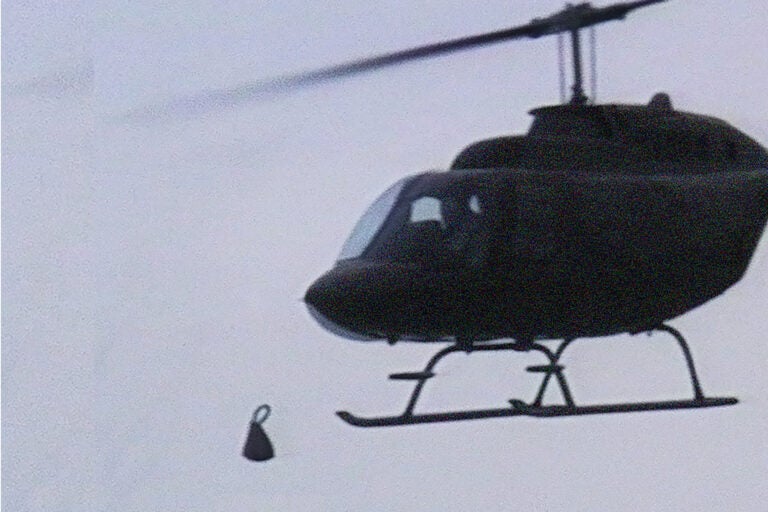
The shocking end to a contentious standoff between police and MOVE, a controversial back-to-nature group, resulted in an aerial bomb dropped by police on 6221 Osage Avenue in Philadelphia on May 13, 1985. A fire ensued, 11 lives were lost, 61 families were displaced, dozens of rowhomes were destroyed by the fire and the soul of the community was shattered.
-
Episode transcript
MOVE @ 40 Podcast
WHYY News
Episode 2 Transcript
[SARAH GLOVER]
Hello, I’m Sarah Glover WHYY’s vice president of news and civic dialogue. This twopart series reported by Tom McDonald uncovers an untold story about the horrific MOVE bombing that rocked the city of Brotherly Love 40 years ago. McDonald poured over 90 hours of the Philadelphia MOVE Commission hearings to refresh his storytelling and document a community in peril, as he reported from Osage Avenue 40 years ago.
Content warning. This episode contains descriptions of violence, death, trauma, and a bomb.
[TOM MACDONALD]
40 years ago, the city of Philadelphia used a helicopter to drop a bomb the size of a backpack on a group of residents. The shocking end to a contentious standoff between police and MOVE, a back-to-nature group.
It ended with 11 lives lost, 61 families displaced, and dozens of row homes destroyed by fire. I’m Tom McDonald, a reporter from WHYY News, who covered the deadly MOVE standoff that ended on May 13th, 1985. This is MOVE at 40, episode 2, the city that bombed itself.
Over several weeks, I poured over more than 90 hours of recordings from WHYY’s TV coverage of the inquiry that followed the bombing. And subsequent fire that was allowed to burn through the neighborhood. The MOVE commission held its hearings at our studios. Here’s a look back at what the MOVE commission uncovered about the days and weeks that led up to that fateful day.
[WOMAN’S VOICE]
Did you consider the MOVE organization to be a terrorist group?
[MAN’S VOICE]
Violation of fencing off the back yard.
[WOMAN’S VOICE]
What he did was politically expedient.
[MAN’S VOICE]
When MOVE refused to surrender, police opened up two gas smoke…
[TOM MACDONALD]
6221 Osage Avenue wasn’t just a home. It was was a command center for MOVE. While MOVE emerged in the 70s as a back-to-nature movement, it eventually transformed into a Black liberation group that later sparked controversy and tension with law enforcement.
Some neighbors referred to the Osage Avenue home as an encampment, most called it a compound. The windows were boarded up, speakers were attached to the outside of the home, they blared day and night with members of the group often screaming profanity. Neighbors were fed up, police were frustrated, and the city decided to take action. Drastic action not seen before or since.
That action left Philadelphia with a new nickname, the city that bombed itself.
[WILLIAM BROWN]
It was one of the most devastating days in the modern history of the city.
[TOM MACDONALD]
That’s William Brown who chaired the MOVE commission, a group created to investigate the city’s decision to drop the bomb on the MOVE home and then let the neighborhood
[WILLIAM BROWN]
Nearly two square blocks of a comfortable residential area lay wasted by fire.
61 families, some 250 men, women and children were homeless. Their achievements and aspirations consumed in the terrible fire that we all watched on our TV sets.
[TOM MACDONALD]
The MOVE commission spent months interviewing key participants to determine what factors that led to the bombings.
[WILLIAM BROWN]
These hearings are a major phase in the search for answers. What we hope to accomplish is to begin healing the wounds caused by the failure to resolve conflicting lifestyles in a peaceful way. I want to tell you about this special commission because it is indeed special, created solely for this task. We are a true citizen’s commission, neither police nor prosecution. We are not accusatory.
Instead, we are an investigatory. We find the facts and report them to you, the people.
[TOM MACDONALD]
They heard from neighbors who lived near the MOVE compound like Cassandra Carter, who lived at 6233 O’Sage for 3 years. She told the commission she was attacked by members of the group as she headed to an exercise class one night.
[CASSANDRA CARTER]
Coming down Race Street. I saw a little little group of kids and I was a little cautious.
And I kept on walking and came down the street and the close I got I recognized the dreadlocks on the two big kids and as I passed them one of the kids said that’s that B– from Osage. Let’s get her and I had a um mat that you exercise on. And I turned and I said I wouldn’t advise that.
I’m a full-grown woman and I have no reason to be frightened of a child. But I was literally frightened. I told him, “Don’t try.” But I didn’t stand there and walk slowly. I hauled from 50 from 60 and race to my church. When I got to church, they asked me what was wrong and I told her, “I didn’t have to exercise that night.”
[TOM MACDONALD]
She said MOVE members slept on the roof of the home and ran across their neighbors rooftops virtually every night.
[CASSANDRA CARTER]
Normally most people go to bed 11:00, 10:00. It would be like either they knew when your lights went out and gave you 15 minutes. And within 15 minutes after your lights went out You could guarantee that you would hear this –duh, duh, duh, duh – just like you would run on the the parkway. That between the the male and females, you could you you can feel the weight and the dogs. They used our roofs as their playing ground.
[TOM MACDONALD]
Another neighbor, Betty Mapp, said residents were fed up with the group. She said MOVE used outdoor speakers to wake up the community with their messages even on Christmas Day.
[BETTY MAPP]
Yes, I think they through the two years and a half, they knew that we had had it. And I really think they felt that. Because they had two years and a half.
[TOM MACDONALD]
Carter and Mapp explained how the group would use young children as a shield right up until the day before the final confrontation when they felt threatened by authorities. [BETTY MAPP]
On the front step of the mood house, three or four of the kids were sitting on a landing. A couple of them was placed on the back fence and back of the MOVE house. Sunday morning they were still there.
[CASSANDRA CARTER]
Whenever they want to to do something, they would make sure that the children were visible. At some time they used to have the children on the bullhorn. Those children were almost as dangerous to some people as the adults were because they were being trained in the same tactics as the adults were. And they would put the kids out as visible points and they stand behind them and, you know, say whatever they had to say. Using a child as a shield.
[TOM MACDONALD]
Former city councilman and U.S. Congressman Lucian Blackwell represented the area. He said it was time to break up the MOVE-in camp for many reasons. One of which was the construction of what he called a bunker on the roof of the compound. That worried police because it gave the group a tactical advantage.
[LUCIAN BLACKWELL]
There were L&I violations. No one’s allowed to build a bunker. Any addition that you build to your home, you have to get a permit. It’s my understanding they never received a permit.
Violation of of of fencing off your backyard, that’s a violation. A violation of keeping 20 or
30 dogs in your backyard, that’s a violation. A violation of of of keeping the kind of of of of home that they had. That’s a violation. A violation of of of keeping a a a a loud speaker going 24 hours a day.
That in my estimation it was the violation of the civil rights of the people who live in that in that area. And so I once again disagree with those people who say that there were no violations.
[TOM MACDONALD]
There were multiple reasons for the city to act said managing director Leo Brooks. He pointed to things like the group’s use of loudspeakers and things they said to neighbors which had many upset and worried.
[LEO BROOKS]
What I was aware of is the the plethora of testimony and rumors and what not from people that the MOVE individuals had been broadcasting over the loudspeaker that uh we’re going to tear up the neighborhood and we would burn it down and all sorts of things of that of that nature. And I suspect that’s probably where what’s the strength of that uh that affidavit.
[TOM MACDONALD]
Brooks also said city officials were never sure about exactly how strong the bunker on the homes roof was built and that uncertainty was a major concern.
[LEO BROOKS]
The bunker uh was a was a had around its outside plywood, which was very deceiving. It looked like some plywood shacks up there. When underneath of that plywood was in fact reinforcing timbers.
[TOM MACDONALD]
Former Pennsylvania Governor and (Former) Philadelphia Mayor Ed Rendell was district attorney at the time of the 1985 MOVE confrontation. He was questioned by commission member Audrey Bronson.
[AUDREY BRONSON]
Did you consider the MOVE organization to be a terrorist group?
[ED RENDELL]
Absolutely.
[AUDREY BRONSON]
Uh, and if so, in what sense?
[ED RENDELL]
Because They had demonstrated a past history of violence. Uh, they had demonstrated a willingness to use the violence force or the threat of violence or force to achieve their objectives uh that that uh it was almost difficult if not well nigh impossible to deal with them on any rational basis. That their stated goals as a group that was a back-to-nature group were frankly a bunch of bull.
In 78, I don’t know if you recall, but uh the Quakers uh made available to them as an effort in an effort to break the log jam in the sea.
[AUDREY BRONSON]
Do you know this for a fact that that the Quakers did…
[ED RENDELL]
Oh yes, it was in the newspapers and and and um it was covered on TV and the MOVE members I think were pretty vociferous about their response. The Quakers offered a farm area in in Bucks County for them to go to. Um and there was also some talk of farms in Richmond for them to go to.
Um where they could live out their individual lifestyle without the tensions and problems that would create in a in a concentrated dense urban area uh and they rejected it. Simple as that. Uh, so there’s no question. People who have killed one person, injured several others, people who threatened to blow up people’s houses, people who threatened to shoot and kill neighbors, police, elected officials. I think that’s a pretty adequate description of the word terrorist.
[TOM MACDONALD]
The MOVE standoff with police started on Mother’s Day, May 12th, when nearby neighbors were evacuated before police tried to arrest MOVE members at 6221 Osage. Rendell said he didn’t advise the city on what level of force was appropriate to make those arrests, but added when the first shot was fired by people inside the home, the rules changed.
[ED RENDELL]
Whatever force was justified when they went out with the warrants, that all changed instantaneously in the eyes of the law when the MOVE members opened up with fire on fire. Once the MOVE members started firing, their status changed radically in the eyes of the law. They at that point became forcible felons.
[TOM MACDONALD]
Randall went on to say once the shot was fired, that turned MOVE members into criminals, giving authorities the ability to defend against injury.
[ED RENDELL]
And there’s a whole different set of laws as to the apprehension and and the amount of force that can be used in the apprehension of and the prevention of the escape of forcible felons.
[TOM MACDONALD]
Once the standoff started, police fired 10,000 rounds of ammunition into or over the building according to accounts given during the commission hearings.
Ultimately, the decision on how to end the standoff rested with then-mayor Wilson Goode. Goode said he relied on his experts to come up with a plan that he approved. In hindsight, the mayor expressed doubts that the city was prepared for what they did.
[WILSON GOODE]
I’m of the opinion that at that point in time that my reliance was on what I knew at that time. If you’re asking me now whether or not they are experts in carrying out the kind of mission that was there, I would have some questions about that at this point in time.
[TOM MACDONALD]
The mayor was given a summary of the plan to attack MOVE and then decide to I on the experts to get the job done.
[WILSON GOODE]
At that point in time, there were no questions. Uh, the police commissioner came in.
He was confident. He gave me assurance. Everything was under control. And I don’t know what else I can do as a mayor other than to rely upon those people I appoint in jobs to make those decisions. I really uh uh uh there’s a difference in my view uh between being hands on and meddling.
At this point in time, I can say to you that I had received sufficient amount of information to be assured that there was a workable and sound plan and there was no need for me to become further involved in those details.
[TOM MACDONALD]
Goode told the commission he never went to the scene because he was afraid of being shot if he went out to Osage Avenue.
[WILSON GOODE]
And I heat it although I think sometime people over exaggerate and and sometime we over compress it for that exaggeration. But I can say it to you there was sufficient concern on my part uh for my continue to live that I decided not to go to the scene.
[TOM MACDONALD]
The mayor had a somber admission during his testimony.
[WILSON GOODE]
I made mistakes in this process.
[TOM MACDONALD]
LaVerne Sims was the sister of MOVE founder John Africa. She told the commission of her opinion of Mayor Goode.
[LAVERNE SIMS]
What he did was politically expedient. As it was not God he was obeying but his constituents and he was wrong.
[TOM MACDONALD]
Sims said MOVE members were not the people Benny thought they were. Once the city decided to confront members of MOVE in their home, police started evacuating neighbors on Mother’s Day weekend. Homes around the MOVE compound were emptied in abundance of caution. Police commissioner Greg Sambor said, “From the beginning of the planning, they did not want to hurt anyone.”
[GREG SAMBOR]
I believe, sir, there was my duty to serve the warrants and consistent with that to protect life as much as possible. All lives, not just the children’s.
[TOM MACDONALD]
This was not the first confrontation between police and MOVE. That happened in Palton Village in 1978, ending in the death of police officer James Ramp, who was killed in the standoff. MOVE members have said they believe Ramp was killed by friendly fire. That history made many police even more cautious of MOVE the second time around.
[ALBERT REVEL]
We were asked to devise a plan that would result in the arrest of mob members for whom there were outstanding warrants.
[TOM MACDONALD]
Sergeant Albert Revel was among those who are part of devising a plan for the 19th 1985 action.
[ALBERT REVEL]
It was to be done under circumstances never before encountered by the Philadelphia Police Department.
[TOM MACDONALD]
Revel said there was quite a contrast between the first confrontation with MOVE and this one.
[ALBERT REVEL]
Unlike the confrontation with MOVE in 1978 at their home in Palton Village, this home on Osage Avenue was in its structure so entirely unique that many new problems had to be addressed and many new options had to be explored and considered. The major concern was getting all the residents of the MOVE house out alive.
[TOM MACDONALD]
He said one particular issue came to mind as he was doing his pre-planning.
[ALBERT REVEL]
On one of my visits to the area during this planning stage, I was standing in the alleyway on O’Sage and a little boy came up to me and he tugged on my jacket sleeve and he said, “Mr. policeman, are you going to help us?” I looked down at him and back up at that house And I said, “Son, I’m going to try.” Well, I did try.
[TOM MACDONALD]
Revel said many people worked hard to have a successful conclusion, but the results were not what anyone expected.
[ALBERT REVEL]
The neighbors tried, the clergy tried, the police and fire departments tried, and the city tried. As I walked away from that scene, after being on duty for 26 hours, I could feel the heat of a fire on my back and deep in my heart I know we had failed.
[TOM MACDONALD]
Mayor Goode admitted during his testimony he didn’t know every element of the tactical plan and he entrusted the people he hired to do their jobs in this situation.
[WILSON GOODE]
Yes, I was aware that essentially I had given to the police commissioner and to the manager director the authority to to implement and overall plan. And that overall plan was to safely evacuate the house to protect the lives of police officers and firefighters, uh to protect civilians in the area by evacuating them and that their job was implement the plan. Uh, it is my view that they made every attempt, uh, to carry out that plan that the tactics which they use do not all approved by me, I’m convinced we’re geared to carry out that plan. And therefore, I need not be personally aware of every single tactic they would use in order to achieve that plan in order to in order to be supportive of it overall.
[TOM MACDONALD]
Commission member Charise Lilly said she believed there was racism in the decision.
[CHARISE LILLY]
What we are really talking about here is institutional racism. And institutional racism but this really goes beyond the fact of whether or not you have a black mayor or black manager director. What we are talking about is those kind of unseen factors that will affect decisions of government. And uh the point of this comment is that that um people in decision making uh positions have to be conscious and aware of that.
[TOM MACDONALD]
Mayor Goode and Managing Director Brooks were both black, Police Commissioner Sambore and Fire Commissioner Richmond, white. Mayor Goode said during the commission hearings, even with the outcome of the standoff, he wouldn’t have changed his mind about ending the encampment.
[WILSON GOODE]
The people of this city elected me To make decisions, tough ones, easy ones.
It’s my job to protect them, protect life and preserve property. And I made a decision. And throughout the day on May 13th, I made a series of decisions.
I’m not suggesting to you at all that because of the implementation of that decision in any way shape or form that it is not a part of my decision making process at all. And I’m not I’m not sure how you define the word blame. There’s not a man up here.
Who’s not going to the rest of his life live with us throughout. There’s no one who’s not going to ever not not when or whether not something different could have been done.
I’m not sure what it is that you want in the the end as a result of this. Um, lives were lost. People lost their homes. City lost part of public image.
[TOM MACDONALD]
The commission’s final report was issued in March of 1986. It determined that dropping a bomb on an occupied rowhouse was quote unconscionable unquote and that the city’s plan was quote reckless, ill-conceived and hastily approved unquote. The report also said city leaders including Mayor Goode were quote grossly negligent and that they quote clearly risked the lives of the children who were killed in the house.
Mayor Goode won re-election in 1988.
[TOM MACDONALD]
MOVE at 40 is a production of WHYY News. I’m Tom MacDonald, reporter and fill-in host at WHYY. Our executive producer is Sarah Glover, WHYY’s vice president of news and civic dialogue. Our editor is Mark Eichmann, WHYY News senior managing editor. Our engineer is Charlie Kaier.
Some of the audio provided by the Temple University Archives, which houses the WHYY broadcast of the MOVE commission. Funding for this podcast has been provided by WHYY. Please rate and review this content wherever you get your podcast and share on social media. Visit WHYY dot org for more news content on the MOVE bombing. Thank you for listening and engaging.
collapse
WHYY is your source for fact-based, in-depth journalism and information. As a nonprofit organization, we rely on financial support from readers like you. Please give today.
Brought to you by MOVE Bombing @40