
Submerged
The third episode of “Dying on the Inside: Women Lifers at Muncy Prison” examines the hospice program for dying women at Muncy.
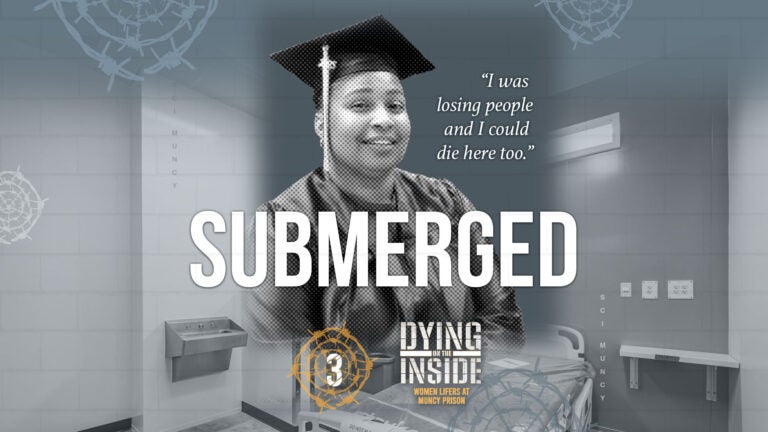
Sheena King has spent more than three decades incarcerated at State Correctional Institution Muncy. | Illustration by Sheldon Sneed Designs
Sheena King, 52, was terrified of dying alone and afraid inside the prison infirmary at State Correctional Muncy. She became a prison hospice volunteer, comforting and helping women in their final stage of life, in hope the same would eventually be done for her. During her 33 years at Muncy, Sheena has dedicated her life to being the support she wishes she’d had before she committed murder at 18 years old. Sheena discusses healing from a lifetime of trauma while serving a life without parole sentence, working in prison hospice, and her new book “Submerged,” a memoir to help others on their own healing journeys inspired by her experiences. At an event for her book launch, recordings of Sheena reading from her book played, and her daughter Keeva King spoke alongside attorney Rupalee Rashatwar about her mother’s condition in prison.
-
Episode Transcript
Cherri Gregg, narrating: Trigger warning: this episode contains descriptions of rape and childhood sexual abuse.
Robovoice: This is a prepaid collect call from—
Sheena King: Sheena.Robovoice: An incarcerated individual at SCI Muncy.
[music]
Cherri, narrating: Today I am talking to Sheena King. Sheena is serving a life sentence without the possibility of parole for murder. She is 52. She has been at State Correctional Institution Muncy for 33 years. Like most of the women lifers I’ve been speaking to, she’s had a long list of ailments.
Sheena: So I’ve been diagnosed with hypertension, hypothyroidism, diabetes and with all of those things, I’m in menopause too. So I have a stack of medication that I take. And I also have osteoarthritis, which, of course, has caused spinostenosis and some spurring on the spine and on the knees as well.
Cherri, narrating: But the health issue that may have had the biggest impact on her life was a 2014 hysterectomy. For days after the surgery, Sheena lay in the prison’s cinderblock infirmary room. Nearby was an elderly woman who was dying.
Sheena: It’s short-staffed, so people have short tempers, and that bothered me the way that they would respond to her when somebody did come to change her or to feed her. Like she was a problem. There was no compassion, no empathy. It was almost like they just kinda couldn’t stand her because she was older and she had needs and she had dementia. And that just really burned in me, you know, I’m losing people and I could die here too.
Cherri, narrating: It felt like a glimpse into what the end of her own life sentence might look like.
Sheena: I would hear the elderly ladies just kind of scream, just screaming for the workers, screaming for nurses. And that kind of stayed with me because I thought, Why isn’t anybody answering it?
Cherri, narrating: That’s when Sheena decided to dedicate her time at Muncy to women who were dying alone.
[music]
I’m Cherri Gregg, I’m a journalist and radio host at WHYY. This is Dying on the Inside: Women Lifers at Muncy Prison. A podcast that looks at the national crisis of our aging prison population and its incredibly high cost. Welcome to Episode 3: Submerged.Cherri, narrating: According to The Sentencing Project, if current prison trends continue, as much as one third of all people in America’s prisons will be at least 50 years old by 2030. And UCLA prison data reported that roughly 5,200 people died in U.S. prisons in 2024. Just a small fraction of prisons have hospice programs; Muncy is one of them. Sheena started volunteering with the Muncy prison hospice program in 2017.
Sheena: So when I saw that there was a possibility of training to be a hospice volunteer I just jumped on it because I thought I don’t want to be sitting in a room screaming for somebody to come and no one does. And I thought about my grandmother who had Alzheimer’s. Like, this is the things that my grandmother endured. I can’t let somebody go through this by themselves if I could be there because if I’m sitting with you and you need something, then I’m going to the warden and saying, Listen, she needs this. Somebody has to be their voice or just to sit with them because it is lonely.
[music]
Cherri: What is involved in working in the hospice program?
Sheena: A two-week training that happens first. And because they don’t happen often, there’s about seven or eight of us. That’s it. And the training is really pretty long and extensive.
Cherri: After you do the training, you do all of that, what exactly do you do with the women?
Sheena: We watch them constantly, we keep a log of when they’ve had their medication, what nurses came to visit them, any changes so that way, because we do like eight hour shifts, so when the next person comes on, like she can read the log and know exactly what happened.
Cherri, narrating: Hospice volunteers ensure every woman on hospice has a personal advocate, and they keep the women company.
Sheena: While I’m sitting with them, I’m like a mother hawk, right? I won’t go to sleep. I can’t sleep because I’m watching for every labored breath. Most of the time they don’t want to eat so then they will give them a straw, so we give them ice water. We keep them moist, like their hands and their face. We brush their hair and keep their lips moist because for some reason people really dry out as they’re going through those end-of-the-life processes.
Cherri, narrating: Sheena says this kind of work can weigh on you.
Sheena: It’s sad and you have to have a really strong life of prayer, honestly, because you’re watching day by day as a person, just kind of waste away and just become emaciated. But at the same time, it’s like, you have to put that, how you feel aside because you have to be there for that person.
Cherri, narrating: But Sheena says she draws a lot of strength from what she’s able to offer these women.
Sheena: You know, they really miss their family. So while they’re still lucid, you can kind of make it okay for them. You know, talk about their family, read to them, watch television with them and, just to kind of keep them engaged. But when they’re at their like, really final stages, it’s just sitting and watching and really praying that today’s not the day.
Cherri: Yeah, you really are helping them to the very end. Are most of these women lifers?
Robovoice: [overlapping] This is a call from Pennsylvania State Correctional Institution, Muncy. This call is subject to recording and monitoring.
Sheena: Every person I have ever sat with had a life sentence, yes.
Cherri: What’s the typical age of the women that you’ve worked with in hospice?
Sheena: Well, it varies, because the last person that I sat with, she was younger than I am, so she was in her 40s. I think maybe though the oldest person was maybe 60?
Cherri: The oldest person that you’ve seen in hospice was 60?
Sheena: Yes, within her sixties, yes.
[music]
Cherri, narrating: I had heard about this phenomenon called accelerated aging in prison. Studies show that every year of incarceration decreases life expectancy by two years, but I hadn’t fully understood how hard prison is on a body until I learned that these frail and dying women Sheena is sitting with, are at the oldest in their sixties.
Cherri: What are the illnesses that you see the most?
Sheena: It was cancer.
[music]
Cherri, narrating: SCI Muncy opened a $5.9 million infirmary in 2018, but the old infirmary is where the dying inmates stay. Some of the small rooms have a view of another building or barbed wire.
Sheena: It’s weird looking at it, right? Because the walls look like subway tiles. Like that’s how they look. And it’s that beige color. So, and their hospital beds, they’re old ones. So they’re the old creaky turn-the-crank type of bed in order to change the mattress. So they’re very small dark rooms. It looks like—and the infirmary has a smell to it. Like maybe stomach cancer, or—
Robovoice: [overlapping] This is a call from Pennsylvania State Correctional Institution, Muncy. This call is subject to recording and monitoring.
Cherri: Yeah, you said that they have stomach cancer, what?
Sheena: Right, so that has its own distinct kind of smell to it as well. Honestly it smells like sickness, which is why most people they actually don’t want to go to the infirmary because of that, like it smells like, like sickness always.
It would get so bad that what we would do is we would keep a jar of Vicks down there so that each person, you just put a little under your nose because it just smells like death and it’s very dark and depressing.Cherri, narrating: But the nurses and volunteers try to bring light into the hospice cells.
Sheena: Decorate the room if the person has pictures. So put up the pictures of their family or maybe they’ll color something just to kind of brighten it up.
Cherri, narrating: But Sheena says it doesn’t really work.
[music]
Sheena: It’s still cold and damp, and it has that damp smell to it.
[background noise]
Cherri: And so—
Sheena: Oh my God, it’s count time, oh my gosh. I have to get off the phone.
Cherri: Oh. Okay.
Sheena: I’m so sorry.
Cherri, narrating: It was time for Sheena to report for the daily count.
[music, midroll]
Voiceover: At Klein College of Media and Communication, at Temple University, we believe the best way to learn it is to live it. From day one, students get real world experience in sports media, journalism, communication, production, PR, advertising, and more. Guided by industry pros and fueled by Philly’s energy, Klein prepares you to lead in media and communication. Learn more at klein.temple.edu.
[music]
Cherri, narrating: In addition to Sheena’s work with hospice patients, she now leads peer support groups for sexual abuse survivors at Muncy.
Sheena: I run a childhood trauma group. It’s called Victims of Inappropriate Childhood Experiences. It is women who have, have really had childhoods of any level of abuse, and it’s mainly sexual abuse. Trying to help them see it for what it was and then heal and move beyond it.
[music]
Cherri, narrating: Sheena grew up in South Philadelphia. When she was nine, she says her mother’s live-in boyfriend began to sexually abuse her, which then led to rape. This went on for years.
So many of the women I spoke to at Muncy had been sexually abused as children. In fact, studies show that the majority of all women prisoners were victims of sexual and physical abuse prior to being incarcerated—which for many started in childhood.Sheena: So going through sexual abuse and when it’s long-term, it kind of turns inward, right? Like all of that nastiness that you feel about yourself, that just kind of grew. And it grew until I didn’t see anything in myself that was good. And I always just seemed like really angry and hurt and constantly putting myself down, never seeing that I had any worth.
Cherri, narrating: The sexual abuse young Sheena experienced was relentess.
Sheena: There was so many things that was happening to me, so much abuse. And if maybe somebody could have stepped in and seen it, and if not removed me from the situation, then maybe gave me an outlet, you know, somebody to talk to some sort of resources.
Cherri, narrating: During her decades at Muncy, Sheena has poured her soul into working with women dealing with many of the same issues she has.
Sheena: I mainly work with those who are in a residential treatment unit for mental health. So that entails going to the unit, trying to help women work through their schizophrenia, deep levels of anxiety. And I’ve just now been approved to mentor people who are outside of that too. Just any people that-that we may identify as needing some additional support, some help in navigating this process, you know, some help in moving beyond who you were when you arrived here so that you leave as someone different.
[music]
Cherri, narrating: Helping others has been the focus of her life at SCI Muncy.
Sheena: People laugh at me, they call me pastor and they laugh because that is what it is for me. I will keep going. It doesn’t matter. As long as I feel like I have some sort of purpose, it gives me a reason to get up. A reason to keep going day after day, despite the pain. There’s something that I can do to help, somewhere I can give back, and maybe atone in some way for the damage that I’ve done.
Cherri, narrating: Sheena was 18 when she committed the murder that put her in prison for life. At the time of her arrest she was the mother of a three-year-old daughter and four-month-old son.
[music]
Her boyfriend was a drug dealer, and Sheena was too. One day he told her to kill his former girlfriend, a 24-year-old mother named Shawn Wilder. He was concerned she knew too much about his criminal enterprise. Sheena was scared of him, and she obeyed. She shot Wilder as the young woman’s children played nearby. About a year later she was sentenced to life without parole. She was 19 years old. She says over three decades in prison have turned her into a completely new woman.
Sheena: I think what changed me was kind of feeling really an incredible level of guilt. Those are the things that changed me immediately because I didn’t like the person that I was as a teenager. And I knew that I wanted to be somebody different, somebody better, especially for my children.
Cherri, narrating: Sheena says she has written a new story for herself.
[music]
Sheena: I’m not what I was at 18, at 52. But I’ll forever be viewed as that moment, as exactly what I’ve done and not that I’ve tried for over three decades to be someone better. And not for freedom’s sake, just because of what I carry, because of what I’ve done.
Cherri, narrating: Over the last few years, Sheena’s worked to put her regret and sorrow into a book. It’s a memoir she titled, “Submerged: On Healing from Abuse While Navigating a Lifetime of Imprisonment.” It came out last year through a small local publisher.
Sheena: 99% of the women here have experienced some trauma in their childhood. And I thought, Well, let me write this to help me and to, to help other people that have experienced the same thing.
Cherri: So I gotta ask you, why do you do that type of work for other women?
Sheena: I needed to do something with-really with my guilt. Try to mentor and raise up another generation of children as they enter prison, and try very, very hard to hold on to some, some bit of humanity, to some level of hope in a place that it’s very easy to succumb to hopelessness and madness, honestly. And people really don’t know that we’re always seen as what we’ve done.
Cherri, narrating: The woman she killed, Shawn Wilder, is always on her mind.
Sheena: That’s what started it for me because I thought about, you know, this was a woman, a mother. What kind of help did both of us need that we were in this situation with this person? And how do I prevent other young girls from finding themselves in those same situations?
I can’t of course return life or undo what I’ve already done, then maybe I can do some good with some women since this was what I needed for myself and what I believe Ms. Wilder needed too. So then maybe I can do this. I can be the person to give what I didn’t have.[music]
Steve Bloom: I’m so pleased to see so many folks who are interested in this important book. We do have a sign-up sheet on the table right here…
Cherri, narrating: A small West Philadelphia bookstore held a launch event for Sheena’s book. They played recordings of Sheena reading from her chapters.
[music]
Sheena, reading: My elders’ skin sagged, and their quick-paced walks slow to a crawl, some even requiring the aids of canes and wheelchairs. It depresses me that Terri and Deirdre needed back surgery, that Karen is frightened and wondering how long she has to live because of multiple medical complications.
Cherri, narrating: About two dozen people filled the bookstore to hear Sheena’s recorded readings.
Sheena, reading: We grew up in Muncy together, and their mortality is a testament to my own. So we try not to talk about it as we watch and cry while our friends and associates die around us. No one wants to die alone and in prison, but it’s our reality and we fear it.
Cherri, narrating: Sheena is currently seeking commutation. It’s a long and difficult process. Rupalee Rashatwar spoke at Sheena’s book launch event. She’s a Staff Attorney at the Abolitionist Law Center.
Rupalee Rashatwar: Sheena applied and actually was granted a public hearing in 2019, but it was denied, and so she applied again last year. For folks who may not know, Sheena committed this crime when she was 18.
Cherri, narrating: In 2012 the U.S. Supreme Court ruled that giving mandatory life without parole sentences to juveniles was unconstitutional.
Rupalee: The Supreme Court basically stated that anyone who was under the age of 18 at the time they committed a crime and was sentenced to life without parole, which we call death by incarceration, that they would be able to challenge their sentence or have a re-sentencing, acknowledging that people who are younger often don’t have—they aren’t able to develop their judgements and make sound decisions in the same way an adult would and that our sentencing law should reflect that.
Cherri, narrating: But there is a very sharp cut off at 18.
Rupalee: So even if anyone is eighteen in a couple months, 18 in a couple days, they’re not able to access the benefit of that law.
Cherri, narrating: That’s Sheena’s case—she was just past her 18th birthday.
Rupalee: The only legal recourse she has is to pursue a commutation, which is basically trying to ask the governor for a clemency or pardon. So it’s a very difficult process. It can take anywhere from three to five years. It requires the board of pardons to vote and to get institution support, meaning support of the prison, support of the entire Department of Corrections, and then enough votes to make it to a merit review and enough votes at a merit to make it to public hearing and enough votes at a public hearing to be granted a commutation.
Cherri, narrating: Sheena’s daughter, Keeva King, represented her at the book launch event. Afterwards she says she is worried about her mother’s health.
Keeva King: My mom has gained a lot of weight, and I’m not even trying to be funny, but she’s gained a lot of weight, so then when we do talk about her nutrition, she tells me that they don’t have access to a lot of the, to things that’ll keep them living. Healthy fruits, healthy vegetables, and things like that, so she has to resort to a bunch of junk food and snacks.
Cherri, narrating: Keeva sends her mom care packages, but it’s hard sending care packages to prison. You have to use certain vendors, it’s expensive, you can only send so much food, and the options are pretty limited.
Keeva: I’m trying to select the healthiest things, but that’s still like, you know, maybe a trail mix, but it has chocolate and yogurt balls. A lot of the women in there are aging and require different diets, you know, just to keep them healthy, so I don’t see it.
Cherri, narrating: At the end of the event, book buyers walked over to Keeva, who placed a sticker signed by her mother onto a book page and wrote thank you above it. She was beaming.
[music]
Keeva: I’m just happy and I’m proud of her. She just got her master’s degree, woop-woop. She’s going forward to get her doctorate, so I just can’t wait for that time when we can kind of continue the path that she started in prison out here and help people directly.
Cherri, narrating: On the next episode of Dying on the Inside: Women Lifers at Muncy Prison, we look at freedom through commutation and compassionate release.
[music]
Naomi Blount-Wilson: I was in stage three, and stage three just doesn’t happen overnight. And with me being on the inside, so many of my sisters on the inside, was diagnosed with cancer.
Rupalee: Your doctor says, okay, here’s this aggressive kind of chemotherapy you should pursue. If that treatment you’re pursuing is gonna extend your life beyond a year, you’re confronted with some crazy decision that in order to be released, you have to give up hope and let yourself die.
Sen. John Fetterman: Why, why do you need to die in prison? After you’ve paid 40 or 50 years there, I mean, is there a value just to be marched out in a pine box?
Cherri, narrating: Dying on the Inside: Women Lifers at Muncy Prison is a production of Create.Genius.Media and Temple University Klein College’s Logan Center for Urban Investigative Reporting.
I’m Cherri Gregg, Executive Producer and Host.
Executive Producer, Producer, and Script Writer is Yvonne Latty, the Director of The Logan Center.
The podcast Editor is Audrey Quinn.
Sound design, scoring, mixing, and mastering by Michelle Macklem.
Our Data Editor is Colin Evans.
Associate Producer is Natalie Reitz.
Our Community Impact Producer is LaTonya Myers.
Original Music by Theodore Damascus Merz and Jarvis Cain.
Our Podcast Art is by Tracy Agostarola.
Our Production Assistants are Leila Oyeku, Caroline Keane and Caelan O’Neill.
Funding support comes from The People’s Media Fund, Women’s International Media Foundation, Jonathan Logan Family Foundation, The Lenfest Institute for Journalism, Eppchez Yo-Sí Yes, and Temple University’s Klein College of Media and Communication.
Special thanks to WHYY’s Head of Digital Studios Tom Grahsler and Audio General Manager Joan Isabella.
And to the Dean of Klein College, David Boardman.
We’re also grateful to Jack Klotz of Klein College’s Media and Production Department and Audio & Live Entertainment Major, Amanda Stankiewicz, Danielle Martinez and Stephanie McClellan.
Do me a favor. Please rate and review wherever you are listening and hit us up on social media @dyingontheinsidepodcast. We’d love to hear from you.
And check out our stories on mass incarceration issues and solutions at whyy.org/dyingontheinside. Please join us in this conversation.
This podcast is presented by WHYY, and thanks for listening.
collapse
WHYY is your source for fact-based, in-depth journalism and information. As a nonprofit organization, we rely on financial support from readers like you. Please give today.