

Sunoco pipeline leak cleanup in Upper Makefield is ‘moving too slowly,’ residents say
Bucks County residents are raising concerns over noise and safety, as well as impacts on the water supply, as Sunoco works to clean up leaked jet fuel.
Listen 1:06
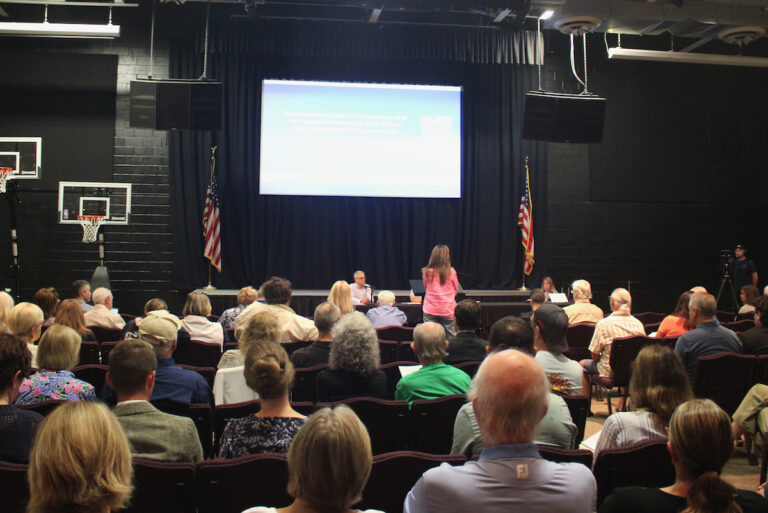
Residents registered concerns about Sunoco LP's Remedial Action Plan for a pipeline leak that spilled an estimated 6,500 gallons of jet fuel in Upper Makefield Township at a meeting in Washington Crossing, Pa., on Wednesday, July 8, 2026. (Emily Neil/WHYY)
From Philly and the Pa. suburbs to South Jersey and Delaware, what would you like WHYY News to cover? Let us know!
At a meeting Wednesday night, Sunoco LP and parent company Energy Transfer presented its cleanup plan for the estimated 6,500 gallons of jet fuel leak from its pipeline that contaminated well water in Bucks County’s Upper Makefield Township.
The company submitted its Remedial Action Plan to the Pennsylvania Department of Environmental Protection in June. The document, prepared by Verdantas LLC, outlines how Sunoco LP will meet the agency’s Act II remediation cleanup standard.
Sunoco LP is proposing a pilot test of a process called multiphase extraction, abbreviated as MPE, to clean up the leaked jet fuel that seeped through fractured bedrock and remains in the groundwater.
The estimated month-long pilot test will most likely take place before the end of this year, company representatives said. If proven effective, a full-scale system will be installed.
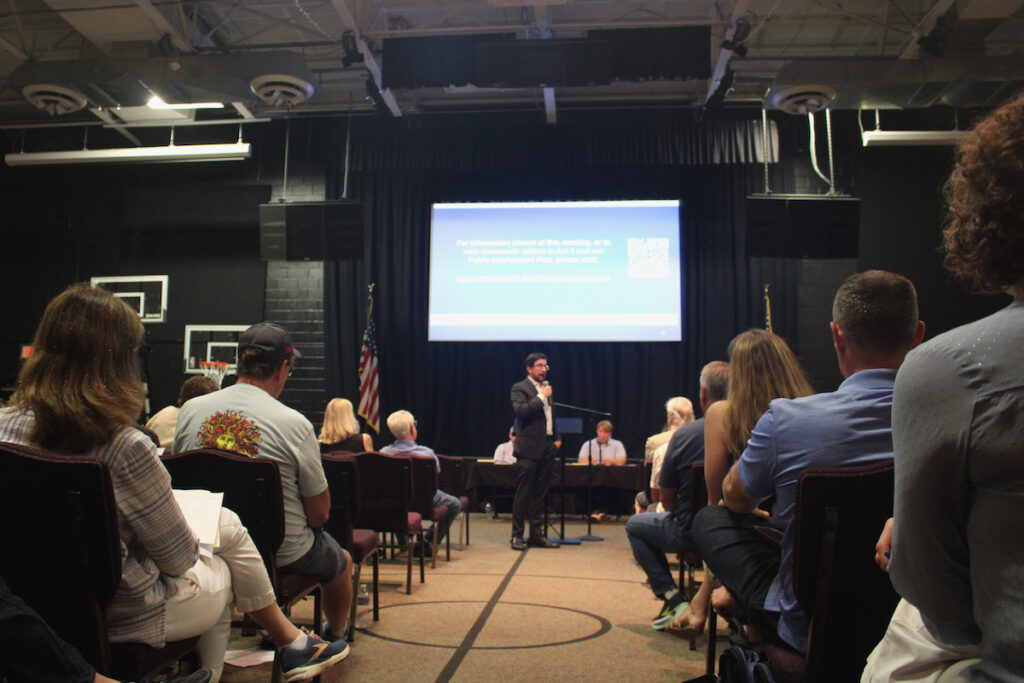
Pipeline leak cleanup disrupts a once ‘bucolic, beautiful neighborhood’
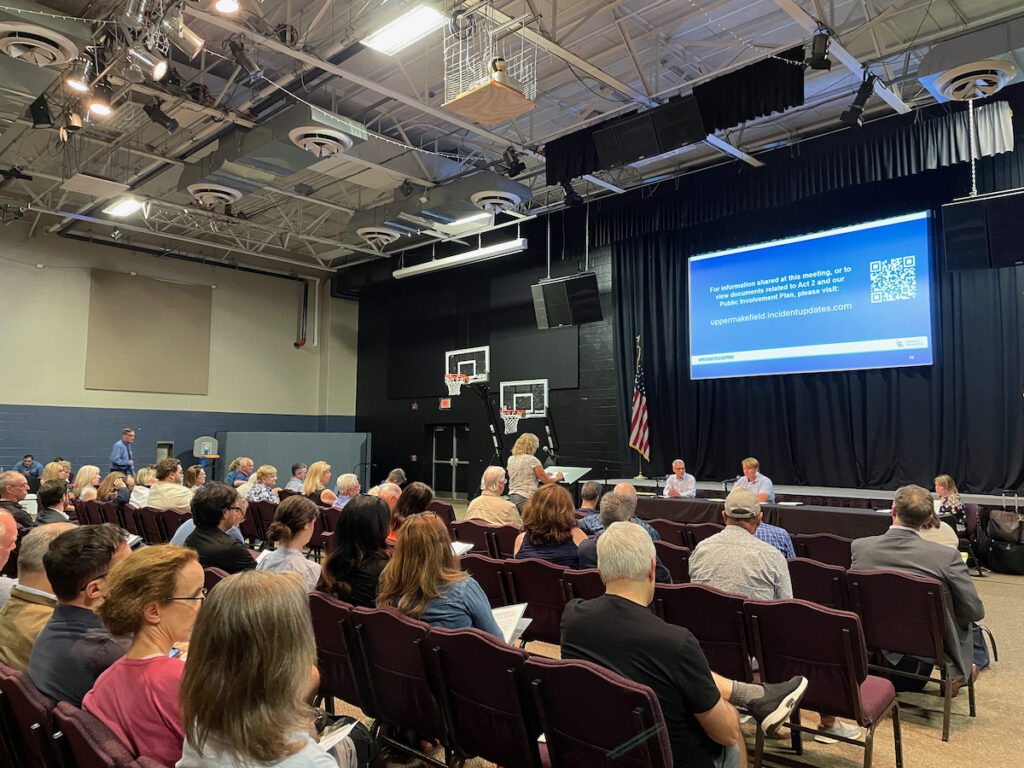
Residents and elected officials packed The Crossing Church gymnasium in Washington Crossing on Wednesday. They expressed concerns about noise and safety, and impacts on the water supply.
Ben Weldon, chair of the Upper Makefield Township Board of Supervisors, said the cleanup is “moving too slowly,” and that identifying a long-term clean water source in the affected Mt. Eyre neighborhood would expedite the process.
“Presumably one of the reasons this is moving slowly is because we are trying to clean an aquifer that you all are accessing for your drinking water,” Weldon told the crowd. “They have to consider, they have to plan … and mitigate what happens when what they do in this aquifer impacts all of your homes. If you had a separate, a different water source, presumably this cleanup could happen much quicker.”
Other residents cited concerns about safety and noise levels from the equipment, which company representatives said would run around the clock during the pilot and eventually during the full-scale cleanup.
“This is a major interruption into what was a bucolic, beautiful neighborhood,” said Terry Dearden, a Mt. Eyre resident. “So, regardless of the fact that we all are ticked off about the fuel, we now do not live in the neighborhood that we paid a whole lot of money for.”
As of June 16, the company said it has recovered approximately 518 gallons of jet fuel. Sunoco has recovered an additional 644 gallons through soil excavation beneath the pipeline.
The company also said it collected more than 1,800 water samples from 365 private drinking water wells in the neighborhood. Since the leak was discovered in January 2025, the company has provided bottled water and installed more than 200 Point-of-Entry Treatment, or POET, water filtration systems to prevent exposure to the leaked chemicals and impacted groundwater.
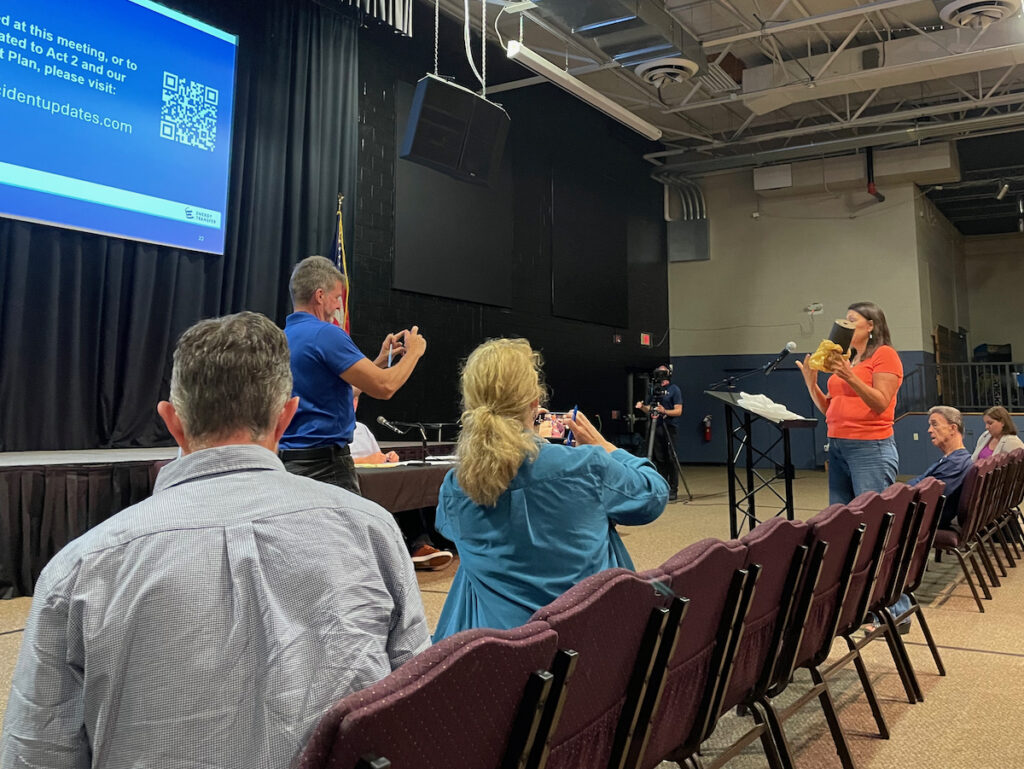
Kim Brunnquell, a resident, expressed concerns Wednesday about the continued maintenance of the water filtration systems. She showed a sediment filter removed in June that had turned black with debris in three months.
“The POET filter systems are a treatment, not a solution,” she said.
Several residents also raised concerns about dozens of redacted pages in the public version of the plan, which company representatives at Wednesday’s meeting attributed to privacy concerns about addresses.
Related Content

Upper Makefield residents call for answers on Energy Transfer pipeline leak
Some residents in Bucks County reported smells of gasoline in their water as far back as September 2023.
2 years ago
Listen 1:17Bucks County lawmakers press Sunoco for more transparency
Residents from one impacted household said they first detected a smell of jet fuel in their tap water in September 2023. An inspection at that time found no contamination.
The leak was first identified by Sunoco LP on Jan. 31, 2025. Six private drinking wells were found to be contaminated then.
A preliminary investigation by the Pipeline and Hazardous Materials Safety Administration, the federal regulator, found that the leak had started 16 months before it was discovered. The agency’s full investigation into the spill is ongoing.
PHMSA issued a safety advisory in June 2026 for Type-A sleeve repairs for all hazardous liquid pipeline operators. The agency found a faulty Type-A sleeve repair was responsible for the Upper Makefield leak and ordered Sunoco LP in May 2025 to inspect and verify the integrity of all Type-A sleeve repairs along the length of the 105-mile pipeline.
Legislation introduced by state Sen. Steve Santarsiero, D-Bucks, and state Rep. Perry Warren, D-Bucks, in January, modeled on New Jersey’s Spill Act, would give the state DEP more authority to enforce cleanup deadlines and act decisively in the event of future hazardous-substance spills.
“The fact that we’re still here is because Pennsylvania law is inadequate, and that’s why Representative Warren and I have introduced the Environmental Responsibility and Cleanup Act,” Santarsiero said Wednesday. “That act would not only have made this happen a hell of a lot faster, as it would have happened had this occurred across the river, but it also would require cleaning up to a much higher standard that comports with our state constitution.”
Santarsiero also expressed concerns about the pipeline’s safety while it continues to operate at 80% capacity, per an order from PHMSA.
“I’m not confident here today that the continued operation of this pipeline does impose a risk not just to these residents but other residents throughout the region,” he said.
Late last year, U.S. Rep. Brian Fitzpatrick, R-Bucks, proposed pipeline safety reforms at the national level. A representative from his office attended the meeting Wednesday night and delivered a comment on his behalf, stating that the remedial action plan “is completely flawed, evasive, and heavily redacted.”
The company is accepting public comment on the plan through Aug. 3. The DEP said the company has until Aug. 18 to respond to public comments, after which the agency will complete its review of the plan and issue a decision letter.
“DEP will oversee the installation and operation of SPLP’s remediation system,” a department spokesperson told WHYY News in a statement. “In addition, DEP will review the monitoring data and SPLP’s evaluation of how effectively the system is performing, and we will work with SPLP, Upper Makefield Township, and other stakeholders to ensure compliance with the Order.”

Get daily updates from WHYY News!
WHYY is your source for fact-based, in-depth journalism and information. As a nonprofit organization, we rely on financial support from readers like you. Please give today.
Part of the series

Watershed
Preserving Our Water: How we use our Delaware Watershed.
The project is funded by The William Penn Foundation.
New Jersey American Water rates to increase by $4 per month on average
The new water rate will help the investor-owned utility pay for water and wastewater projects.
1 month ago
Listen 1:17
The annual Delaware River Sojourn has been drawing kayakers and canoers to the Delaware River for 31 years.
4 months ago
Listen 2:20
Scrap metal fire on Delaware River barge now under control, officials say
Piles of scrap metal burned for more than 24 hours in the Delaware Bay. The barge is owned by the Camden scrapyard EMR, which will be taking the cargo.
7 months ago
Listen 0:59