

Princeton ends century-old tradition of unsupervised exams amid AI concerns
University leaders say artificial intelligence and fear of doxing have weakened the student-run system.


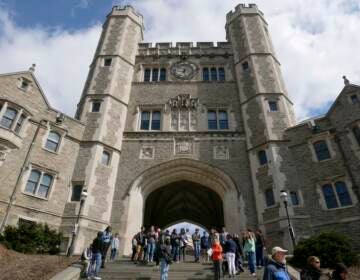
FILE - The Princeton University campus is in Princeton, N.J., Oct. 8, 2024. (AP Photo/Ted Shaffrey, File)
From Camden and Cherry Hill to Trenton and the Jersey Shore, what about life in New Jersey do you want WHYY News to cover? Let us know.
Princeton University is overhauling a cornerstone of its academic culture, requiring faculty to supervise in-person exams beginning July 1. It’s the most significant change to the school’s honor code since it was implemented in 1893.
Michael Gordin, dean of the college, said in a memo proposing the change that he met with current and former chairs of the student-run Honor Committee, faculty members and the academics chairperson of the undergraduate student government before making any recommendations.
The change is being driven by AI and doxing
In his memo, Gordin acknowledged the perceptions of widespread cheating in recent years. However, he alluded to technology being the main factor in driving the change in policy, particularly the advent of generative artificial intelligence, or AI. He wrote that the technology “significantly” lowers the barrier to gain an unfair advantage during exams.
“The ease of access of these tools on a small personal device have also changed the external appearance of misconduct during an examination, which is much harder for other students to observe (and hence to report),” Gordin wrote.
There has also been an increase in anonymous reports to the Honor Committee, which Gordin blamed on “another technological development of longer standing — social media.” The dean said it has “reportedly deterred students from reporting openly out of apprehension of doxxing or shaming among their peer groups.”
Gordin added that the fear of being outed has made it difficult for the Honor Committee and the Office of the Dean of Undergraduate Students to follow up on cheating concerns.
“If students alone are present in the examination room and students are unwilling to report, then there is no check against misconduct during assessments,” he wrote.
In a 2025 survey, The Daily Princetonian found that 44.6% of seniors said they had knowledge of honor code violations they chose not to report. The campus newspaper also reported that a survey of undergraduate students found a majority were either in favor of or indifferent to any change, though a “sizable minority” was opposed.
Faculty will be required to observe and report
Under the rule change, proctors will serve as a witness to what happens in an exam room. They will not interfere with students taking exams, but will note suspected violations and report them to the Honor Committee. Proctors who report suspected violations are expected to be available to testify before the committee when called upon.
The number of proctors needed and the practices they will abide by are expected to finalized by the time the fall 2026 semester begins.
Gordin made it clear in his memo that “the procedures of the Honor Committee, and the due process protections and rights to appeal of those brought before the committee, do not change.”
“Alleged violations of the Code during in-class examinations would still be adjudicated by the student-run Honor Committee,” he wrote.
Related Content

Stockton University and 4 county colleges in New Jersey partner to smooth path for transfer students
The South Jersey Higher Education Alliance aims to increase the number of students that complete their undergraduate degrees.
4 months ago
Listen 1:04Other schools have similar honor codes enforced by students
Jackson Juzang, a recent alumnus of Haverford College in Pennsylvania, said that while he is used to institutions with a student culture similar to that of his new alma mater, he never experienced anything like their honor code.
“I had never heard of something where you don’t really have exams, and I was never really used to an environment like that,” he said. “It was definitely a little bit of a culture shock.”
Haverford introduced its honor code in 1897, four years after Princeton. The most recent update happened in fall 2025. The college’s honor code includes a social code that encourages students to uphold the dignity of themselves, their peers and an academic code with the goal of emphasizing individual student progress over grades.
Juzang, who graduated with a degree in English language and literature, said he “never really had exams” but was assigned final projects he completed on his own time. As he begins a master’s program at the University of Southern California, Juzang said Haverford’s honor code was beneficial to him.
“[It] definitely helped every other aspect of my academic rigor and learning process,” he said. “That was definitely deeply beneficial for my ability to be an entrepreneur and to get into other spaces and really not worry about silly things like exams.“
While the honor codes at Haverford and Princeton were more focused on academics and school environment, students at the University of Virginia were under a broader code, pledging not to “lie, cheat or steal.”
Until recently, the only punishment available to the Honor Committee was expulsion. The punishment was controversial in 1971, when a student was kicked out of the university for stealing cans of Coke from a vending machine left open.
Students updated the honor code in 2023 to allow those who admitted guilt to take a two-semester leave or propose their own ideas about making amends.

Get daily updates from WHYY News!
WHYY is your source for fact-based, in-depth journalism and information. As a nonprofit organization, we rely on financial support from readers like you. Please give today.
Princeton’s president says university will tighten budget because of endowment outlook
Though the Ivy League institution is financially strong, Christopher Eisgruber said it must be more efficient in the future.
7 months ago

Black enrollment is waning at many elite colleges after affirmative action ban, AP analysis finds
At Princeton and some others, the number of new Black students has fallen by nearly half. Some colleges attribute it to natural fluctuations.
11 months ago

Federal cuts threaten Princeton University program for formerly incarcerated persons
The university’s Prison Teaching Initiative has built partnerships to scale programs that provide formerly incarcerated students with research opportunities.
1 year ago
Listen 3:30