

Philadelphia slavery exhibit: Judge blasts federal lawyers over removal, calls their argument ‘horrifying’
Philadelphia sued after the signs telling the story of people enslaved at the site were torn down last week.

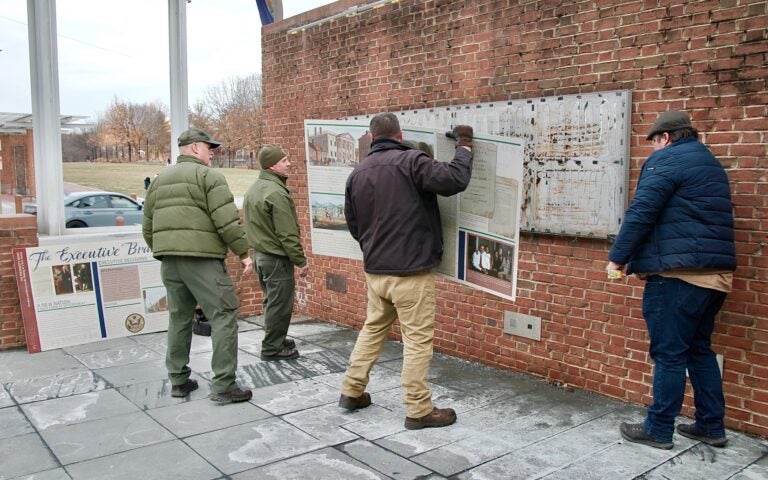
Workers remove signs from the President's House exhibit on Independence Mall. (Emma Lee/WHYY)
From Philly and the Pa. suburbs to South Jersey and Delaware, what would you like WHYY News to cover? Let us know!
A federal judge asked Justice Department lawyers to not disturb the panels removed from a Philadelphia exhibit about slavery before she visits the site herself as the city argued its case against the removal of the President’s House installation in court Friday.
In Philadelphia’s U.S. District Court, attorneys representing the federal government claimed that the National Park Service had the full authority to decide what exhibits they placed at park sites.
“Ultimately, the government gets to choose the message it wants to convey,” Gregory in den Berken, representing the federal government, told the court.
However, U.S. District Court Judge Cynthia Rufe called that statement “dangerous.”
“It is horrifying to listen to,” she said. “It changes on the whims of someone in charge? I’m sorry, that is not what we elected anybody for.”
The comments came as part of a tense exchange between the U.S. attorneys and Rufe during a hearing regarding the city of Philadelphia’s lawsuit against the federal government for its removal of the exhibit earlier this month. Friday’s hearing was in regards to the city’s motion to seek a preliminary injunction to stop the park service from further disposing of the panels before the case proceeds.
Rufe, who was appointed to the bench by President George W. Bush, chastised the government’s lawyers for the argument.
“You can’t erase history once you’ve learned it. It doesn’t work that way,” Rufe said.
The city is arguing that the federal government violated a 2006 cooperative agreement between the National Park Service and the city when they “unilaterally” removed and damaged the exhibit.
In her opening testimony, City Solicitor Renee Garcia said that the National Park Service caused “irreparable harm” when they changed “the first federal property to feature a slave memorial.”
For “the park service to now destroy a commemorative site that took 10 years, millions of dollars and substantial collaboration without so much as a conversation is the very definition of an arbitrary and capricious action,” she said.
The cooperative agreement was signed in 2006 and required that the federal government consult with the city if any changes to the site were made.
However, the federal government argued in its defense that the court did not have proper jurisdiction over what is “fundamentally a contract claim” and that the park service was in charge of “the safekeeping and interpretation” of American history.
However, Rufe appeared skeptical, interrupting the federal government’s lawyer several times.
“It was in an awful lot of people’s interests, time and money coming from the city, other organizations, fundraising, taxpayers, that went into all of this creation of part of the exhibit of the President’s House,” she said, adding that the government took down the site with “no notice, no cooperation, no intent to involve the city.”
Rufe also appeared concerned over the state of the panels and told the government attorneys she wanted to personally see them “by Monday.”
In den Berken said that the city “signed over all ownership and title to the exhibit to the National Park Service.”
“They have no standing and there are no legal consequences that stem from taking down the exhibit,” he said.
Related Content
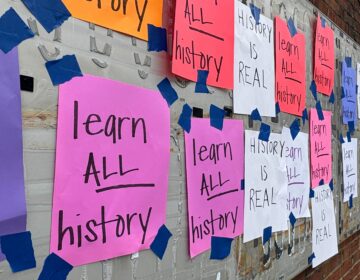
The removal enforces a White House executive order to remove exhibits “disparaging” American history. The city has filed a lawsuit.
3 months ago
‘We can make this happen’
Garcia called three witnesses who testified that the city played a significant role in the development of the President’s House Site exhibit and, therefore, was an “equal partner” in the project. The first was Joyce Wilkerson, then-Mayor John Street’s chief of staff who served on the project’s oversight committee. She also signed the original cooperative agreement between the city and the park service.
Wilkerson took the project to Street to help provide “gap funding” to complement federal grants and fundraising.
“I remember going to him and saying, ‘We can make this happen,’” she told the court.
Wilkerson went on to say that it was the city that led the planning of the site, the design and soliciting public feedback. She added that the city and the park service “historically” had a “really close relationship” and regularly served as partners.
“The agreement to collaborate on projects, sign off approvals, that was very much the history of city and park service operation over the decades,” she said.
“Did you ever contemplate the possibility that the federal government would tear down all that was designed, built and installed over the course of almost a decade worth of partnership in just a single afternoon?” Bailey Axe, deputy city solicitor, asked.
“Never occurred to me,” Wilkerson said. “I don’t think it ever occurred to any of us that we would turn our backs on that or that the federal government would turn its back on the commitments that were made to tell the truth.”
During cross-examination, in den Berken read from the signed agreement which said “upon completion of the exhibit in accordance with this agreement, ownership of the exhibit shall transfer to the NPS. NPS ownership of the exhibit shall survive any termination of this agreement.”
“Did I read that correctly?” he asked.
“Yes,” Wilkerson answered.
‘Visceral reaction’
The city’s second witness, Everett Gillison, who served as chief of staff to Street’s successor, Mayor Michael Nutter, testified that the city continued to shepherd the project even as Philadelphia faced the Great Recession and severe budget pressures.
He described continued coordination with the park service to resolve outstanding issues, involving the city’s law department and capital projects staff. When asked whether he ever imagined the exhibit could be dismantled years later, Gillison responded emotionally.
“That question gets an emotional response from me that I don’t want to curse in court,” he said. “Viscerally, the answer is no. I would never have imagined … that they would overnight tear it down. It boggles my imagination.”
Gillison added that the decision cut against decades of cooperation between the city and the park service.
“There was just too much that went into it,” he said. “A lot of people put a lot of money, a lot of effort, and it was all done because we collaborated with one another. That was the tradition.”
The city’s third witness, Val Gay, Philadelphia’s chief cultural officer, testified about the cultural, educational and civic impact of the exhibit’s removal.
“The site represents a fuller telling of our founding,” Gay said, “a history that allows the convergence of history in the present day.”
She added that the President’s House is part of the National Underground Railroad Network to Freedom and that at least two enslaved people connected to the site escaped to freedom, including Oney Judge, who fled in 1796 and lived free for more than 50 years.
When asked how she learned that the panels had been removed, Gay said she saw images on social media.
“I actually thought I was having a concussive nightmare,” she told the court. “I felt sick to my stomach and couldn’t believe it was actually happening.”
Gay testified that the removal comes at a critical moment as Philadelphia prepares for the nation’s semiquincentennial in 2026, when as many as 1.5 million visitors are expected.
“Not having the panels as part of it,” she said, “we are bereft. The backdrop is bereft.”
The federal government’s attorneys did not cross-examine either Gillison or Gay.
Related Content
Justice Department says it’s releasing 3 million pages from its Jeffrey Epstein files
The files include some of the several million pages of records officials said were withheld from an initial release of documents in December.
3 months ago
What is the case about?
The city filed the lawsuit against the Department of the Interior and National Park Service over the removal of an exhibit depicting George Washington’s slaves at the President’s House Site on Independence Mall.
President Donald Trump had issued an executive order last year for the park service to review and remove exhibits that “disparage” American history. Park service rangers removed the exhibit last week and Philadelphia is now suing for the return of the panels, which were paid for by the city and private contributions rather than the federal government.
In 2006, the city of Philadelphia and the park service agreed to cooperatively establish the exhibit at the President’s House that would memorialize the inhabitants of the executive mansion, including Washington’s nine enslaved residents.
That agreement was amended in 2009, making the city responsible for the “design, fabrication, installation, and completion” of the new exhibit, which was to be placed on park service property. According to the lawsuit, the city spent $3.5 million on the project, titled “Freedom and Slavery in Making a New Nation.”
That money was complemented by grant funding from the Delaware River Port Authority and congressional appropriations secured by U.S. Reps. Bob Brady and Chaka Fattah.
The exhibit opened in 2010.
In 2015, the city transferred copyright of the exhibit to the park service. In the lawsuit, the city argues, however, that “did not include the authority to materially alter or destroy altogether the exhibit underlying the copyright.”
Therefore, the lawsuit claims that the government was required to confer with the city before making any changes to the exhibit. The city says the government acted “arbitrarily and capriciously” in its unilateral decision to remove it.
“The City’s right to approve the exhibit’s final design, including the interpretive displays would be meaningless if the NPS could at any time later change or remove the displays without the City’s approval,” the lawsuit reads.
In addition to its request for a preliminary injunction to halt the further disposal of the panels, the city is also seeking to force the agency to permanently restore the exhibit “to its status as of January 21” before the exhibit’s removal.

Get daily updates from WHYY News!
WHYY is your source for fact-based, in-depth journalism and information. As a nonprofit organization, we rely on financial support from readers like you. Please give today.
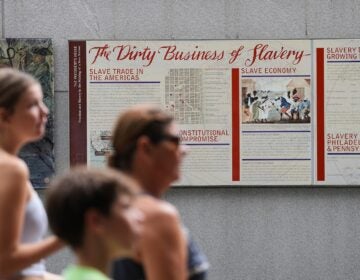
Court blocks National Park Service plans to replace slavery exhibit at President’s House Site
Advocates for the site say the new renderings diminish references to slavery and whitewash American history. A federal court stopped any further changes.
2 weeks ago
Philadelphia congressman authors bill to ‘protect history’ from censorship
Boyle said the bill was necessary after the Trump administration removed an exhibit about the history of slavery at the President’s House Site.
2 months ago
Listen 1:01
Philadelphia’s slavery exhibit is being restored at the President’s House
“This is the American people fighting back and saying we will not accept this,” said one Independence Mall visitor. “Will not allow history to be rewritten.”
2 months ago