

Iranians in Philadelphia grapple with war’s toll as ceasefire brings little clarity on Iran’s future
After weeks of war and a fragile ceasefire, Iranian Americans in Philadelphia weigh hopes for change against fears for loved ones back home.

Philadelphia Iranians hold protest celebrating the death of Iran's former Supreme Leader Ali Khamenei. (Courtesy of Hamidrza Nourzadeh of Philly Iranians)
From Philly and the Pa. suburbs to South Jersey and Delaware, what would you like WHYY News to cover? Let us know!
Even days into a fragile ceasefire, Hamidreza Nourzadeh said he’s still checking for news from Iran with a mix of dread and hope—unsure whether the past month of war has brought his homeland closer to liberation or deeper into danger.
Across Philadelphia’s Iranian diaspora, that uncertainty has become a defining emotion of the war’s second month. Some residents welcomed the deaths of the Supreme Leader Ali Khamenei and top Iranian officials, who they see as brutal oppressors, while others have protested U.S. military escalation in the streets of Philadelphia.
Nourzadeh, who has been living in the United States since 2009, is a member of Philly Iranians, a greater-Philadelphia nonprofit calling for an end to Iran’s theocratic regime and aligned with the Woman, Life, Freedom movement. He says he is “extremely concerned, but hopeful at the same time.”
“Fundamentally we are dealing with a theocracy [where] ideology takes absolute precedence over human life and dignity,” he said.
When U.S.-Israeli strikes began Feb. 28, many Iranians who opposed the regime were grateful for news of Khamenei’s death. Philly Iranians organized a demonstration in Center City, celebrating the “end of the Khamenei dictatorship.”
“Iranian people are not celebrating war,” Nourzadeh said. “They are cheering for the possibility of liberation, and I’m hopeful for liberation at some point.”
However, as the war has continued, more Iranians have expressed doubt about the administration’s intentions.
“I’m not sure if this war is going to lead to [liberation], and many people who fiercely oppose the Islamic Republic have deep concerns about it,” Nourzadeh said.
S.T., an Iranian American living in Philly who asked to be referred to by his initials only, echoed this concern. He said that he does not believe war will bring about liberation for the people of Iran, but he understands why Iranians around the world were happy about the attacks.
“It’s not because they want their country to be destroyed. It’s just that they feel the only way to get rid of the Islamic Republic of Iran is a military solution. Both [sides] have a point,” S.T. said. “These guys are ruthless. They have no mercy on anyone.”
He emphasized how stressful the past month has been for people with family or emotional ties to Iran, as he feels the international community has shown a lack of compassion. “Politically it has become normalized,” he said.
Even as Trump insisted the war was nearing an end, he continued escalating his rhetoric and threatened further attacks. In an April 1 address to the nation defending the conflict, he said that U.S. forces would bomb Iran “back to the [Stone Age], where they belong.”
On April 5, Trump doubled down on his threats with an obscenity-filled post on Truth Social, alarming some Iranians who had initially welcomed the strikes.
Related Content
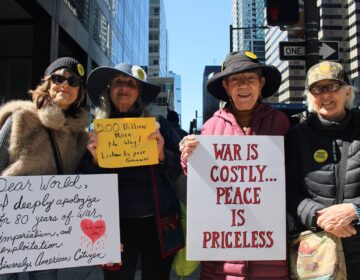
Iran war protesters in Philadelphia target McCormick, Fetterman, demanding end to conflict
Demonstrators said they are concerned about the human and financial costs of war overseas while Americans struggle at home.
5 months ago
Listen 1:08Nourzadeh noted that threats to target infrastructure and power plants would fall hardest on ordinary Iranian civilians.
“U.S. officials seem to operate under the impression that the Islamic Republic actually cares about losing civilian infrastructure. It only emboldens the regime to crack down further and kill more innocent civilians,” he said.
Tensions escalated further after Iran shut down the Strait of Hormuz, a critical global shipping route, causing oil prices to spike and prompting Trump to warn on April 7 that “a whole civilization will die tonight” if it was not reopened. Ten hours later, he announced that Pakistani diplomatic intervention had led to a temporary, two-week ceasefire.
Despite the pause in fighting, Nourzadeh said, the danger has not eased for Iranians on the ground. Since the start of the war, there have been reports that at least four Iranian prisoners, arrested during government protests in January, have been executed, including an 18-year-old. And according to Amnesty International, more are at imminent risk of execution.
Iranian-Americans in the U.S. have also received threats from the regime, according to Nourzadeh. Speaking specifically about his community, he said, people have received messages from the Islamic Republic threatening to execute them or their families back home.
In early March, antiwar groups held protests across Philadelphia that Nourzadeh said revealed what he sees as a double standard. While protesters may have good intentions and “don’t want any conflict, they don’t want any civilians to get killed,” he said, “I haven’t seen any of these groups voice their opinion when the Islamic Republic was killing thousands of people on the street.”
“In their rush to oppose Western governments, they inadvertently end up shielding or excusing the Islamic Republic,” he stated.
The divide reflects a deeper disagreement within Philadelphia’s Iranian and Muslim communities: whether opposing the Islamic Republic requires supporting military action against it.
Robert Zayd KiaNouri-Zigmund, a member of the Council on American-Islamic Relations and also an Iranian American, strongly opposed the war and military action against Iran. In response to the criticism of anti-war protests as being seen as pro-Islamic Republic, he said, “We are in solidarity with the people of Iran. We support those people who are fighting for their rights. And the best way to do that is not to bomb them, not kill them.”
“We live in the United States. We don’t live in Iran. So the government that we are responsible for ensuring represents us is the American government, and right now the American government is saying that the way that it is best representing the American people is to drop billions of dollars a day of bombs on hospitals, schools, civilian centers in Iran,” KiaNouri-Zigmund said.
Ahmet Selim Tekelioglu, executive director of CAIR-Philadelphia, told WHYY News that it is the civic duty of those who oppose the war to speak out against the use of their tax dollars to fund it. According to the Pentagon, the first week of the war alone cost over $11.3 billion, and in the intervening weeks, that number is now estimated to have grown to around $28 billion, according to Mark Cancian of the Center for Strategic and International Studies.
Tekelioglu said that this operation is a weaponization of U.S. tax dollars as the cost of living increases. A new poll conducted by the Pew Research Center shows that 61% of Americans disapprove of how Trump has handled the war.
“We have schools closing in our own cities right here. Right now, we have people who are being cut off their Medicare, Medicaid and food aids. We have an economy that needs boosting over here,” Tekelioglu said.
KiaNouri-Zigmund echoed this concern. “Our communities are struggling. … Why are we spending so much money on bombing people, on bombing children, on displacing hundreds of thousands of people in Iran, in Lebanon, in Gaza, when nobody ever asks, ‘Do we have enough money for that?’” he said.
Though the president claims that a regime change has occurred in Iran, S.T. said it’s simply not true. “The Islamic Republic of Iran is the ideological regime. So even if they kill the head of the master, still the ideology [remains],” he said.
S.T. said he wants to see a regime change, but he worries for the future of Iran.
“It’s on the verge of becoming [a failed state], if there is any other uprising, and if there’s any sort of weakness from the government,” he told WHYY News.
Ultimately, for many Philly residents who have been vocal about their reactions to the war, this ceasefire does not indicate the end of their concerns.
KiaNouri-Zigmund urged people to think compassionately about the conflict, saying, “If the dice had just been thrown a little bit differently, it could be your child, it could be your brother, your sister, your parents, who are under the rubble in some building that was just struck.”


Get daily updates from WHYY News!
WHYY is your source for fact-based, in-depth journalism and information. As a nonprofit organization, we rely on financial support from readers like you. Please give today.
Iran war protesters in Philadelphia target McCormick, Fetterman, demanding end to conflict
Demonstrators said they are concerned about the human and financial costs of war overseas while Americans struggle at home.
5 months ago
Listen 1:08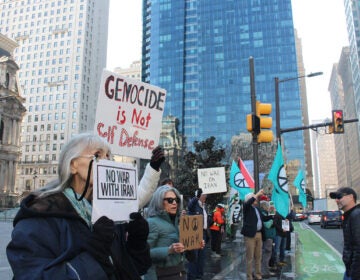
While dozens protested at City Hall, members of the group Philly Iranians said they are “concerned” for family members in Iran and “hopeful” that the regime will fall.
5 months ago
Listen 1:14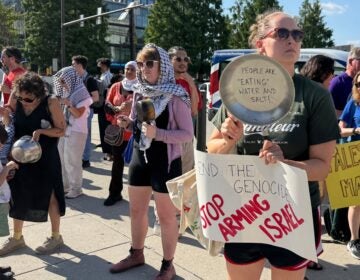
After being denied entrance to the busy station, activists of all ages gathered outside — banging pots and pans — to call attention to the “forced starvation” of Gaza.
1 year ago