

‘Fingerprint of climate change’: April heat wave could break a record in Philadelphia
Climate change makes balmy April temperatures twice as likely, according to a research nonprofit.
Listen 0:48
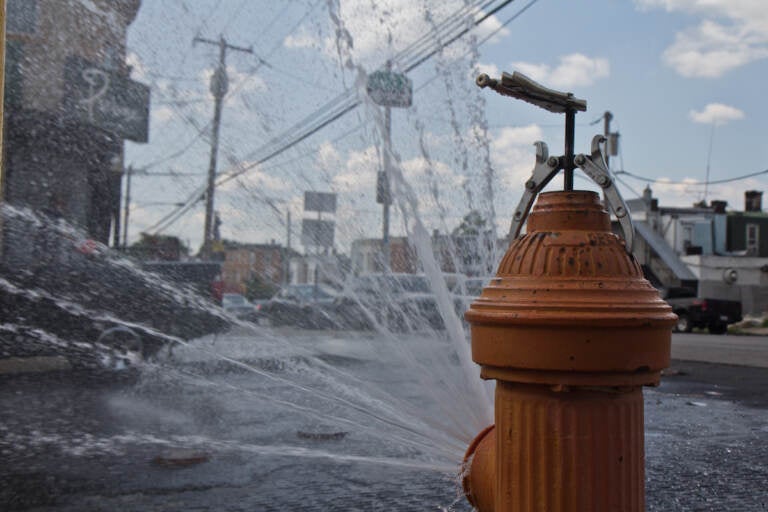
Residents of Reese Street in the Hunting Park Section of Philadelphia opened a fire hydrant during an intense heat wave on July 20, 2022. (Kimberly Paynter/WHYY)
This story is part of the WHYY News Climate Desk, bringing you news and solutions for our changing region.
From the Poconos to the Jersey Shore to the mouth of the Delaware Bay, what do you want to know about climate change? What would you like us to cover? Get in touch.
It feels like summer in Philadelphia this week, even before the leaves have fully sprouted on trees.
Forecasted high temperatures of around 90 degrees Fahrenheit in Philadelphia could break a daily record on Wednesday set in 1941 and tie a record on Thursday set in 2002.
The balmy temperatures will be roughly 20 degrees above normal in Philadelphia for this time of year.
Unseasonably hot temperatures are sweeping through the Mid-Atlantic and southeastern U.S. this week, caused by a ridge of high pressure over the western Atlantic Ocean that’s bringing warm air up from the South, said Paul Fitzsimmons, lead meteorologist at the National Weather Service office in Mount Holly, New Jersey.
Climate analysts say these hot temperatures fit into a trend of warming spring weather.
“This heat snap we are going to have does have a fingerprint of climate change,” said Jen Brady, senior data analyst with the research nonprofit Climate Central.
Climate change makes this week’s high temperatures in Philadelphia twice as likely, according to the organization’s Climate Shift Index, which uses models to compare today’s world to a world without human-caused carbon pollution. In some parts of southern Delaware and South Jersey, this week’s high temperatures are three to five times more likely to occur due to climate change, the index found.
Related Content
What you can do about your rising electric bills in Pennsylvania
The National Consumer Law center said that about a quarter of all U.S. households sacrificed food and medicine to pay for their energy bills in 2024.
3 months ago
Listen 6:08Since 1970, Philadelphia’s average spring temperatures have risen roughly 3 degrees, according to Climate Central. Over that time period, the city’s growing season, defined as the days between the last frost in the spring and first frost in the fall, has lengthened by about a month. Trees are blooming earlier, bringing the potential of earlier spring allergies.
March was the warmest on record for the U.S. In Philadelphia, the first leaf out of early-blooming plants occurred a couple days earlier than usual, according to the USA National Phenology Network, which predicts the start of spring using historical observations, temperature and weather events.
Forecasters from the National Weather Service predict much of the U.S. is likely to see a warmer-than-normal May through July, with a strong likelihood of El Niño developing later this year. El Niño could intensify extreme weather events and drive global temperatures next year to new record highs.
Philadelphia’s warm weather is expected to cool off Sunday or Monday, Fitzsimmons said.
“It’s going to be well above normal through the weekend before our temperature starts to get a little bit cooler next week,” he said.

Get daily updates from WHYY News!
WHYY is your source for fact-based, in-depth journalism and information. As a nonprofit organization, we rely on financial support from readers like you. Please give today.
Part of the series

What Philly’s Fourth of July heat wave reveals about climate change
Scientists say rising temperatures and intense storms will become more likely because of human-caused climate change.
2 days ago

New Jersey heat wave: 29 people died amid dangerous temps, officials say
Many of the victims lived in homes without air conditioning, according to state officials.
6 days ago

Philly-area heat wave could push electricity demand to record levels
The dangerous heat is accelerating air conditioner use. Data centers could be directed to use their own backup power.
1 week ago