

Philly lawmakers are pushing to reduce wait times for renters fighting unfair landlords, retaliatory evictions
The bill is part of a broader effort to increase the capacity of the Fair Housing Commission, which is responsible for policing a variety of renter protections.
Listen 1:05
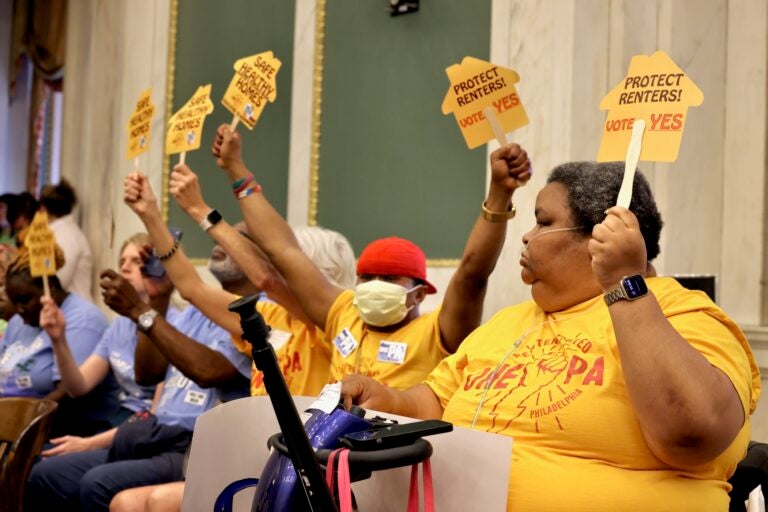
Members of OnePA Renters United Philadelphia express their support for legislation that would make tenants eligible to receive a one-time payment if they must move because of a negligent property owner or landlord, June 12, 2025. (Emma Lee/WHYY)
Have a question about Philly’s neighborhoods or the systems that shape them? PlanPhilly reporters want to hear from you! Ask us a question or send us a story idea you think we should cover.
Philadelphia lawmakers have advanced legislation aimed at reducing the time it takes to resolve landlord-tenant disputes heard by the city’s Fair Housing Commission.
The bill would raise the stipend paid to commissioners for each hearing from $85 to $100, and increase the annual cap on those payments from $8,500 to $14,000. Backers say the bill is needed because the commission’s workload is expected to increase again in the new fiscal year, starting July 1.
That’s when new renter protections approved by City Council are expected to generate additional cases. The agency is projected to handle more than 700 cases in fiscal year 2027. During the current fiscal year, that total has surpassed 600. Before that, it eclipsed 500 cases.
“It’s just simple math. More hearings and meetings mean lower wait times for cases to be heard, more cases being closed and more Philadelphian’s rights protected,” said Councilmember Rue Landau, who introduced the legislation during Wednesday’s committee hearing.
Currently, the commission meets twice a week to hear cases stemming from a wide range of unfair rental practices.
Commissioners frequently hear cases centered on security deposits, rent increases and lease agreements. They also consider a variety of complaints involving tenants facing an eviction after complaining about housing conditions or asserting their rights.
The commission’s rulings are legally binding, and often save tenants from having to fight an eviction in court, an experience that can make it tougher for them to secure safe and affordable housing going forward. Even if they win, simply having an eviction filing on their record can be viewed as a red flag by a prospective landlord.
Recently, cases are taking longer to close, putting some tenants in limbo as they await the outcome. Increasingly, delays occur when too few commissioners are present to hear cases in real time. In those instances, commissioners review video of the hearing and related evidence later. This can add weeks to the process, which typically takes two to three months to complete.
Related Content

Advocates say additional staffing would enable employees to prepare more cases for administrative hearings, positioning the agency to make more rulings.
2 months ago
Listen 1:25During Wednesday’s committee hearing, Renee Chenault-Fattah, executive director of the commission, applauded Landau’s bill, saying she was “overjoyed” to support it.
“I would have waited all day for this stipend,” said Chenault-Fattah more than two hours into the hearing.
The measure must now be approved by the full Council, where it is expected to pass.
Wednesday’s vote comes as lawmakers push to double the commission’s staff. The budget request is aimed at clearing a backlog of cases and keeping pace with new ones as new renter protections are added to the commission’s purview.
The commission currently has four dedicated employees. To that, lawmakers want to add three investigators and a deputy director, a new position proposed in Mayor Cherelle Parker’s spending plan.
Starting in November, all renters in the city will have “good cause” protections, regardless of the term of their lease. Currently, the law only applies to renters who have leases that are month-to-month or run for less than a year. For these tenants, landlords must provide written notice stating why they want to terminate or not renew their lease.
Housing advocates say the rare exception has allowed some landlords to retaliate against tenants with longer leases by refusing to renew them without explanation or advance notice.
Separately, lawmakers approved legislation allowing some renters to pay large security deposits in installments —- if the deposit is more than one month’s rent. In that case, renters can elect to pay the balance over three months.
Another measure passed by Council restricts when landlords can charge an application fee and how much they can charge a prospective tenant.
Council must pass the next budget by June 30.

Subscribe to PlanPhilly
WHYY is your source for fact-based, in-depth journalism and information. As a nonprofit organization, we rely on financial support from readers like you. Please give today.
Brought to you by PlanPhilly

PlanPhilly
In-depth, original reporting on housing, transportation, and development.

Thousands of West Philly tenants remain in limbo as city considers saving 925 affordable rentals
The city missed its exclusive window to bid on the homes, opening the door to outside buyers and possible displacement.
7 hours ago
Advocates say additional staffing would enable employees to prepare more cases for administrative hearings, positioning the agency to make more rulings.
2 months ago
Listen 1:25
Bills to protect Philadelphia renters are poised for passage following landlord lawsuit
The bills are part of the Safe Healthy Homes Act, a legislative package that has drawn considerable opposition from independent landlords.
3 months ago
Listen 1:00