
PGW’s proposed liquefied natural gas plant in Philadelphia’s Port Richmond neighborhood now in limbo
PGW says it needs to replace an aging liquefier in Port Richmond. Philadelphia Gas Commission staff had recommended not to approve the project.

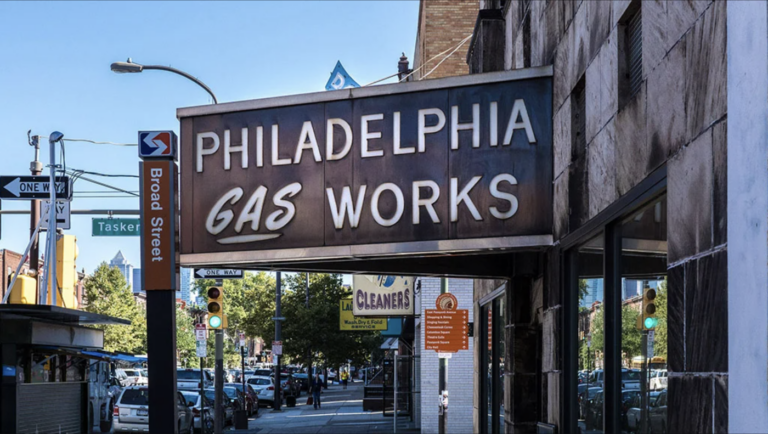
A Philadelphia Gas Works sign is pictured on South Broad Street. (Danya Henninger/Billy Penn)
This story is part of the WHYY News Climate Desk, bringing you news and solutions for our changing region.
From the Poconos to the Jersey Shore to the mouth of the Delaware Bay, what do you want to know about climate change? What would you like us to cover? Get in touch.
In a surprise move Tuesday morning, the Philadelphia Gas Commission tabled a vote on Philadelphia Gas Works’ proposal to replace its natural gas liquefier in Port Richmond, which would increase its capacity to liquefy and store natural gas.
The commission’s staff had reviewed the proposal as part of the utility’s 2027 capital budget and recommended the five commissioners reject the $182 million project. The Public Advocate agreed.
“PGW’s proposal, which is capable of producing 1.1 [billion cubic feet] more [liquefied natural gas] annually than its existing plant is oversized and could overburden PGW customers with unnecessary debt service expense,” Rob Ballenger, a Community Legal Services attorney who serves as the Public Advocate in budget proceedings, told the commissioners.
Ballenger said the utility does not need more capacity to liquefy natural gas to serve its customers. He said he agreed with the commission staff that PGW’s plant and project designs are incomplete.
PGW has two LNG facilities: the Richmond Plant in Port Richmond has one liquefier and the Passyunk Plant in South Philadelphia stores LNG. The utility uses the facilities to liquefy and store gas that it purchases during the offseason when it is cheaper for use during cold winters when demand is high.
Currently, the Richmond Plant has a capacity to produce 2.2 billion cubic feet and the newly proposed plant would be capable of producing 3.2 billion cubic feet. PGW is also negotiating a public-private partnership to fund the new plant, which, if successful, would negate the need for the $182 million in capital funds.
Andre Desant, an attorney for PGW, urged the commissioners to approve the utility’s entire proposed capital budget request of about $390.6 million and reject the staff’s recommendation not to approve the $182 million for the liquefied natural gas, or LNG, plant. Desant told commissioners that approval for the plant was urgent, as the utility needed to have the liquefier operating by 2030 for safety and affordability.
“Without it, we not only risk exposing customers during the coldest winters to a possible harm, but we also have a situation where we use the LNG liquefier to avert problems with system failure,” Desant said.
He said the project proposal is the right size to avoid trucking needed LNG through the neighborhood.
“It doesn’t produce excess capacity,” Desant said. “It produces enough capacity. If you truck in the LNG, you’re basically dealing with the issue on an ad hoc basis, and we’re suggesting that you deal with it … as a plan.”
PGW and the Public Advocate disagreed over how much money, if any, the LNG plants saved customers.
Related Content
Philadelphia utility bills surged in 2025, and more increases are coming in 2026. Here’s why
Philadelphians’ electric, gas and water bills all increased in 2025. Together, the typical household is paying around $30 more per month.
9 months ago
In an email, PGW told WHYY News that its LNG operations saved customers $4 billion over 50 years. Desant told commissioners the plants saved ratepayers $90 million over the two weeks of harsh winter weather with subzero temperatures in late January and early February.
“PGW did not save $90 million this winter due to its LNG facility,” Ballenger responded. “Whatever the cost was to purchase that gas is not factored in, PGW had already liquefied the gas. The operational expense of liquefying the gas is not factored in.”
The debate over the $90 million raised more questions from Commissioner Dominic McGraw, who is a deputy director at the city’s Office of Sustainability.
“I’d just be curious to know the official breakdown of what went into the $90 million figure.” McGraw said. “Are we looking at the liquefaction, as mentioned, storage, vaporization, all of that that goes into that, and specifically around this January event?”
McGraw also asked for an accounting of the air emissions if PGW had to truck in LNG.
After the presiding four commissioners voted to table the decision, citing the need for more information, Desant urged them to at least approve the rest of the budget, which they declined to do.
Related Content

PGW spends millions to promote natural gas. Advocates accuse the utility of ‘greenwashing’
Utility records show Philadelphia Gas Works spent $4.2 million on promotions over a 14-month period ending in November 2024.
1 year ago
Listen 6:38How the LNG plant proposal aligns with the city’s climate goals
During the public comment period, about half a dozen people opposed the project. Several residents took issue with how expanding the city’s capacity to liquefy and store natural gas aligns with the goal of becoming carbon neutral by 2050.
“Since our city has resolved to be carbon neutral by 2050, only 24 years from now, this will become a stranded asset,” said Center City resident Emily Davis. “As the city moves toward carbon neutrality, PGW must have a plan for its employees who will still need jobs, just as Philadelphians will still need heating and cooling.”
Port Richmond resident Sara Baier objected to the lack of public engagement over the project in her neighborhood.
“I will remind you that Port Richmond is a proud working-class neighborhood that’s long carried more than its fair share of industrial burden, and investing further in LNG infrastructure here raises serious concerns about our safety, air quality, emergency preparedness and environmental justice,” Baier said.
Dr. Paul Devine Bottone, a pediatrician, told commissioners to reject the LNG plant due to health concerns, specifically high rates of childhood asthma that he said were in the 20% to 25% range.
“We’re talking about more than three times, almost four times the national average for asthma,” Bottone said. “We also know that all the compounds that are associated with the production of natural gas, with the burning of natural gas that affect us in our communities and in our homes increase levels of pediatric asthma.”
The mayor’s office did not respond to a request for comment regarding how PGW’s plans conflict with the city’s climate goals.
It’s unclear when the commission will take up the issue.

Get daily updates from WHYY News!
WHYY is your source for fact-based, in-depth journalism and information. As a nonprofit organization, we rely on financial support from readers like you. Please give today.
Part of the series
PGW agreed to hold public meetings on reducing its carbon footprint. At the first meeting, there were lots of questions from the public but no answers from the utility.
4 months ago
Listen 1:23
Philadelphia Gas Commission rejects PGW’s expanded Port Richmond LNG plant until further study
The Philadelphia Gas Commission tabled the $182 million proposal but agreed to fund $5 million for engineering and environmental studies.
5 months ago
Listen 1:25
Philly climate activists celebrate a rare win in their battle to reform PGW
The settlement with PGW lowers the utility’s planned rate hikes, and forces the natural gas provider to hold public hearings over climate impacts.
1 year ago
Listen 1:19