

2 unvaccinated Pennsylvanians die after contracting measles as outbreak reaches nearly 400 cases
The measles-associated deaths occurred among two residents of Lancaster County.
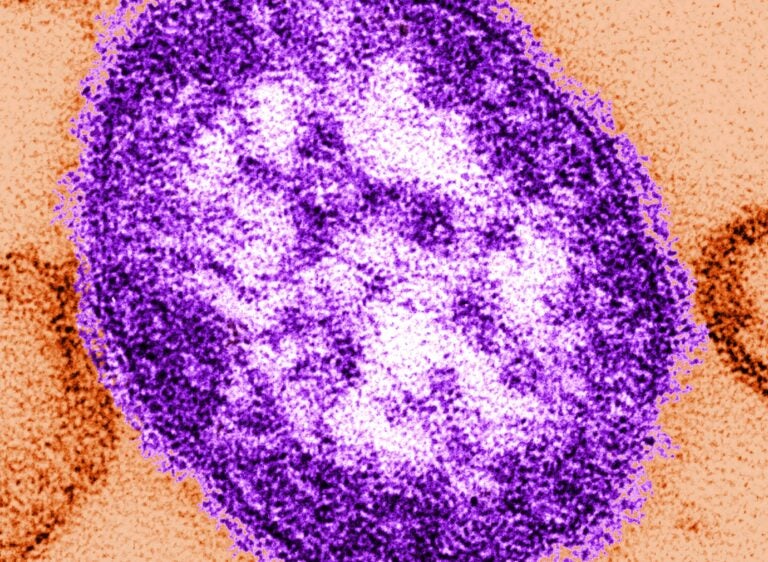
This undated image made available by the Centers for Disease Control and Prevention on Feb. 4, 2015 shows an electron microscope image of a measles virus particle, center. (Cynthia Goldsmith/Centers for Disease Control and Prevention via AP)
From Philly and the Pa. suburbs to South Jersey and Delaware, what would you like WHYY News to cover? Let us know!
Two people in Lancaster County have died from measles-associated complications, Pennsylvania health leaders announced Tuesday.
They are the first fatal cases linked to the highly infectious viral disease seen in the commonwealth in 35 years, officials said.
Both people were unvaccinated, according to health experts. State Department of Health officials said they will not release information about their ages or identities to “protect the privacy of the individuals and their families.”
The deaths come at a time when Lancaster County remains a hot spot for an ongoing measles outbreak. Since April, the county has recorded 177 measles infections.
There have been 393 total cases across 29 counties so far this year, according to state data.
“My deepest sympathies are with the loved ones who are facing this unimaginable loss,” Dr. Debra Bogen, Secretary of Health, said in a statement. “Because measles was largely eliminated in the Commonwealth for more than three decades, people are not familiar with this disease and don’t fully understand the potential severity of the illness. We want to ensure every Pennsylvanian has the information they need to protect themselves, their loved ones and their communities.”
State leaders say vaccine misinformation and distrust in scientific evidence on the safety and efficacy of vaccines is driving waning immunization rates, leaving communities vulnerable to disease outbreaks.
“Folks are spreading skepticism about things like the MMR vaccine without any evidence to back up their claims,” Gov. Josh Shapiro said Tuesday in Lancaster. “That scares a parent who’s just trying to do the right thing by their kids. And it plays a role in why so many people right now are getting measles for the first time in decades. When the information we see coming from the federal government in some cases isn’t driven by facts and by science, it makes it even more confusing for parents, and that has a serious impact.”
Related Content
As Pa. measles cases persist, back-to-school vaccine efforts ramp up
As measles infections statewide reach nearly 300 cases, public health leaders are looking toward preventing disease in schools this fall.
7 days ago
Listen 1:56Measles symptoms, complications and vaccine protection
Measles is one of the most infectious viral diseases. It spreads when someone who is infected coughs, sneezes or breathes. The virus can linger in the air for up to two hours, creating an exposure risk for people passing through.
Early signs of infection can include cough, runny nose, red, watery eyes and a fever. A skin rash, the hallmark of measles, appears on the head and other parts of the body about three to five days after first signs of illness, according to the American Academy of Pediatrics.
Children and adults with measles may also have diarrhea or ear infections. While most people survive the disease, infection can lead to complications like pneumonia, encephalitis or brain swelling, deafness and intellectual disability and, in rare cases, death.
The combination measles, mumps and rubella vaccine, or MMR, “is safe and provides the best protection we have against measles,” Bogen said.
Two doses of the vaccine are about 97% effective against the virus. The American Academy of Pediatrics and the American Academy of Family Physicians recommend babies get their first dose after 12 months old and their second between 4 and 6 years old.
Families may be able to get their children vaccinated earlier if they plan to travel to areas with known measles outbreaks or internationally.
Adults can also get a measles shot if they’ve never been immunized or are unsure of their vaccination status.
Related Content
Delaware declares measles outbreak as cases quickly climb to 4
Delaware had not recorded a single case of measles in more than a decade until this week, as outbreaks and infections nationwide grow.
1 month ago
Listen 0:55Declining immunization rates and Pennsylvania efforts to boost MMR shots
More adults and children in Pennsylvania, and across the country, are vulnerable to measles infections due to declining vaccination rates. As a result, the number of infections and outbreaks has climbed.
Local public health leaders are focusing on increasing immunization rates in communities and in schools where rates have dropped below the 95% required for strong herd immunity, or when vulnerable people are still protected because they are surrounded by others who are vaccinated.
State and county health teams have partnered to host temporary pop-up vaccination clinics in Lancaster and at other sites across the commonwealth to offer measles, mumps and rubella shots.
Pennsylvania health providers typically administer about 25,000 doses of the MMR vaccine per month, but they’ve given out about 35,000 shots in the last month, Bogen said.
“We have seen that when measles reaches a community, the interest in getting vaccinated increases. But we know families often have questions before they seek a vaccine,” she said. “We want to have meaningful conversations so that everyone can understand and be confident in the protection available through the vaccines.”
People can think of vaccination and contributing toward herd or community immunity as showing compassion for others, said Dr. Jeffrey Martin, chair of the Department of Family and Community Medicine at Penn Medicine Lancaster General Health.
He’s been practicing medicine in Lancaster for more than three decades.
“The strength of a community is measured not by how well it protects the strongest among us, but by how well it protects those who are most vulnerable,” Martin said. “If we continue to look out for one another, support one another, and take steps to protect one another, we will get through this outbreak together.”
State health experts are also working with schools and school nurses across Pennsylvania to make sure they are prepared for possible measles infections or outbreaks in the months ahead.
Related Content
There are already more U.S. measles cases this year than in all of 2025
The U.S. has surpassed 2025’s record for measles cases, with five months left in 2026.
1 month ago
Federal response to growing measles cases nationwide
Measles infections in Pennsylvania are part of 2,777 confirmed cases nationwide, according to data from the Centers for Disease Control and Prevention.
Annual cases have already eclipsed the total number seen last year, which included the deaths of two unvaccinated school-aged children in Texas and an unvaccinated adult in New Mexico.
Support for the MMR vaccine has been inconsistent among Trump administration appointees and agency leaders, with some repeating disproven theories about the shots’ links to autism and other safety concerns.
President Donald Trump signed an executive order earlier this month ordering that the combination MMR shot be broken up into separate injections after arguing that the move would make the vaccinations safer, despite no scientific evidence supporting that claim.
Major medical organizations and pediatricians across the country have stated that the change would most likely lead to vaccination delays and more gaps in immunization coverage.
Shapiro spoke in Lancaster Tuesday after taking a call from U.S. Department of Health and Human Services Secretary Robert F. Kennedy, Jr., who is a known vaccine skeptic.
The Pennsylvania governor said Kenney offered additional federal support in the state’s response to its measles outbreak.
While he appreciated the offer of assistance, Shapiro said he was “blunt” in telling Kennedy that recent actions and rhetoric from him and the Trump administration has had “a negative impact on communities across America, particularly right here in Pennsylvania.”
“There’s real-life consequences to spreading misinformation. There’s real-life consequences to scaring people and not relying on actual doctors and actual medical professionals to provide unbiased information to parents so that we can make reasonable decisions for our kids,” Shapiro said. “Sharing conspiracy theories and misinformation does not help the cause of public health. And it leaves people less healthy and less safe, and it leaves parents in a position where it’s harder for us to do our jobs to protect our children.”
In a statement made to WHYY and on social media, officials at HHS and CDC said they extend condolences to the families and communities affected by the two measles-associated deaths in Lancaster County.
“CDC is working closely with state and local health departments to strengthen response efforts, rapidly support affected communities across the state, and communicate the steps people can take to slow the spread of measles. The MMR vaccine provides the most effective protection against measles and helps prevent its spread. CDC will continue to follow Pennsylvania’s lead and provide resources to support the state’s response,” federal agencies wrote.
Editor’s note: This story has been updated.

Get daily updates from WHYY News!
WHYY is your source for fact-based, in-depth journalism and information. As a nonprofit organization, we rely on financial support from readers like you. Please give today.
As Pa. measles cases persist, back-to-school vaccine efforts ramp up
As measles infections statewide reach nearly 300 cases, public health leaders are looking toward preventing disease in schools this fall.
7 days ago
Listen 1:56
There are already more U.S. measles cases this year than in all of 2025
The U.S. has surpassed 2025’s record for measles cases, with five months left in 2026.
1 month ago
Delaware declares measles outbreak as cases quickly climb to 4
Delaware had not recorded a single case of measles in more than a decade until this week, as outbreaks and infections nationwide grow.
1 month ago
Listen 0:55