

Pennsylvania joins states asking Supreme Court to block Trump administration’s mail ballot rules
Pennsylvania and Philadelphia election officials warn that imposing new federal mail-ballot rules before the midterms could sow confusion and disenfranchise eligible voters.
Listen 1:22
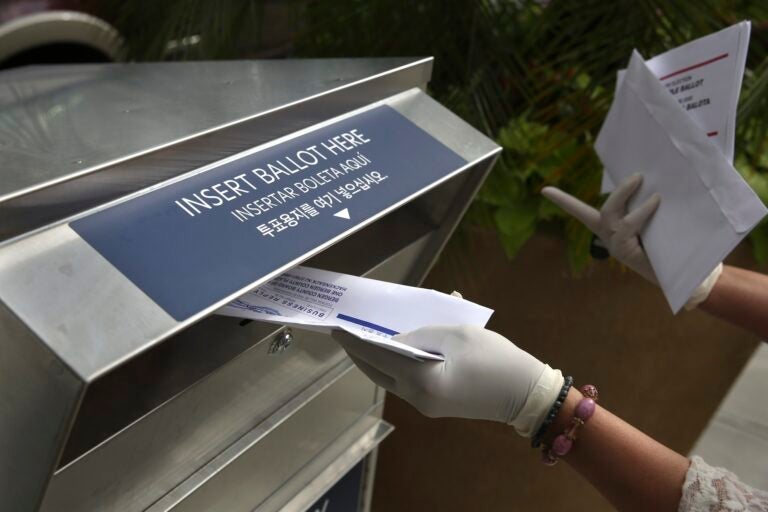
FILE - A woman wearing gloves drops off a mail-in ballot at a drop box in Hackensack, N.J., on July 7, 2020. (AP Photo/Seth Wenig, File)
What questions do you have about the 2026 elections? What major issues do you want candidates to address? Let us know.
Pennsylvania is asking the U.S. Supreme Court to prevent the Trump administration from imposing new federal requirements on mail voting just three months before the November midterm election.
Gov. Josh Shapiro joined a coalition of states Monday in opposing the administration’s emergency request to revive portions of an executive order requiring the U.S. Postal Service and Department of Homeland Security to take a larger role in verifying voter eligibility and handling mail ballots.
The states called it an “unprecedented, legally indefensible voter-verification and ballot-interception program” that would force states to “redesign their ballot mail” just weeks before the midterm election.
“Preparation for the general election is well underway, including having already purchased envelopes,” said Seth Bluestein, a Republican Philadelphia City Commissioner, who said he was speaking for himself and not the commission. “That includes having already purchased thousands of envelopes for mail ballot voters. So the executive order would definitely add uncertainty to the electoral process, and a lot of that confusion could inevitably cause errors that would result in disenfranchising eligible voters.”
The issue stems from an executive order signed by President Donald Trump to create a federal system for verifying voter citizenship and regulating the delivery of mail ballots in federal elections. The order directs federal agencies to create state-by-state lists of people confirmed to be U.S. citizens and calls for new Postal Service rules governing mail ballots in federal elections. Under the order, states would provide USPS with lists of eligible mail voters, and the agency could refuse to transmit ballots associated with people who do not appear on those lists.
It also called for federally approved ballot envelopes with unique tracking barcodes, prioritizes investigations of officials and others who distribute ballots to people deemed ineligible, and allows federal funding to be withheld from noncompliant states.
Related Content
Court panel declines to block Trump’s mail ballot order, but its status for midterms remains unclear
Trump has repeatedly tried to unilaterally change voting procedures since he took office for the second time, only to be blocked by the courts.
7 days ago
A coalition of states sued and a federal district court blocked the Trump administration from enforcing the contested provisions before the Nov. 3 midterm election. A federal appeals court declined to pause that injunction, prompting the administration to seek an emergency review by the Supreme Court.
The Trump administration is arguing that the lawsuit was filed prematurely because the federal agencies have not completed the rules and systems needed to carry out the order and asked the Supreme Court to pause a lower-court injunction while the litigation continues.
The states responded that Trump lacks the constitutional or statutory authority to give the executive branch such power to begin with. The Constitution generally assigns responsibility for conducting elections to states, subject to rules established by Congress.
“There would also be a temptation on the part of the federal government to abuse this new authority for partisan ends,” the complaint reads. “Even the appearance of such abuse could have a devastating impact on voters’ confidence in the integrity of elections.”
Related Content
Trump’s attacks on mail balloting and concerns over delays turn midterms spotlight on Postal Service
Despite the constant attacks from Trump, mail voting remains popular with voters of both major parties.
7 days ago
The states said those comparisons would be technically difficult and could implicate state privacy laws governing sensitive information such as driver’s license and Social Security numbers. They also argued that errors could disproportionately affect naturalized citizens whose information may not appear accurately in federal databases.
“Philadelphia, like the other counties in the commonwealth, already verifies that a ballot is only counted if the voter’s identity has been confirmed on their application,” Bluestein said. “So we already know that only eligible voters are voting by mail.”
Courts have frequently cautioned against changing election rules close to voting because last-minute changes can confuse voters and administrators. The Supreme Court has not set a deadline for ruling. Because the administration is seeking emergency relief, the justices could issue an order at any time.
Spokespeople for the Pennsylvania Department of State and the White House did not immediately respond to requests for comment.

Get daily updates from WHYY News!
WHYY is your source for fact-based, in-depth journalism and information. As a nonprofit organization, we rely on financial support from readers like you. Please give today.
Part of the series
Part of the series

Trump administration seeks to halt SNAP food aid payments after a court order
The court wrangling prolonged weeks of uncertainty for the food program that serves about 1 in 8 Americans, mostly with lower incomes.
9 months ago

SNAP partial benefits will be delayed by Trump admin’s red-tape process, Pa. officials say
Pennsylvania officials are asking the federal government to allow them to use a swifter method to calculate each household’s partial payment.
9 months ago
Pennsylvania and 10 other states, including New Jersey and Delaware, are suing FEMA and the DHS.
9 months ago
Listen 1:02