
Pa. Medicaid now covers abortion, but for how long? AG, pro-life groups wage an appeals fight
Medicaid coverage for abortion services begins as Pennsylvania’s attorney general seeks to reinstate the state's ban on using public funds for abortion.
Listen 1:03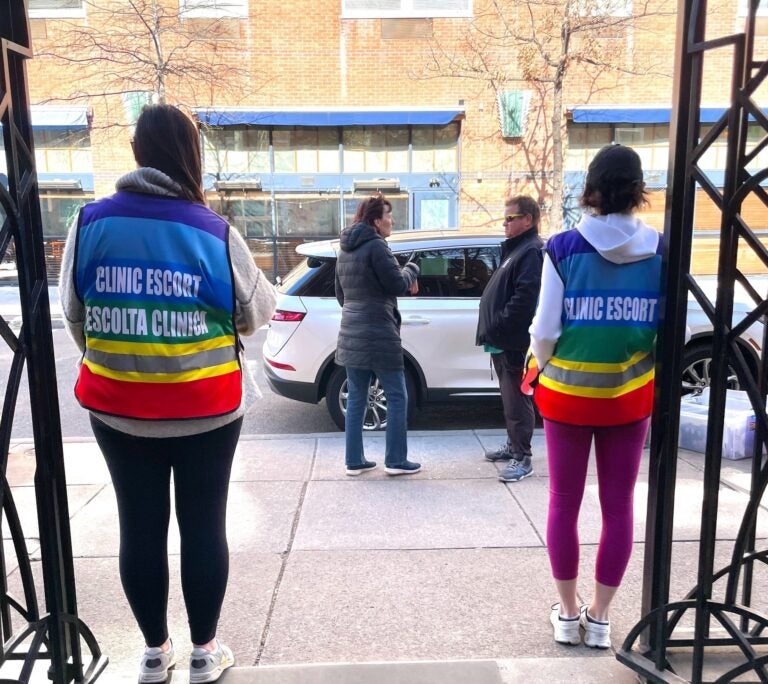
Planned Parenthood volunteer clinic escorts stationed at the entrance gate at The Elizabeth Blackwell Health Center on Locust Street in Philadelphia are usually dressed in colorful or neon pink vests. Their jobs are to help usher patients in and out of the clinic safely, especially when anti-abortion protesters or picketers are present. (Planned Parenthood of Southeastern Pennsylvania)
From Philly and the Pa. suburbs to South Jersey and Delaware, what would you like WHYY News to cover? Let us know!
Pennsylvania Medicaid, also known as Medical Assistance, is now covering medication and procedural abortions.
The taxpayer-funded health insurance program for people with low incomes is paying for the procedures as of July 16. The change follows an appellate court decision earlier this year that overturned the commonwealth’s long-standing ban on using state Medicaid funds for abortion, except in cases of rape, incest and endangerment to the mother’s life.
Advocates are celebrating this new chapter.
“At last, a terrible injustice that has harmed Pennsylvanians for decades has ended,” Susan J. Frietsche, executive director of Women’s Law Project, said in a statement. “Pennsylvania can no longer target women and birthing people on Medicaid to deprive them of their fundamental right to reproductive autonomy.”
However, the coverage may be tenuous. Organizations that oppose abortion have pledged to fight the decision and back Pennsylvania Attorney General Dave Sunday’s appeal to the state Supreme Court.
“We believe quite strongly that taxpayer funds should not be used to pay for abortion, which is the taking of an innocent unrepeatable human life,” said Maria Gallagher, executive director of the Pennsylvania Pro-Life Federation. “And we are hopeful that the Pennsylvania Supreme Court will reverse course on this and will ensure that our hard-earned tax dollars do not pay for abortion.”
Related Content
Pennsylvania Commonwealth Court strikes down ban on Medicaid for abortion
A majority of the Commonwealth Court of Pennsylvania found that the law violates the state’s Equal Rights Amendment.
5 months ago
Listen 0:47How did the state’s Medicaid abortion ban get overturned?
Several reproductive health practices and abortion care providers in Pittsburgh and across Pennsylvania sued the state Department of Human Services over a 1982 law that prohibited state Medicaid payments for abortion services.
They argued that the policy was unconstitutional because it unfairly targeted reproductive services for women while all reproductive services for men continued to be covered, thus violating the state’s equal rights amendment and protection clauses.
The Commonwealth Court of Pennsylvania ultimately sided with the plaintiffs in an April 20 decision and ruled the state law unconstitutional.
Christine Castro, senior staff attorney at Women’s Law Project, called the court ruling “a victory for racial justice and public health.”
“Low-income people and Black women in particular have suffered for decades under an unconstitutional law that seeks to coerce them into carrying pregnancies against their will,” Castro said in a statement.
The decision was also lauded by Democrat Gov. Josh Shapiro, who has campaigned on efforts to preserve and expand access to abortion in Pennsylvania.
Related Content
Anti-abortion activists face significant hurdles in their efforts to limit reproductive health rights. But accomplishing that is far from impossible.
11 months ago
Listen 1:15What could an appeal mean for the new Medicaid abortion coverage?
Sunday, a Republican, filed an appeal in May contesting the Commonwealth Court’s decision. The state Supreme Court has agreed to take up the case.
In the meantime, state Medicaid coverage for abortion will be allowed to continue while the appeal proceeds, a judge decided this past week.
Sunday has said that his appeal falls in line with his responsibilities as attorney general to defend local laws according to Pennsylvania statute, which states that “it shall be the duty of the Attorney General to uphold and defend the constitutionality of all statutes so as to prevent their suspension or abrogation in the absence of a controlling decision by a court of competent jurisdiction.”
Leaders at organizations like the Pennsylvania Pro-Life Federation called Sunday’s move a “bold step” and said the case represents an “urgent matter.”
“We know from research that when taxpayer funding of abortion occurs, abortion rates skyrocket,” Gallagher said.
At least one study published in 2024 that looked at abortions among Medicaid participants in six states, before the overturning of Roe v. Wade, found that lifetime abortion incidence was higher in states where services were covered by the publicly funded health insurance program.
Now with expanded Medicaid insurance coverage in Pennsylvania, Gallagher said she worries that the number of procedures will increase here as well while the appeals case takes place.
“It’s a traumatic situation for women in Pennsylvania and a tragedy for pre-born babies in Pennsylvania,” she said. “It is very important that we go back to the way things were and return to a policy that’s common sense, that makes sense for women and for their families.”

Get daily updates from WHYY News!
WHYY is your source for fact-based, in-depth journalism and information. As a nonprofit organization, we rely on financial support from readers like you. Please give today.
In Philadelphia, city officials have plans to increase awareness and support services for residents who will be affected by the Medicaid changes.
2 weeks ago
Changes to Medicaid under H.R. 1 include new work requirements and restrictions on who is eligible for the safety net insurance program.
2 months ago
Listen 1:14
The federal proposal would block Medicaid reimbursements for preventative health services to nonprofit family planning clinics if they also perform abortions.
1 year ago
Listen 1:01