
Nicetown residents want answers after investigation finds PGW not responsible for deadly natural gas explosion
Public utility regulators say the natural gas explosion was not caused by PGW infrastructure.
Listen 1:13
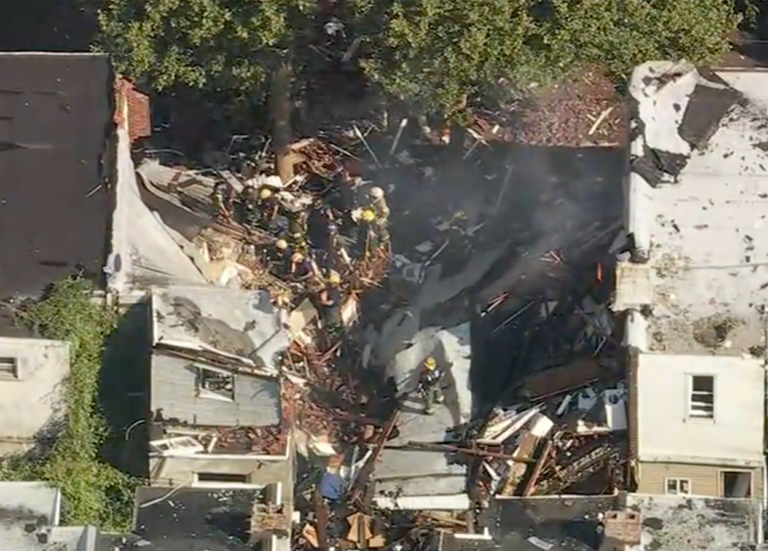
FILE - An explosion and fire in Nicetown last year destroyed three homes. One person died and two were injured. (6abc)
This story is part of the WHYY News Climate Desk, bringing you news and solutions for our changing region.
From the Poconos to the Jersey Shore to the mouth of the Delaware Bay, what do you want to know about climate change? What would you like us to cover? Get in touch.
Tawanda Davis and her 6-year-old granddaughter were in the bathroom of their Nicetown home when they heard a booming sound as loud as a bomb blast.
Davis hurried to her bedroom and found the bed covered in glass. The blast had shattered her window and hurled the air conditioning unit from the window frame onto her bed.
Davis grabbed her five grandchildren and ran outside. She heard people screaming among thick smoke and piles of debris.
“When I got outside, there was smoke and glass everywhere,” Davis said. “I can hear my neighbors across the street from me, screaming, ‘Help me, help me.’”
Around 5 a.m. on June 29, 2025, a natural gas explosion on West Bristol Street killed one resident and injured two others. Three rowhomes collapsed, and several more homes, including Davis’, were seriously damaged.
One year later, the state’s utility regulators have determined the explosion was not caused by utility Philadelphia Gas Works’ infrastructure.
The Public Utility Commission said that after a thorough investigation, no violations of state or federal pipeline safety regulations were found, and that there’s no evidence linking jurisdictional natural gas facilities to the cause of the explosion.
“While the PUC’s investigation has concluded, the Commission recognizes the lasting impact of this tragic event on the victims, their families, and the surrounding community,” the regulators said in a statement. “The Commission remains grateful for the cooperation of residents and appreciates the efforts of the many emergency responders and agencies that assisted throughout the response and investigation.”
The investigation was turned over to the state last year after the city’s Fire Marshal’s Office could not determine the exact cause of the incident. Though the agency last year said the explosion was likely caused by an indoor gas leak, the agency wasn’t able to determine the exact pipe or appliance that leaked.
PGW declined a request for comment.
Related Content
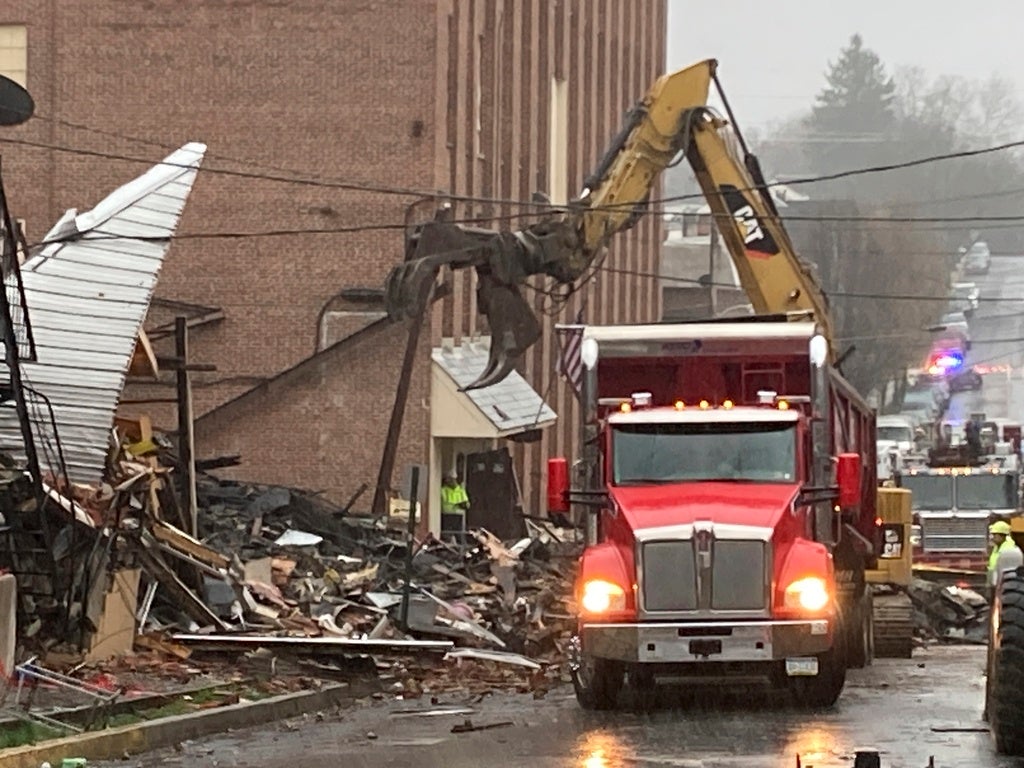
Pennsylvania regulators seek $2.6 million in penalties for deadly 2023 chocolate factory explosion
Regulators argue UGI’s gas distribution equipment serving R.M. Palmer Co. in West Reading violates state and federal rules.
4 months ago
One year later, no closure
Residents like Davis said that they’re frustrated by the investigation and that there’s still no closure a year after the incident.
“They determined it was a gas explosion, but you’re saying it’s not the gas company’s fault, then whose fault is it?” she said.
The PUC confirmed fire officials’ conclusions that the explosion was likely sparked on the customer side of the gas meter, though no official cause was cited.
Gas companies operate the service lines that meet ratepayers’ meters, while homeowners are responsible for maintaining the infrastructure on their side of the meter, such as interior gas piping and appliance connectors.
Gas leaks and explosions can be caused by mistakes during contract work, loose fittings or pipe corrosion in ratepayers’ homes, said Bill Caram, executive director of the Pipeline Safety Trust. He said the cause of a gas explosion can be difficult to investigate because of the extent of damage it can cause.
“I just want to say how frustrating it is for communities that experience these horrific explosions and for public safety advocates, like our organization, to have an investigation happen and then they determine it’s the other side of the meter, the customer side, then it’s, ‘Well, it’s not jurisdictional, not our problem,’” he said. “It’s really, really frustrating, and I can’t imagine how that is for the community to just experience this explosion.”
Philadelphia Councilmember Kendra Brooks, who represents and grew up in Nicetown, is calling for greater efforts to ensure all homes are regularly inspected and that rental properties are licensed and safe.
Some Nicetown residents, including Davis, later learned that their landlords didn’t have the appropriate licenses and safety certifications to rent their properties.
“This is not just one isolated incident. It’s part of a larger pattern of unsafe housing in our city, especially in Black and brown neighborhoods,” Brooks said in an email. “We have some of the oldest housing stock in the nation, and when one structure collapses, it can impact every home on the block. Decades of disinvestment have left our neighborhoods extremely vulnerable.”
Brooks is also calling for the expansion of the state’s Whole-Home Repairs Program, which provides grants for home repairs, and energy efficiency and accessibility upgrades. More than 18,000 people are on the waitlist for the program because of a greater demand than available funds.
President Donald Trump has refused to sign bipartisan federal legislation known as the 21st Century ROAD to Housing Act, which in part would offer home repair grants, until Congress passes the Safeguard American Voter Eligibility, or SAVE America, Act — a voter ID bill.
Caram said renters should report signs of gas leaks, such as rotten egg smells, to their landlords and leave their homes. The Pipeline Safety Trust is advocating for utility companies and landlords to provide in-home methane detectors to their customers.
PGW is now required to offer free methane detectors as part of a settlement over a 2019 home explosion in South Philadelphia that killed two people and caused $1.4 million in property damage.
Pennsylvania legislation known as the Fuel Gas Detector Act would mandate the installation of such detectors in residences, businesses, and other buildings that use natural gas or liquefied petroleum gas. The bill, which awaits a vote in the State Senate, was introduced in response to the 2023 explosion at the R.M. Palmer chocolate factory in West Reading.
A year after the Nicetown explosion, Davis and her family are still impacted by the trauma they experienced that day and the weeks that followed. Davis is still haunted by the screams, and her granddaughter is afraid to go to the bathroom alone.
Davis and her grandkids have found a new place to rent from a landlord who has the required documentation to rent properties. However, she hopes her next move will be in a home she owns.
“I just want a home for my grandbabies. That’s it. That’s all I want, is a home so we never have to go through this again,” Davis said. “I think about that day a lot. I cry a lot, it’s just sad. I was one of the lucky ones. We’re still here.”

Get daily updates from WHYY News!
WHYY is your source for fact-based, in-depth journalism and information. As a nonprofit organization, we rely on financial support from readers like you. Please give today.
Part of the series
3 injured after fire at Delaware County refinery; shelter-in-place order lifted
The Monroe Energy refinery in Trainer processes an average of 185,000 barrels per day, including jet fuel, gasoline and diesel.
2 weeks ago
City of Camden suspends EMR’s junkyard license after 2-alarm fire
The May fire was the latest of over a dozen at facilities run by EMR in Camden since 2020. The suspension will be reevaluated in early July.
1 month ago
Listen 1:00
PECO bills will rise by about $5 on average starting June 1
The increase comes as rising demand and infrastructure costs continue pushing electricity bills higher.
1 month ago
Listen 1:01