New Jersey lifts de-facto moratorium on new nuclear facilities in effort to tackle affordability crisis
The move lifts a 40-year de-facto moratorium tied to the federal government finding a permanent facility to store radioactive nuclear waste.
Listen 0:55
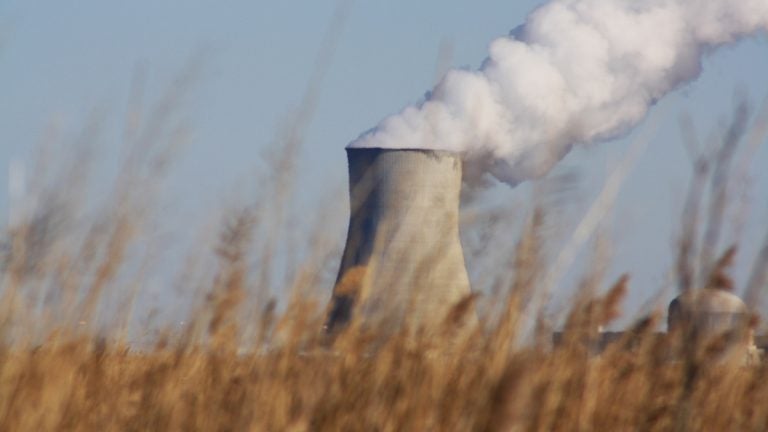
Salem Nuclear Power Plant as seen from the Blackbird Creek. (Brian Drouin/WHYY)
This story is part of the WHYY News Climate Desk, bringing you news and solutions for our changing region.
From the Poconos to the Jersey Shore to the mouth of the Delaware Bay, what do you want to know about climate change? What would you like us to cover? Get in touch.
New Jersey Gov. Mikie Sherrill signed legislation Wednesday lifting the state’s 40-year de-facto moratorium on new nuclear power plants, citing the shrinking gap between supply and demand that has led to skyrocketing electricity bills for consumers. The legislation passed in the General Assembly by a large majority on March 23, and amended the Coastal Area Facility and Review Act. The act had prohibited the state’s Department of Environmental Protection from issuing new permits for nuclear power plants unless the federal government established a permanent nuclear radioactive waste disposal site.
“For costs to come down, we need more energy supply,” Sherrill said in a statement. “New Jersey is well-positioned to be a leader in next-generation nuclear energy to help bring that supply, and we are open for business.”
Sherrill said more power plants are needed to bring electricity prices down. She called the former permit requirements “an outdated standard that cannot be met.”
In a release, the governor’s office said permits for new nuclear reactors will be “based on safe, [Nuclear Regulatory Commission] compliant waste storage” that has a “100 percent effective safety record in the U.S.”
“I … am excited that we are moving closer to building more nuclear generation in our State because it has proven to be a stable and reliable carbon neutral energy source that will help us bridge the gap between what we generate and use,” said Assemblyman Wayne DeAngelo, D-Hamilton, one of the bill’s sponsors, in a statement.
Related Content

TerraPower Isotopes will manufacture a rare, radioactive isotope for use in developing cancer treatments.
1 month ago
Listen 0:55Congress had designated a permanent nuclear waste storage site at Yucca Mountain in 1987. But the project, located about 100 miles from Las Vegas in the Mojave Desert, ran into intense political opposition. Currently, radioactive waste from commercial reactors is stored on-site at more than 70 nuclear facilities across the country. About a quarter of the sites no longer operate. The spent fuel rods are initially stored in giant pools of water to cool them down for five to 10 years. They are then transferred to concrete or steel dry-storage casks.
Sherrill signed the bill at the Salem Nuclear Power Plant in Lower Alloways Creek Township, accompanied by the bill’s sponsors, PSEG executives and union leaders.
Nuclear plants are expensive to build and have in the past saddled ratepayers with high bills. But industry proponents say new smaller, modular reactors could be more affordable. Research shows they could generate more waste than conventional reactors.
Exelon’s Oyster Creek nuclear power plant in Lacey Township shut down in 2018, leaving behind 1.7 million pounds of waste. New Jersey’s two remaining nuclear plants — Salem and Hope Creek, both in Lower Alloways Creek, provide 40% of the state’s electricity and 80% of its carbon-free energy, according to the state. The Salem plant opened in 1977, while the Hope Creek facility has been operating since 1986.
Related Content
N.J. Gov. Mikie Sherrill issues state of emergency on energy costs: Here’s what to know
Sherrill ordered state regulators to boost renewables and natural gas in light of rising electricity prices.
3 months ago
Listen 1:06The governor also announced the creation of a 14-member task force established as part of an executive order she signed in January. The group includes representatives from government, industry and labor who will focus on “financing, supply chains and technology development, workforce growth and training, regulatory and permitting framework, and public trust and confidence.”

Get daily updates from WHYY News!
WHYY is your source for fact-based, in-depth journalism and information. As a nonprofit organization, we rely on financial support from readers like you. Please give today.
Part of the series
PECO withdraws its rate hike case after backlash from Pa. governor, lawmakers
PECO made record profits in 2025 after a recent rate hike. Pa. Gov. Josh Shapiro had called the new proposal “pure greed.”
5 days ago
Listen 1:25
Wilmington residents encouraged to sign up for community solar initiative
Proponents of community solar energy say the initiative is a solution to rising costs of electricity.
6 days ago
Listen 1:26
PGW’s proposed liquefied natural gas plant in Philadelphia’s Port Richmond neighborhood now in limbo
PGW says it needs to replace an aging liquefier in Port Richmond. Philadelphia Gas Commission staff had recommended not to approve the project.
7 days ago