

Temple study finds adults who got gender-affirming surgeries happy with results, not the process
As governments try to limit gender-affirming surgeries for adults, researchers looked at how the process can be better for those who can get them.
Listen 1:41
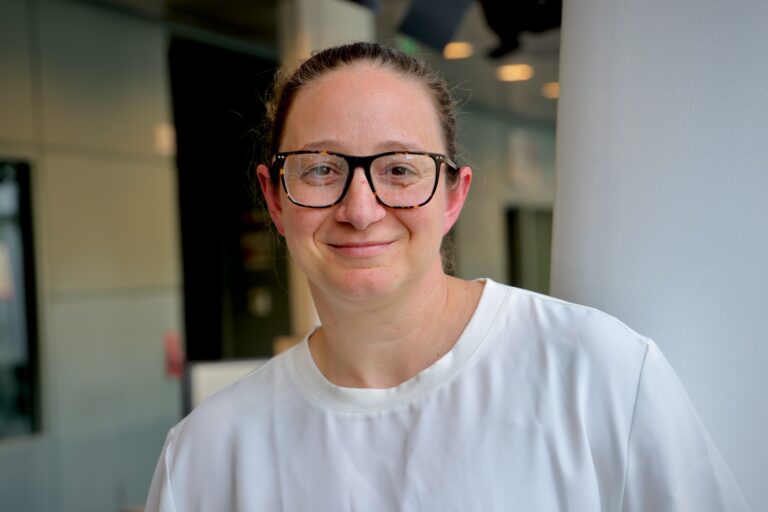
Nicolle Strand is director for the Center for Health Justice and Bioethics at Temple University. She is the lead author on a research paper about the experiences of people who got gender affirming care. (Emma Lee/WHYY)
From Philly and the Pa. suburbs to South Jersey and Delaware, what would you like WHYY News to cover? Let us know!
Every year, thousands of adults who are transgender or nonbinary undergo gender-affirming surgeries, and the number has continued to increase in recent years.
What are their experiences during this process? A few years ago, scientists at Temple University recruited a focus group of 18 transgender or nonbinary adults who had gotten gender-affirming care to document and evaluate how they felt about the process. The research team just released the results of that work.
Overall, the patients reported that while they were happy with the outcome of the surgeries, they were not as happy with the process leading up to their procedures, said Nicolle Strand, a bioethics and health justice researcher at Temple.
“They felt that they were stripped of choices and opportunities. They felt that so much of the process was out of their control. They felt a lot of fear. They felt a lot of frustration and they really didn’t feel empowered,” she said.
The patients cited many barriers they encountered before their surgeries including the expenses, the paperwork they needed to prove to doctors and insurance providers that they qualified for the surgery and wanted it, and surgeons who were not empathetic to them.
“They’re in such a vulnerable position having to ask medicine, ‘Please help me make my body look the way I want it to look, look the way it feels to me inside,’” Strand said, adding that patients want to connect with their surgeons on a human level.
“They’re interested in getting a lot of empathy and a lot of understanding from them and having a conversation about how they want to look, but also why and how they feel inside. And surgeons are not necessarily the best at that.”
Related Content

States sue Trump, saying he is intimidating hospitals over gender-affirming care for youth
The claim in a lawsuit comes after a wave of hospital systems said in July that they're ending aspects of the care.
1 year ago
Why the process of gender-affirming care is so complicated
The conversations that surgeons and medical staff have with patients before doing surgery are important, but surgeons can and should help patients understand why that is, said Loren Schechter, a plastic surgeon and director of gender affirmation surgery at Rush University Medical Center in Chicago, as well as the president-elect of the World Professional Association for Transgender Health.
“That relationship is a two-way street. The patient has to be comfortable with the surgeon and vice versa,” he said. “We understand that not all individuals who are gender-diverse or transgender proceed with surgery or necessarily are candidates for surgery.”
“People often wait for years and years to undergo these procedures and we want to make sure they understand what is a reasonable result, what can someone expect … following surgery, and what are things that go beyond surgery,” he added.
For instance, Schechter said patients may need support from family and friends and other medical providers, or help with the logistics of traveling to surgery or staying to recover afterwards.
He said the field has improved in the more than 20 years since he has been practicing in this field of medicine. For instance, his staff has grown to include a social worker, physical therapist and patient navigator to support patients before and after surgery.
The study found that one way clinics can make a difference is to have patient navigators in charge of helping patients through the paperwork and insurance processes, especially if the navigators are themselves trans or nonbinary.
Strand said she hopes this research could inspire surgeons who provide this kind of care to think about how they can make it a better experience for their patients, and to consider that as a measure of success, in addition to how the surgery turned out.
These findings will not be surprising to anyone in this field, said Damon Constantinides, a psychotherapist and clinical social worker in Philadelphia who primarily works with queer and trans clients.
He said most people don’t understand that this is unlike any other field of medicine because patients who need gender affirming surgery don’t feel like themselves until they have this medical procedure.
“Not only are you a person who in order to feel yourself, you need to access this care, but you’ve also been told over and over again that … it’s bad for you to access care. So by the time you’ve gotten to a surgeon’s office to do a consultation, there are so many steps that someone has gone through to be able to make themselves vulnerable enough to ask for what they need,” he said.
Political climate, legal restrictions complicate outlook
Constantinides said access to care still varies depending on where someone is in the U.S., but overall, health insurance providers covering gender-affirming care means more people can access it now compared to the past. However, some states are now trying to pass limits or de facto bans on gender-affirming care for adults.
Constantinides said “it’s heartbreaking what’s happening right now in the United States for trans people … people are terrified of losing access or not being able to access health care.”
The article from the Temple researchers also concludes that the current political climate and new laws could restrict access to gender-affirming care, which “makes it all the more important to provide humanistic, compassionate, and culturally humble care” to patients who can access it.

Get daily updates from WHYY News!
WHYY is your source for fact-based, in-depth journalism and information. As a nonprofit organization, we rely on financial support from readers like you. Please give today.

The Future of Pain Relief: Managing Chronic Pain, Laughing Gas and Safer Opioids
Exploring new research on the causes of — and potential solutions to — different kinds of pain.
Air Date: July 31, 2026
Listen 49:34
The Women and Families Hospital will begin offering childbirth and maternity care Sept. 3.
1 year ago
Listen 1:56
Temple’s Institute on Disabilities launches a new community center
Tech OWL, which stands for Technology for Our Whole Lives, provides the surrounding North Philadelphia community with workshops, classes and a space for connecting.
2 years ago