

‘Our voice is our vote’: Delaware enacts voting rights legislation banning race-based discrimination in elections
Supporters say it will allow voters to pick their representative, instead of elected officials picking their voters.
Listen 2:17
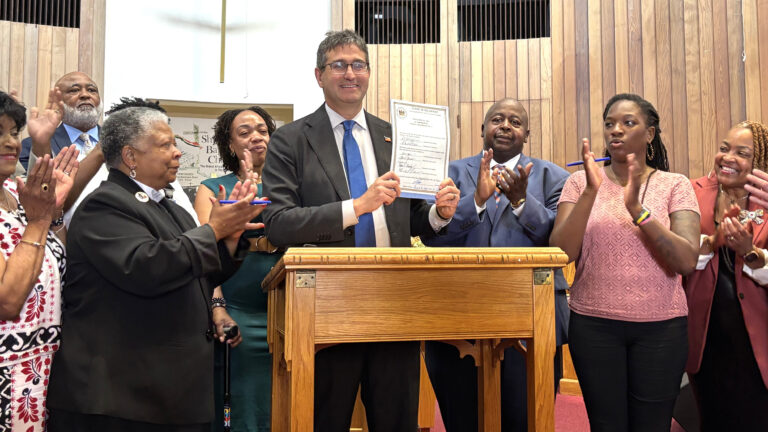
Delaware Gov. Matt Meyer signs the Delaware John Lewis Voting Rights Act at the historic Shiloh Baptist Church in Wilmington. (Sarah Mueller/WHYY)
What are journalists missing from the state of Delaware? What would you most like WHYY News to cover? Let us know.
Delaware Gov. Matt Meyer signed voting protections into law Thursday, the anniversary of the 1965 federal Voting Rights Act, at an historic Black church in Wilmington.
The Delaware John Lewis Voting Rights Act keeps key provisions of the federal Voting Rights Act that has all but been eviscerated in recent years by the U.S. Supreme Court. It protects voters from discrimination, voter suppression, vote dilution, intimidation, deception and language barriers to access.
“The signing of this bill will allow us to bridge participation gaps in voting, which do exist, fight back against federal threats to the franchise and ensure that voters pick their politicians, not the other way around,” said Andrew Bernstein, civic engagement counsel for the American Civil Liberties Union of Delaware.
Delaware and New Jersey are the only two states this year that have passed state-level John Lewis voting rights acts in the wake of the U.S. Supreme Court’s Louisiana v. Callais decision.
The court ruling weakened Section 2 of the 1965 Voting Rights Act, which is the provision that allowed, or sometimes required, the creation of majority-minority districts. Legal experts say the landmark civil rights law has been effectively gutted.
State lawmakers, advocates and community leaders at the ceremony celebrated the achievement of the 1965 Voting Rights Act of the late Congressman John Lewis and other civil rights leaders, who endured beatings and other violence in their fight against racial discrimination.
House Speaker Melissa Minor-Brown is the first Black woman in the state’s history to hold that position. But she said it wasn’t that long ago when Black Americans weren’t allowed to even register to vote.
“It’s only been 61 years since it became illegal to deny someone the right to vote based on race or color,” she said. “It’s only been 61 years since literacy tests were outlawed.”
Related Content
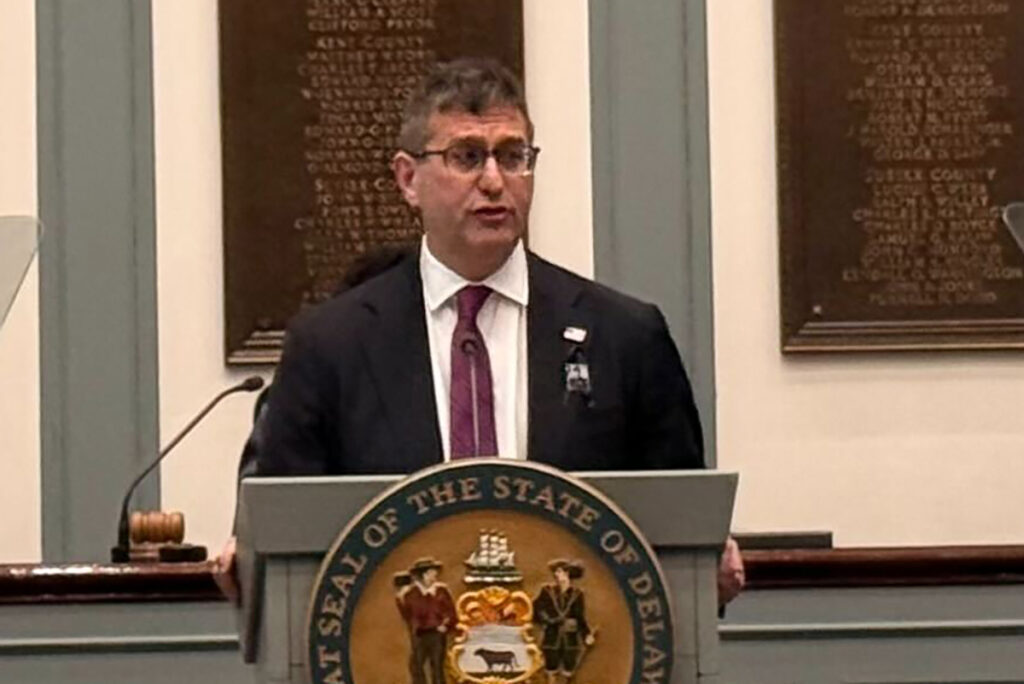
House Speaker Melissa Minor-Brown said she has not had a single conversation with Meyer about his creation of a state surgeon general.
2 months ago
Listen 0:57The bill passed unanimously in the Senate, with Seaford Republican state Sen. Bryant Richardson being the only Republican sponsor, and mostly along party lines in the House. State Reps. Danny Short, R-Seaford, and Rich Collins, R-Millsboro, voted yes on the legislation.
House bill sponsor state Rep. Larry Lambert, D-Claymont, said there was misinformation about what the bill does.
“This bill does not expand voting rights for individuals that are not already eligible to vote,” he said. “This bill is really to encourage voting, to make sure that everyone that is eligible to vote gets out there and votes, and does so without fear.”
The ceremony grew somber at times as speaker after speaker voiced concern about the current backward slide in civil and voting rights.
“The [Trump] administration has been relentless in their pursuit of curbing voting rights across the country,” said Todd Cox, associate director-counsel for the Legal Defense Fund. “They’ve attacked mail-in voting, state voter rolls, election officials, and sought to force restrictive voting measures through Congress. In fact, they’ve weaponized the Department of Justice across the board to accomplish those goals.”
Rev. Rita Paige, the pastor of the African Methodist Episcopal Church in Dover, said while this is a victory for voting rights in Delaware, the fight goes on.
“We ain’t gonna let nobody turn us around,” she said. “No storm can silence us. No hand can steal what God has placed in the hands of the people. Our vote is our voice.”
Bernstein said this was a good step, but added that the state also needs to pass legislation giving formerly incarcerated people their right to vote back.
“That is a remnant of Jim Crow,” he said. “It disproportionately impacts Black and brown communities as our criminal legal system maintains racial bias.”
House Bill 180 is a constitutional amendment that would stop punishing people for committing a crime by taking away their right to vote has passed both chambers of the legislature. It must pass again next year to amend the state’s constitution.

Get daily updates from WHYY News!
WHYY is your source for fact-based, in-depth journalism and information. As a nonprofit organization, we rely on financial support from readers like you. Please give today.
Part of the series
Part of the series

The town council voted in favor of starting a repeal process for the divisive ordinance last month. The planning commission says there’s not enough evidence to support it.
4 hours ago
New Jersey election 2026: Cory Booker faces 3 challengers in U.S. Senate race. Here’s what to know
The incumbent Democrat is being challenged by Republican Justin Murphy, independent Veronica Fernandez and Socialist Workers Party candidate Joanne Kuniansky.
1 day ago
A former pastor is challenging U.S. House candidate Joe Arminio, calling his misgendering of Democratic Congresswoman Sarah McBride “offensive.”
2 days ago
Listen 0:58