

‘It’s harming us’: Delaware lawmakers, educators want to scrap SAT mandate for 11th graders
Delaware usually falls near the bottom of national rankings because, unlike most states, almost all high school juniors take the test.


A student takes a practice SAT on March 6, 2024. (AP Photo/Butch Dill)
What are journalists missing from the state of Delaware? What would you most like WHYY News to cover? Let us know.
Every year about 10,000 Delaware public school 11th graders take the SAT that measures their comprehension of mathematics and English.
Since 2016, the state has required students to take the hourslong examination to fulfill its federal obligation to conduct standardized testing of high school students in those subjects. Taxpayers foot the bill for the testing — roughly $500,000 annually — that this year will take place at students’ schools from March 2 to 27.
The results have long cast Delaware’s education system in a devastating light, however, with the average score typically at the bottom of the 50 states. Last year, for example, Delaware’s average score of 948 out of a possible 1600 tied Florida for 47th lowest, trailed by only West Virginia’s 919 and New Mexico’s 885.
The dismal showing has long led many state educators, policymakers and lawmakers to argue that the rankings are unfair. They point out that while almost all Delaware students take the SAT, that’s not the case in dozens of states that don’t mandate the test. For example, while 94% of Delaware kids were tested last year, only a small fraction of students took the SAT in the leading states.
Kansas ranked highest in SAT average score at 1256, but only 2% of kids took it. Wyoming was second at 1253, but only 1% took the test. Nebraska was fifth at 1227, but only 7% were tested. And on and on.
While Delaware’s public school struggles are real, with only 41% of third- to eighth-graders proficient in English, and just 34% proficient in math, two state lawmakers are spearheading an effort with other education leaders and advocates to remove the SAT requirement.
One is Democratic Rep. Kim Williams, chair of the House Education Committee. Williams stressed that she and Republican Sen. Eric Buckson aren’t looking to stop any kids from taking the test at state expense.
“We just don’t want it to be our 11th grade assessment at this time because Delaware is being compared to all the other states that use the SAT and they’re only testing 2% where we’re testing every 11th grader,” Williams told WHYY News. “Other states are having kids take the test who want to go to college. Not every kid is looking to go to college.”
Williams also noted that with fewer colleges requiring the SAT for admission, including the University of Delaware, it’s time to develop a different assessment measure for 11th graders.
Buckson, a former gym teacher and wrestling coach at Polytech High near Dover, said he’s been a proctor for SAT tests where many students basically blew off the exam because they weren’t planning to go to college and knew their score wouldn’t affect their ability to graduate.
“You’ve got people that are literally signing their name and just circling in circles that are getting counted in the data. And that just doesn’t reflect anything,” Buckson said.
Buckson agrees with Williams that SAT testing should be provided without charge for those who want to take the exam.
“It should be a useful option for those that see the value and benefit of potentially improving their status for going to college,” he said. “But I do not think that we should be expecting every single student to take it and then having no mechanism to have accountability in it. It’s just a skewed number.”
Williams and Buckson aren’t alone in their view. They’re piggybacking off a 2023 review of statewide assessments that was conducted by the state Department of Education under then-Secretary Mark Holodick.
The report generated by the state noted that all standardized testing poses challenges. But it suggested the “SAT is not the best indicator of high school achievement for all students” and that state officials “explore alternatives to SAT reporting.”
The state’s new education secretary, Cindy Marten, would not agree to an interview, but issued a written statement that indicated a willingness to rethink the SAT requirement.
“We hear the concerns being raised about the SAT, and we’re taking them seriously as part of a broader effort to modernize how we measure student learning and school success,” said the statement by Marten, who was appointed last year by Gov. Matt Meyer after he succeeded John Carney.
Marten’s statement noted that while “assessments play an important role in ensuring accountability, equity, and transparency for families and communities … we want those measures to reflect not only achievement, but student growth over time. Any changes need to be thoughtful, aligned to our standards and goals for graduates, and made with input from educators and communities.”

Related Content
The revamped school funding formula targets more money to students with higher needs to achieve better academic outcomes.
9 months ago
‘It’s a good time to rethink where we are’
The idea of removing the SAT requirement, which would require legislation and a new system for assessing 11th graders that complies with federal law, has plenty of support in the education community.
Lisa Lawson, superintendent of the Brandywine School District, the state’s fifth-largest district with about 10,000 students, agrees that it’s time to end the SAT requirement, especially with the evolution of an array of secondary curriculums that include a pathway to careers that don’t need a college education. Another factor, Lawson said, is that so many post-secondary schools don’t require the SAT any longer.
Lawson said the state’s six vocational-technical high schools — none of them in Brandywine — have steep challenges in getting many students enthused about the SATs, but her district also has many students who don’t take the test seriously.
“We’ve got some headed directly to their family’s construction business. We’ve got some headed directly to the other workforce areas or other trade areas, absolutely positively,” Lawson said. “We have the same cluster of students who don’t intend to go to college.”
The mandate has actually hurt Delaware grads trying to get jobs, she said.
“It’s harming us,” she said, “especially when it comes to folks that are looking at our kids coming out and then making assumptions that they’re not as high quality, potentially, as a student graduating from Pennsylvania, Virginia, Maryland, or coming from someplace else, because we used a college-bound assessment to determine their worth as a student. That’s just inappropriate.”
Lawson also said it makes sense to replace the SAT requirement during a time when the Trump administration is taking steps to eliminate the federal Department of Education.
“If the 11th grade accountability measure continues, we are suggesting alternatives to the SAT, such as potentially thru-year assessments, not a onetime summative assessment,” Lawson said. “We’ve talked about project-based or performance assessments.”
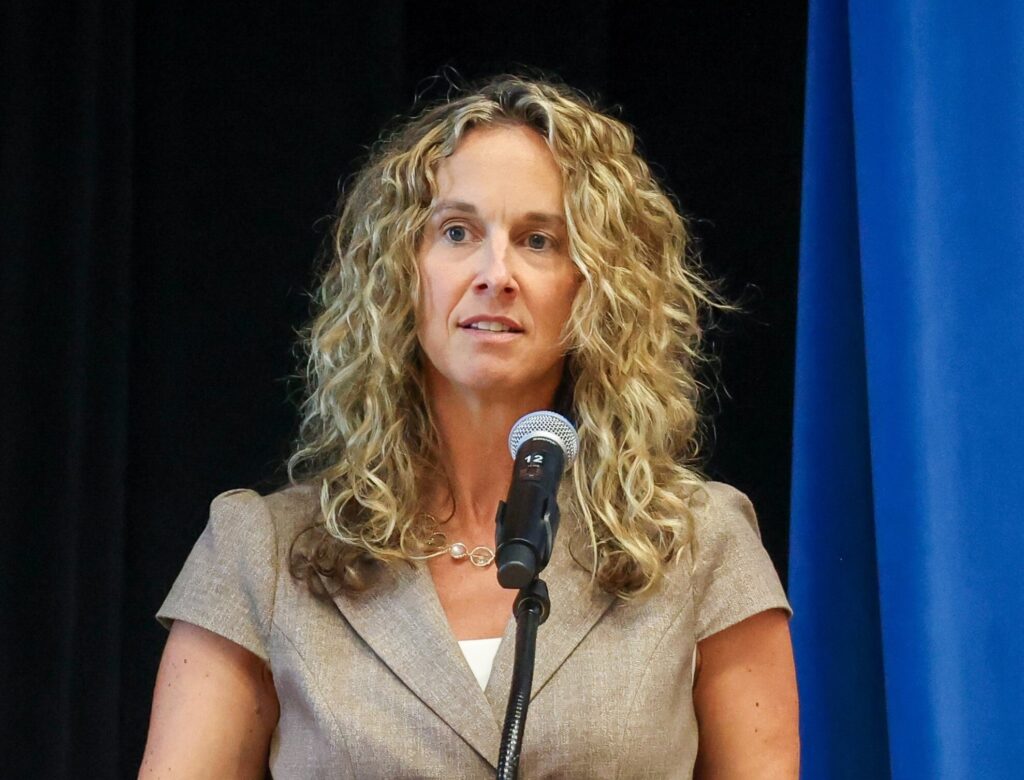
Paul Herdman, who heads the educational nonprofit Rodel Foundation of Delaware, agreed that it makes sense now to reconsider the assessment tool the state uses.
“It’s a good time to rethink where we are,’’ Herdman said. ”We’ve got a federal landscape that is basically saying to the states, give us what you think. They’re not saying what you have to do as much as they might have a while back.”
Herdman said it’s still important to measure 11th graders’ grasp of math and English.
“Does it have to be the SAT? No, but I think the intent around trying to capture how we’re doing with our high school kids across the state makes sense,” Herdman said. “And providing the feedback back for students and their families as to how well they’re doing such that they can make good choices about their future plans also is still very relevant.”
Julia Keleher, of the nonprofit First State Educate, said its fair to question whether the SAT needs to be a requirement for all 11th graders. Her group works with school board members and candidates to assist them with governing Delaware’s 19 independent districts.
“If someone’s going to graduate from high school and is ready to walk into a career, I don’t know that the employer is really asking, ‘What did you score on your SAT?’” Keleher said. “The best indicator is one that provides an accurate and authentic and meaningful indicator of the quality of the graduate and the education system.”
After hearing about Buckson’s tale of students signing their name and doing little else but fill in circles with little or no regard to the pending math or English question, Keleher said the story resonated with her.
“If we just hold that image that you just articulated in our minds for a second, we really don’t want 17, 18, 19-year-old young people to be that disconnected, to feel that school is not that relevant,” Keleher said.
“It has to be meaningful. Ideally, going to school becomes an opportunity for one to exercise agency over their future and to will into existence by pursuit of knowledge, forward motion in life and and the ability to to experience a whole range of things, right? But they’ve got to be invested. They’ve got to believe that the things that we’re asking them to do and they show up every day are going to help get them there.”
Buckson said there’s plenty of discussions and decisions to be made before the SAT rule is scrapped and another one is in place.
“But as long as there’s a consensus that the SAT is not a useful tool and in fact has become harmful because it doesn’t actually portray the story, we need to get rid of it,” Buckson said. “And then the question is how do you do it? What do you do? What do you replace it with because you have to replace it with something.”

Get daily updates from WHYY News!
WHYY is your source for fact-based, in-depth journalism and information. As a nonprofit organization, we rely on financial support from readers like you. Please give today.

Are high school seniors ready for college?
A new report from UC San Diego sparked concern over declining math skills. What's driving learning loss? What can we do to reverse these trends?
Air Date: December 9, 2025 12:00 pm
Listen 51:12
The Education Department is dismantling. Here’s what that means
Since he took office, President Donald Trump has called for the dismantling of the Education Department, saying it has been overrun by liberal thinking.
11 months ago

Breakthrough trains teachers, aids students in Philadelphia’s underrepresented communities
“We’ve served over 1,600 students since we've been founded, and we’ve served over 550 teaching fellows,” said Michelle Palmer.
1 year ago