
Pa. legislators and activists celebrate signing of CROWN Act, which protects against discrimination based on hairstyle
After several years of activism and coalition building, the commonwealth became the 29th state to enact such legislation.
Listen 1:08
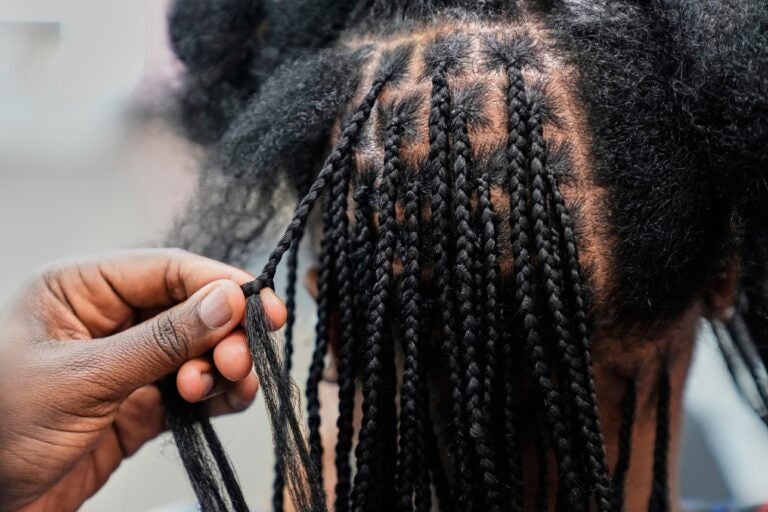
File - A braider in College Park, Georgia, feeds in synthetic braiding hair while styling a client's hair into knotless braids, Tuesday, May 6, 2025. (AP Photo/Stephanie Scarbrough)
From Philly and the Pa. suburbs to South Jersey and Delaware, what would you like WHYY News to cover? Let us know!
State House Speaker Joanna McClinton (D-Philadelphia) and Pennsylvania State Rep. La’Tasha D. Mayes (D-Pittsburgh) on Sunday celebrated last week’s signing of the CROWN Act, a law that bans discrimination based on hair texture and protects hairstyles in workplaces, schools and public accommodations.
They joined Jasmine Sessoms, chief executive officer of Center 1968, to discuss how passage came after years of organizing, coalition building and personal testimony from Black women who have experienced bias in professional and educational spaces.
McClinton introduced an early version of the bill in 2019, inspired by a detailed conversation with national CROWN Act advocate Adjoa B. Asamoah. She said the issue resonated instantly.
“I just knew my own experience, how many times I made efforts about how I was showing up in my professional world,” McClinton said. She recalled worrying as a law student about keeping the same hairstyle so employers would “remember me” and not dismiss her. She added that norms around appearance and implicit bias have shaped the careers of Black professionals for decades.
Mayes, who became the prime sponsor of the bill in 2023, only months into her first term, said she did not expect her first bill to become law. She called the moment “powerful and transformative” and credited McClinton for trusting her with a measure that touches the daily lives of Black Pennsylvanians.
“Two and a half years of my three years in office has been spent working and fighting and scratching and organizing and strategizing and battling to make this real and [end] hair discrimination as the experience of Black people in our commonwealth,” she said.
The final votes reflected rare, broad agreement in a deeply divided political climate in Harrisburg. The Senate passed the bill 44 to 3, and the House passed it 194 to 8.
“What more could we ask for?” Mayes said.
Related Content

Head spas are gaining a strong following among beauty influencers and wellness buffs — and their numbers are growing.
4 months ago
Listen 2:07Joining a national movement
The CROWN Act — an acronym for “Creating a Respectful and Open World for Natural Hair” — emerged from growing recognition that hairstyles often associated with Black identity, such as braids, locs, twists and afros, have long been unfairly policed in workplaces, schools and other institutions. Bias studies suggest that Black women’s natural hair or protective styles are more likely to be judged “unprofessional.” One report found Black women are 2.5 times more likely to have their hair perceived as unprofessional compared with other women.
Earlier this year, New Jersey U.S. Rep. Bonnie Watson Coleman reintroduced the CROWN Act in Congress, where it has bipartisan support. The first state to pass such legislation was California. On July 3, 2019, Gov. Gavin Newsom signed the law that prohibits discrimination based on hair texture and protects hairstyles under the state’s civil rights and education codes.
Since then, the movement has accelerated. When Gov. Josh Shapiro signed the local law last week, Pennsylvania became the 29th state to adopt either the CROWN Act or similar legislation.
Organizing played a central role in the bill’s momentum. Mayes drew on her community-organizing background to craft a statewide coalition that included more than 100 partners. They ranged from local YMCAs and community colleges to the Pittsburgh Penguins, major unions including firefighters and carpenters, and the state’s human-relations authorities. Mayes called it a coalition of “unlikely supporters.”
“And so it was a very powerful coalition,” she said. “It’s because of their work and their support, putting their name with ours around this bill.”
After it was introduced, coalition members traveled to Harrisburg for a CROWN “day of action” to lobby for its passage and remained involved through votes in both chambers. Sessoms said she remembered walking into the Capitol and seeing Black women everywhere.
“People that you wouldn’t even think should be there,” she said. “It was like, ‘What are you doing here?’ ‘I’m here to support the CROWN Act.’ ‘Oh, me too.’”
Related Content

A new report found carcinogens and lead in popular brands of synthetic hair widely used in salons. A Philly scientist says more transparency is needed for consumer safety.
11 months ago
The future
McClinton and Mayes stressed that the work does not end with the governor’s signature. The law creates new civil-rights protections, but changing workplace culture and school policies will take sustained outreach.
McClinton said the next phase includes educating employers, schools and institutions about the new legal standards, and tracking how the protections are applied on the ground.
“We’re monitoring the implementation to ensure that protections are applied consistently across Pennsylvania,” she said. “There are many times that a law is made and change occurs, but we find out we have to strengthen it or expand it or make other tweaks to make sure that it’s implemented in a very fair way.”
Although the bill centers the experiences of Black women and girls, Mayes emphasized that the protections apply to everyone.
“This is a win for Pennsylvania because the CROWN Act makes our commonwealth more just, more fair, and more free,” she said. She noted that Black men often face discrimination in restaurants and public spaces because of braids or locs, and that the bill also strengthens protections for religious head coverings across faiths.
“So when we’re talking about our Black brothers and sisters who are Muslim, who are Jewish, who are Christian, or whatever your walk of faith may be, you also now have more protections, as well,” she said. “It is adding another form of protection around religious discrimination, and it is working for all Pennsylvanians by making this a more free commonwealth.”

Get daily updates from WHYY News!
WHYY is your source for fact-based, in-depth journalism and information. As a nonprofit organization, we rely on financial support from readers like you. Please give today.
Former Rep. Susan Wild, D-Lehigh, submitted 15 projects for federal financing. She blames her Republican successor for their elimination.
3 months ago
Listen 1:24
Shapiro, Garrity strike different notes on National Guard deployments as Trump expands reach
Gov. Josh Shapiro told reporters in Philadelphia that violent crime is down in Pennsylvania, and any attempt to direct federal forces to U.S. cities is unconstitutional.
7 months ago
Pennsylvania Democrats attract some buzz in the party’s bid to take back the U.S. House
Scranton Mayor Paige Cognetti is viewed as the best candidate to try to unseat freshman Rep. Rob Bresnahan.
7 months ago