
Black history celebrated in Atlantic City with Chicken Bone Beach historical marker unveiling
Along with the historical marker from the state, the city launched a virtual tour of the city’s Northside neighborhood, where Black culture once thrived.
Listen 1:18
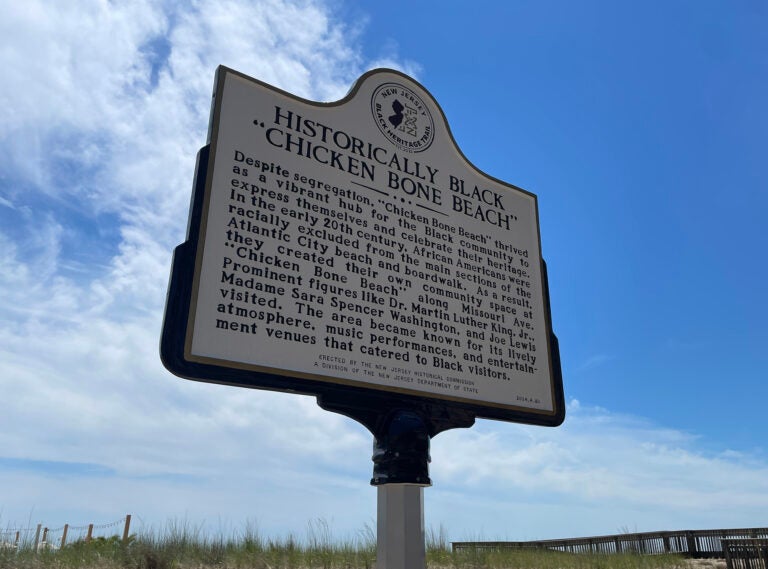
The historical marker for Chicken Bone Beach in Atlantic City, New Jersey unveiled as part of the state's Black Heritage Trail. (P. Kenneth Burns/WHYY)
From Camden and Cherry Hill to Trenton and the Jersey Shore, what about life in New Jersey do you want WHYY News to cover? Let us know.
Beginning in 1900, African Americans were excluded from most sections of Atlantic City’s beaches and boardwalk. They would be relegated to the beach along Missouri Avenue.
What followed was six decades of what Henrietta Wallace Shelton described as a “beautiful family atmosphere.”
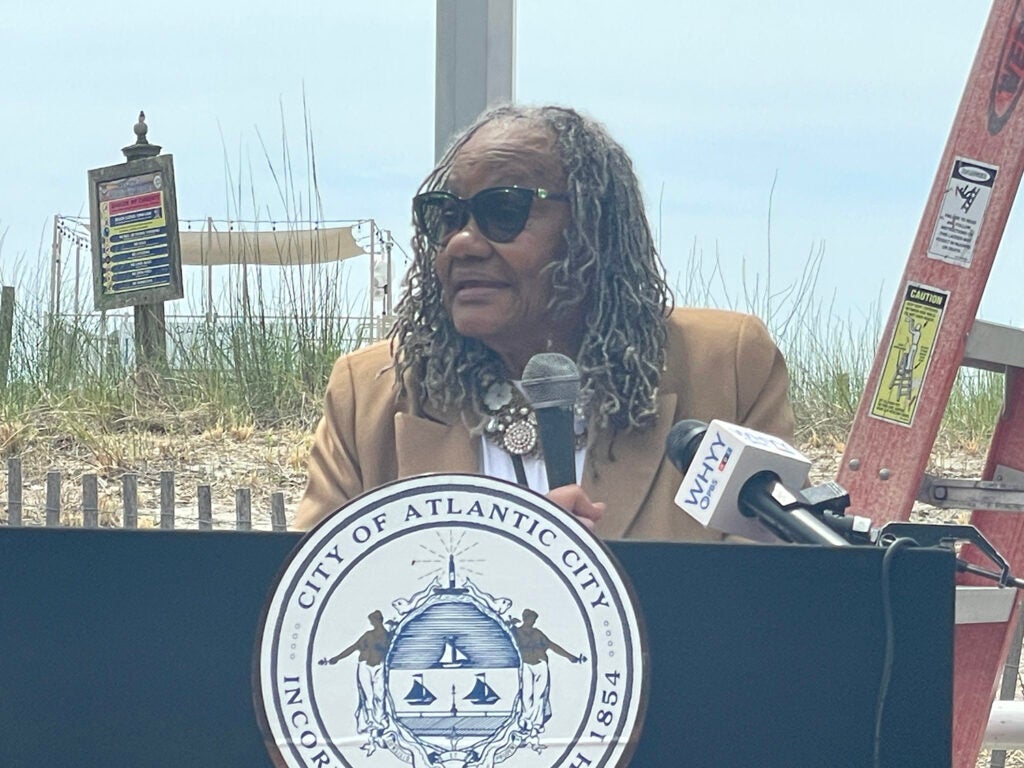
“We always seem to make lemon out of lemonade as a culture,” said Shelton, president of the Chicken Bone Beach Historical Foundation. “I’m always very proud to be a Black African American. And I’m very proud of the accomplishments that we have done throughout the years.”
Shelton made the remarks Thursday before dozens of people at the unveiling of a historical marker signifying the inclusion of Chicken Bone Beach into New Jersey’s Black Heritage Trail. It is the third marker unveiling in the last week.
A marker was unveiled in Cape May to recognize the Macedonia Baptist Church, which has not only served as a haven for the city’s Black community, but has also worked to preserve Black history there. The next day, a marker was unveiled in Lawnside, Camden County, the state’s only incorporated antebellum Black community.
Shelton said work towards getting state recognition of the Chicken Bone Beach historical site took nearly three decades.
“I’m really impressed. It’s beautiful, isn’t it?,” she said. “My family and I have taken a long time to get this point.”
Chicken Bone Beach is a product of Jim Crow segregation
According to the foundation, African Americans had started to be excluded from major sections of the beach and the boardwalk around 1900, as more white travelers from the Jim Crow South came to Atlantic City.
As a result, African Americans, who were not allowed to eat at nearby restaurants, brought homemade meals — which included fried chicken — to the beach with them. The leftover bones would be found in the sand during beach clean up.
The beach became a cultural touchpoint where notable African Americans such as Sammy Davis Jr. and the Rev. Martin Luther King Jr. spent time there.
Synatra Smith, project manager for the Black Heritage Trail at the New Jersey Historical Commission, said she is inspired by a snapshot of King at the beach.
“When I look at that image of Dr. King, I see Black leisure,” she said. “I see a human flesh and bone; just like us, who not only deserves rest, but actually implemented it.”
Chicken Bone Beach is among 77 Black Heritage Trail sites throughout 16 counties in the state, according to Smith. An additional 30 sites are currently under review.
Related Content
The state’s only antebellum community will be part of the Black Heritage Trail.
2 months ago
Chicken Bone Beach is part of the hub of Atlantic City’s Black cultural hub
Following the marker unveiling, Atlantic City officials launched the Black Cultural Heritage Virtual Tour, focusing on 15 sites, including Chicken Bone Beach, in the city’s Northside neighborhood beginning at Pop Lloyd Stadium, the one-time home to the Atlantic City Bacharach Giants of the Negro Leagues. The stadium is named for Lloyd, who played for the team in 1924 and 1925. He was considered one of the greatest shortstops in Negro League history.
The tour launch event took place across the boardwalk at Caesar’s Atlantic City with photos of the 15 sites on display, as well as a touchscreen where people could interact with the tour.
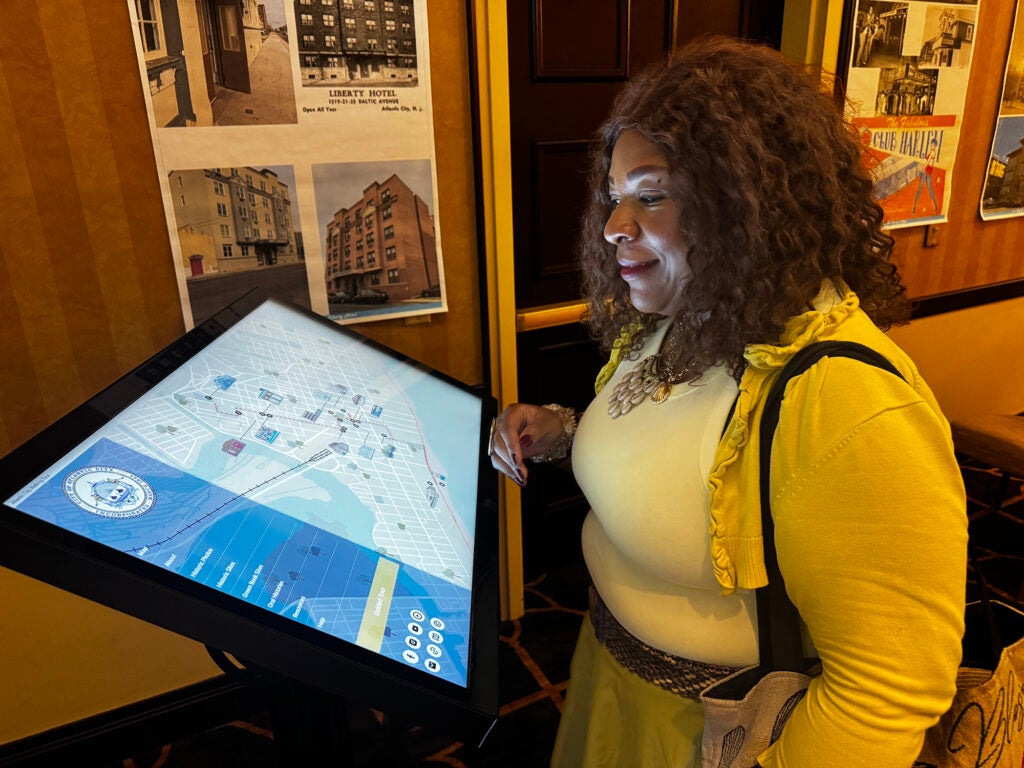
Mayor Marty Small said they wanted to show off the city’s Black history.
“There’s a story to tell,” Small said. “Some people want to forget history, but we won’t here in the great city of Atlantic City.”
The tour has two options, a self-guided tour with interactive features, such as swiping photos of the sites between past and present and interviews with residents telling their own stories of the sites. There is also a guided tour featuring a 38-minute documentary.
Small said it was important to share the history as the Trump administration makes moves to remove certain displays it disagrees with, such as the slavery exhibit at the President’s House Site on Independence Mall in Philadelphia.
“We’re not going to allow that in this great city of Atlantic City,” he said. “We unapologetically embrace our culture.”

Get daily updates from WHYY News!
WHYY is your source for fact-based, in-depth journalism and information. As a nonprofit organization, we rely on financial support from readers like you. Please give today.

The project takes a focused look at the contributions of Black trailblazers who contributed to the foundation of the city and country from 1776 to 2026.
2 months ago
Listen 1:00
Philadelphia’s oldest Juneteenth festival draws thousands to the Johnson House in Germantown
The festival celebrated its 20th year with music, vendors, a small-business opening and renewed calls to preserve Black history.
2 months ago

Atlantic City’s Ralph Hunter envisions new Black history museum in town
The 87-year-old Atlantic City resident said he will be knocking on doors to raise $100,000 for the museum.
1 year ago