
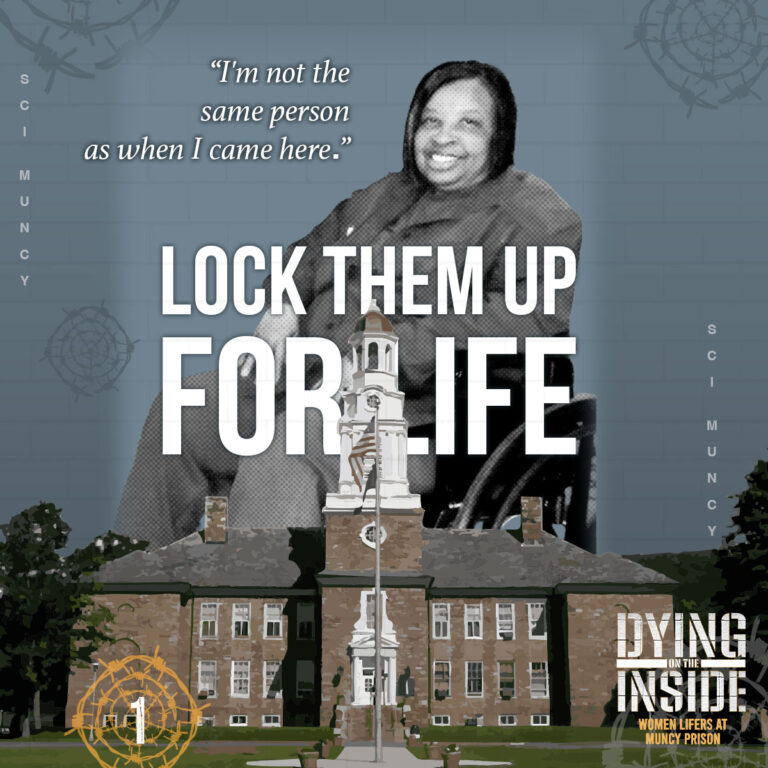
Lock Them Up For Life
The first episode of “Dying on the Inside: Women Lifers at Muncy Prison” takes listeners inside Pennsylvania’s largest women’s prison.
This episode is from Dying on the Inside: Women Lifers at Muncy Prison, a podcast production from Studio 2 co-host Cherri Gregg and Temple University’s Logan Center for Urban Investigative Reporting
Cherri Gregg and the Logan Center for Urban Investigative Reporting visit State Correctional Institution Muncy, Pennsylvania’s largest women’s prison and home to roughly 150 lifers. As they tour the prison, they witness the challenges of aging while incarcerated. We meet Sylvia Boykin, 68, who has been at SCI Muncy for 33 years. Her body is ravaged by multiple serious illnesses. Advocates call her sentence “death by incarceration” and say our nation’s prisons are turning into nursing homes because of the “tough on crime” policies of the 70s, ’80s and ’90s. Prisons across the U.S. are grappling with rising healthcare costs that are passed on to taxpayers, as well as ethical questions about how to care for aging inmates.
-
Episode Transcript
Robovoice: This is a prepaid collect call from—
Sylvia Boykin: Sylvia.
Robovoice: An incarcerated individual at SCI Muncy.
Sylvia: Hi, how are you?
Cherri Gregg: I’m good Sylvia, this is Cherri. Thank you so much for calling us. I know that—
Sylvia: Oh, you’re so very welcome.
Cherri: Yes.
Sylvia: I’m having a pretty rough day today. My back hurting and my feet hurt really bad right now. They’re swollen really bad.
Cherri: Yeah, yeah, that sounds like a lot.
[music]
Cherri, narrating: Sylvia Boykin is 67 years old. She’s serving a life sentence without parole at State Correctional Institution Muncy in North Central Pennsylvania. She has been there for 33 years.
Sylvia: I didn’t kill anyone or shoot anyone, but I was with somebody who did. And you get the same amount of time as the perpetrator. Because it’s called conspiracy.
Cherri, narrating: She says the man she was with who committed the murder served six years. Sylvia now uses a wheelchair and a cane to get around. She is on 12 different medications and spends a lot of time in the prison infirmary.
Sylvia: I suffer from asthma, high blood pressure, high cholesterol. I have cataracts on my eyes, I also suffer from sinusitis and I had an incarcerated hernia and a obstructed bowel. And so my whole stomach is mess.
Cherri, narrating: Sylvia is slowly dying in prison, and there are countless other women like her at Muncy.
Sylvia: We have a lot of cancer here right now. You got a lot of people here in wheelchairs, a lot of people here walk with canes. It’s hard and it’s mostly lifers.
[music]
Cherri, narrating: When I started talking to women lifers at Muncy State Prison last year, I almost could not believe all the ailments they were telling me about. Diabetes, arthritis, hypertension, back problems, sometimes starting in their mid-thirties. Muncy prison records show the average age of women inside is 41—and women are developing chronic illnesses early. By their mid 50’s, many are already living with conditions that, on the outside, we associate with advanced aging.
As I learned all this, all I could think was what was going on in there? And when I started looking further into Muncy, I found a much bigger story than I ever expected— that affects every state in the country.
I’m Cherri Gregg, I’m a journalist and radio host at WHYY. This is Dying on the Inside: Women Lifers at Muncy Prison. A podcast that looks at the national crisis of our aging prison population, and its incredibly high cost. Welcome to Episode 1: Lock Them up for Life.
[driving sounds]
Yvonne Latty: How you doing?
Cherri: I’m feeling good.
Yvonne: Let’s hit it.
Cherri, narrating: On a chilly winter day, my team and I take the nearly three hour drive through a landscape that moves from city to flatlands and up and down the mountains of Central Pennsylvania. Our destination is Muncy State Correctional Institute in Lycoming, Pennsylvania. I want to see for myself the prison where women serving life sentences live and die.We pass by farms, churches, and lots of Trump and American flags before we get to what looks like a college campus with a clock tower. It’s surrounded by barbed wire and metal fences. I’ve come here with my producers Yvonne Latty and Colin Evans, and also with LaTonya Myers, we call her T. She served time at Muncy and is part of our team.
T Myers: I never imagined that I would be walking back into Muncy, willingly.
[music]
Cherri, narrating: SCI Muncy is 106 years old. It started out as a home for “wayward women.” In 1953 the home became part of the Bureau of Corrections. Now it’s a medium-sized maximum security prison that’s home to over a thousand inmates. 143 of them are lifers. The superintendent agreed to let us get a tour. We’re not allowed to record, but a guard and a deputy superintendent showed us all around.
I’m struck by how pretty Muncy actually is outside. It even has views of the mountains. But inside, it looked more like the kind of prison you might see in movies. Tiers of small cells, guards, open showers—a total loss of freedom.
As our tour guides led us around, we see dozens of women of all different races dressed in drab brown prison uniforms. The women walk close together in twos or threes. They don’t make eye contact with us. The color scheme at Muncy is beige. There is very little if any natural light. The cells are small and windowless. Some were beautifully decorated with photos and artwork. Every inch of space was used. Laundry hung up, books stacked, some had TVs.
The women we did speak to were kind, and the staff was proud of the work that they do on their behalf. But the truth is, our day at Muncy was draining. The team was close to tears when we got back to our car. Here’s my producer Yvonne.
[driving noises]
Yvonne: I felt like just running, running out of there. It was so horrible to hear all the positivity and to be witnessing so much despair. I found it really hard to look at the older—I noticed that almost everyone there, most of the women I saw were middle-aged women.
T: I’m just like, going back and thinking about my friends that I lost. Thinking about the fact that that’s a whole city with inside a city and that’s people moms, grandmoms. That’s people that I shared food with, that I pray for, that pray for me to be successful.
Cherri, narrating: T says the food hall brought back a lot of memories.
T: [laughter] Soon as that—I seen that kitchen, like, my stomach, like, I looked at Miss Cherri like, you know—we trying to sneak lettuce out, and rice and flour so that we can cook, because the food is not enough.
Cherri, narrating: The kitchen was covered by a gate so inmates and the cooks couldn’t not see each other. A guard tells us this is so kitchen workers can’t give inmates they like more food or ones they’re beefing with less. There is a slot in the corner and a tray is shoved out with what looks like a mystery meat, a starch, and one over-cooked, limp looking vegetable. The women have 15 minutes to eat. T says most women have to supplement with food from the commissary.
T: These women are running this facility, they’re cooking their own food, they’re cutting their own grass, they’re fixing their own pipes, and they’re paying for their own food. They’re only making, you know, at the least 19 cents an hour, at the most 55 cents an hour?
Cherri: Yeah.
T: And that’s for the skilled work.
Cherri, narrating: Today was visiting day at Muncy. The family visiting room was filled with toys for the kids, but there were no kids there. In fact, there was only one man visiting one woman in the large room. One of the guards described visitor protocol to our producer Colin.
Colin Evans: The inmates have to sit in specified chairs, and they go as far to say that you only get a short hug with a closed-mouth kiss, and you’re not allowed to embrace in the middle of the visit. And I just think about those little aspects of being incarcerated, like thinking that for your entire time there, you’ll never get an open-mouthed kiss with your partner again.
[music]
Cherri, narrating: Muncy is far. It’s the definition of the middle of nowhere. It’s not a quick car, bus, or train ride. It takes planning and money. T says most of the visits these women usually get are video calls.
T: Nobody got a lot of visits. I don’t care if they was older, younger, 12 kids, twenty. The buses is like $100 to get up there. It’s just too far.
Cherri, narrating: We also visited the prison’s $5.9 million infirmary. We saw several middle-aged and older women getting kidney dialysis. They sat in reclining chairs, connected by tubes to a machine that is filtering their blood. They smiled at us.
Since the infirmary opened in 2018, it’s been busy. From 2019 to 2024, Muncy infirmary visits increased sixfold. We also saw the nursing home wing of the infirmary, where elderly women are kept alone in even smaller cells.
T: I’m looking at cells and seeing older people way past the age 65 laying on hospital beds, locked behind metal steel doors.
Cherri, narrating: We met an older lifer with dementia, a Vietnam War marine veteran. One of the staff leading our tour was excited for my producer Yvonne to meet her because he knew Yvonne had written books on veterans. But the woman did not know who or where she was. She spoke a few words of gibberish and walked back into her small hospital prison cell. It was a difficult moment, but Yvonne appreciated the gesture.
Yvonne: The officers that took us around were very positive and really nice.
Cherri: Yeah.
Yvonne: I do think that they’re doing stuff to help these women, even if they never get out.
Cherri, narrating: But their kindness and enthusiasm could not cover what we were witnessing. When we walked into the building where the lifers live I saw dirt caked up in the fans circulating the air, black soot, and cracked paint. The radiators looked ancient. A guard told me renovations in this unit are especially difficult because the older residents don’t want to move. The tight quarters, the smells—it got to me.
[music]
Cherri: Some of the places, the smells were very stifling to me. My eyes were watering.
Cherri, narrating: Colin says the staff who took us on the tour were surprisingly honest about how many of the women had ended up in Muncy.
Colin: They didn’t have stable housing or had an abusive boyfriend or were addicted to drugs and alcohol or had mental health issues. And implicit in that is the admission that had those things been in place, had money been invested into those things for those women, then they would have never ended up here.
Robovoice: This is a prepaid collect call from—
Sylvia Boykin: Sylvia.
Robovoice: An incarcerated individual at SCI Muncy.
Cherri: Hi Sylvia. How are you?
Sylvia: I’m OK. Just a little pain-pains in the leg today.
Cherri: Pains in the leg, I’m so sorry to hear that.
Cherri, narrating: In our phone calls, Sylvia told me about her difficult life. She’d been physically and sexually abused as a child. She’d attempted suicide. She had three kids on her own. She turned to crack. When she moved to North Philadelphia in the 1990s, she began dating a drug dealer. Before long, she was dealing too.
One day she and the dealers she worked with got in a fight with a woman who owed them drug money. One of the men shot the woman to death, a 43-year old mother. She allegedly owed them $75.
[music]
Sylvia: Every day I live with the decision that I made and the wrongs that I made.
Cherri, narrating: Her first stop when she got to Muncy was the chapel.
Sylvia: I put roots into the church and I became the secretary at the church and I just stayed there. I’ve been in the church ever since that I’ve been here.
Cherri: What do you want the people on the outside to know about you?
Sylvia: After all of these years, I’m not the same person as when I came here. There’s no way that a person after 33 years, I think, could be the same person.
[music, midroll]
Voiceover: At Klein College of Media and Communication, at Temple University, we believe the best way to learn it is to live it. From day one, students get real world experience in sports media, journalism, communication, production, PR, advertising, and more. Guided by industry pros and fueled by Philly’s energy, Klein prepares you to lead in media and communication. Learn more at klein.temple.edu.
[music]
Cherri, narrating: The United States incarcerates nearly 2 million people. It has more inmates than any other country. And prisons are an expensive endeavor. Keeping older people incarcerated comes at an especially high cost for taxpayers. According to the Pennsylvania House Appropriations Committee, the state spends $3.2 billion on mass incarceration. And that price continues to increase as inmates grow older and older. In 2000, about one in ten inmates were over 50 and now it’s more than 1 in 4.
I wanted to talk to someone who could make sense of this data and what it means, so I reached out to Alyssa Gordon, an attorney and Borchardt Fellow at the American Civil Liberties Union. Alyssa has spent years researching what she calls “the silent crisis” of elderly people in prison.Alyssa Gordon: If trends continue, then by 2030, one in every three incarcerated people could be over the age of 50 years old.
collapse
Cherri: Did it surprise you to learn just how many elderly prisoners there are right now?
Alyssa: No. So it did not surprise me at all actually and I think that people don’t take the time to think about—when you lock thousands of people up to spend their entire lives in prison and then you continue to lock even more people up as the years go on, not only will the overall prison population balloon but the elderly population will also balloon.
Cherri: And there’s going to be implications for that, because I’m thinking that the older you are, some of the costs are going to shift.
Alyssa: Elderly people are much, much more expensive to incarcerate and that is because elderly people have much higher rates of chronic illnesses and chronic diseases. So you think about cancers, you think about mental health considerations like dementia or how costly mobility devices are, right? Like wheelchairs or canes, walkers, things like that, dialysis treatments, like the list goes on and on.
[music]
Cherri, narrating: Alyssa says prisons like Muncy were never designed to hold people for their entire lives
Alyssa: If you look at the history of prisons in America, you’ll find out that jails and prisons were not meant to be the punishment. They were meant to just hold people there while they wait for their punishment.
Cherri, narrating: Studies show lifers who are released reoffend at very low rates.
Alyssa: This group of 178 people, they got released and the study followed them. And in the two years following their release, not a single one of them obtained even more than a traffic citation.
Cherri, narrating: Alyssa believes releasing elderly inmates is just common sense.
Alyssa: If incarcerating elderly people is expensive, if their recidivism rate is so low, and then if elderly incarceration is so unsafe and people are dying, why are we not releasing them? You think about the physical plant of a prison itself, they’re not designed to care for elderly people because a prison is not a nursing home. It was never designed to be a nursing home, yet that’s what it has become.
Cherri, narrating: To understand how we got here we gotta go back in time.
[music]
News Anchor 1: Coming up on Action News at noon, a pizza delivery man is shot and killed in Northeast Philadelphia. He is just one of several murders as the city’s murder rate for the year hits 400.
News Anchor 2: —murdered in less than 12 hours. We’re not talking about Iraq here. We’re talking about Philadelphia, the city of brotherly love.
Cherri, narrating: This was the soundtrack of Philadelphia from the late 70’s to late 90’s. The tough on crime era.
News Anchor 3: A high-speed drive-by shooting on the Schuylkill Expressway, gunfire rings out, and a woman is dead.
Cherri, narrating: Crime, violence, murder. And everywhere you looked, politicians were turning to a tough on crime approach. Harsh sentences became popular nationally—
Voiceover 1: Bush supports the death penalty for first degree murderers.
Cherri, narrating: Statewide—
Voiceover 2: The man Mark Single voted to free is arrested for rape and murder. How can we ever trust him again? There’s a better choice, Tom Ridge.
Cherri, narrating: And especially in Philly, where the response was arrests and more arrests. Lynne Abraham was Philadelphia’s District Attorney. She earned the nickname “one tough cookie” as she made life sentences the routine—
Voiceover 3: And The New York Times said she was America’s deadliest DA, Lynn Abraham. As District Attorney, she led the fight to pass 80 new laws, toughen penalties for repeat offenders, longer sentences for violent criminals, and reform the juvenile justice system.
Cherri, narrating: The prison population swelled, and that included women. Nationwide, between 1980 and 2023, the number of incarcerated women increased by over 600 percent.
Alyssa: America’s tough on crime era was absolutely a failed experiment, right? We locked people up in higher numbers. And at the time you had these young kids, right? 20, 25 years old getting locked up and you fast forward from 1990 to 2025, thirty-plus years later, those young kids are now reaching that age of 50, 60, 70 years old and they’re still locked up. So that is what is a driving factor of this mass incarceration of elderly people
[music]
Cherri, narrating: Women make up only about ten percent of the incarcerated population, which Alyssa says means their individual healthcare needs are too often overlooked.
Alyssa: Correctional agencies don’t prioritize medical care for aging incarcerated women, even though they have unique medical needs that men and aging men don’t have. You know, I’m thinking of healthcare needs related to menopause or cervical cancer or gynecological conditions. And when the unique healthcare needs of women are overlooked, people die. People die.
Robovoice: This is a prepaid collect call from—
Sylvia Boykin: Sylvia.
Robovoice: An incarcerated individual at SCI Muncy.
Cherri: Hi Sylvia. How are you?
Sylvia: Alright.
Cherri: So we only got 15 minutes. So we gonna jump right in. Is that okay?
Sylvia: That’s fine, yes.
Cherri: What keeps you going?
Sylvia: My children, we’re so close.
Cherri, narrating: Sylvia says she’s especially close to her daughter
Sylvia: And she tell me how much of a good mother I am, “Mom, I love you so much.” And she always tell me that I’m a good grandmother. All of my kids, you know, they tell me all the time how much they love me.
Cherri, narrating: Sylvia just wants to go home.
Sylvia: I’m asking for mercy just to go out of here. I have a couple of great grandchildren. I would just like to spend some time with them, you know, before I leave this world.
Cherri, narrating: She says if she ever gets out, she wants to help others not make the same mistakes she did.
[music]
Sylvia: My daughter-in-law, she has a church, and my plan is to have groups there for young girls, or even young guys, and to let them know that there’s a better way of life, and to tell them about prison and how hard it is to live there, you know where—
Robovoice: [overlapping] This is a call from Pennsylvania State Correctional Institution, Muncy.
Sylvia: Where everything is 15 minutes. You got fifteen minutes to take a shower, 15 minutes to use the phone. 15-everything is fifteen minutes.
Cherri: Yeah
Sylvia: So that you don’t want to live life like that.
Cherri, narrating: In the next episode of Dying on the Inside: Women Lifers at Muncy Prison, we dive into the prison health care maze.
Terri Harper: In the last 15 years I’ve had seven surgeries.
Dr. Oluwadamilola Oladeru: Symptoms get ignored or they’re dismissed or attributed to other things.
Sarita Miller: You know, have you ever considered having a hysterectomy?
Terri: Because I have a life sentence, it’s just that simple.
Cherri, narrating: Dying on the Inside: Women Lifers at Muncy Prison is a production of Create.Genius.Media and Temple University Klein College’s Logan Center for Urban Investigative Reporting.
I’m Cherri Gregg, Executive Producer and Host.
Executive Producer, Producer, and Script Writer is Yvonne Latty, the Director of The Logan Center.
The Podcast Editor is Audrey Quinn.
Sound design, scoring, mixing, and mastering by Michelle Macklem.
Our Data Editor is Colin Evans.
Associate Producer is Natalie Reitz.
Our Community Impact Producer is LaTonya Myers.
Original Music by Theodore Damascus Merz and Jarvis Cain.
Our Podcast Art is by Tracy Agostarola.
Production Assistants are Leila Oyeku and Caroline Keane.
This episode used sound from WPVI-TV and WCAU-TV.
Funding support comes from The People’s Media Fund, Women’s International Media Foundation, Jonathan Logan Family Foundation, The Lenfest Institute for Journalism, Eppchez Yo-Sí Yes, and Temple University’s Klein College of Media and Communication.
Thanks to WHYY’S Head of Digital Studios Tom Grahsler and Audio General Manager Joan Isabella.
And to the Dean of Klein College, David Boardman.
We are also grateful to Jack Klotz of Klein College’s Media and Production Department and Audio & Live Entertainment Major, Amanda Stankiewicz, Danielle Martinez and Stephanie McClellan.
Please rate and review wherever you are listening and hit us up on social media @dyingontheinsidepodcast. We want to hear from you.
Check out our stories on mass incarceration issues and solutions journalism at whyy.org/dyingontheinside and join in this conversation.
This podcast is presented by WHYY. Thanks for listening. -
Show Credits
This episode is from Dying on the Inside: Women Lifers at Muncy Prison, a podcast production from Create Genius Media (founded by Studio 2 co-host Cherri Gregg) and Temple University’s Logan Center for Urban Investigative Reporting.
Find it on Apple Podcasts, Spotify, or wherever you get your podcasts.
collapse
WHYY is your source for fact-based, in-depth journalism and information. As a nonprofit organization, we rely on financial support from readers like you. Please give today.