




Artemis II and the new space race
NASA’s Artemis II mission will surpass the record for the farthest distance traveled from Earth by humans. Next up, NASA wants to build a moon base...but so does China.
Listen 51:39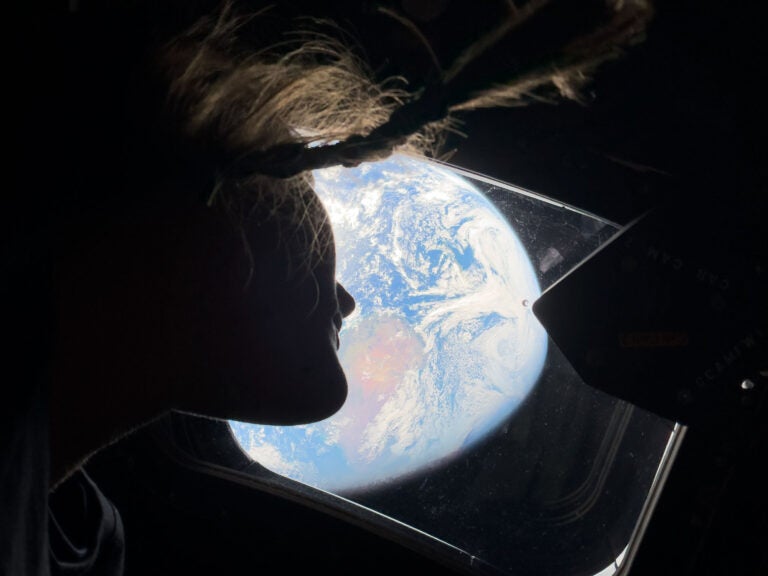
This image provided by NASA, astronaut and Artemis II mission specialist Christina Koch peers out of one of the Orion spacecraft's main cabin windows, looking back at Earth, as the crew travels towards the Moon on Thursday, April 2, 2026. (NASA via AP)
On Monday, the crew of NASA’s Artemis II mission will surpass the record for the farthest distance traveled from Earth by humans.
As the space capsule loops around the moon in the “lunar sphere of influence,” the four astronauts will have the ability to make observations never before seen by human eyes.
The crew is the first to leave Earth’s orbit since Apollo 17 in 1972, and NASA’s ramp up of its space program is just getting started. By 2028, the agency in partnership with either SpaceX or Blue Origin, wants to return humans to the lunar surface and gradually build a permanent moon base with landings every six months. “This time the goal is not flags and footprints,” NASA administrator Jared Isaacman said recently. “This time the goal is to stay…America will never give up the moon.”
Meanwhile, China is chasing a similar goal and plans to be on the moon by 2030. So, today on Studio 2 we’re unpacking the new space race. At a cost of billions of dollars and a decades long timeline, what’s at stake and is the American public onboard?
Guests:
— Christian Davenport, CBS space correspondent and author of Rocket Dreams: Musk, Bezos, and the Inside Story of the New, Trillion-Dollar Space Race
— Scott Solomon, professor of evolutionary biology at Rice University and the author of Becoming Martian: How Living in Space Will Change our Bodies and Minds
WHYY is your source for fact-based, in-depth journalism and information. As a nonprofit organization, we rely on financial support from readers like you. Please give today.
Brought to you by Studio 2


Triumph, Tragedy and Ennui: Three NASA Missions That Shaped the Future of Space Exploration
We look back at the first spacecraft landing on Mars in 1976, the Challenger tragedy in 1986, and the long-game Pluto mission launched in 2006.
Air Date: January 23, 2026
Listen 50:29
NASA astronauts Butch Wilmore and Suni Williams return to Earth after 9 months stuck in space
Their SpaceX capsule parachuted into the Gulf of Mexico in the early evening, just hours after departing the International Space Station.
1 year ago

What to know about Monday’s blue supermoon
The next blue supermoon will not happen until 2032, but supermoons occur more frequently.
2 years ago