Penn, Bryn Mawr and Swarthmore back Harvard in lawsuit to defend international student enrollment
The colleges say blocking international enrollment would harm U.S. higher education and the economy.
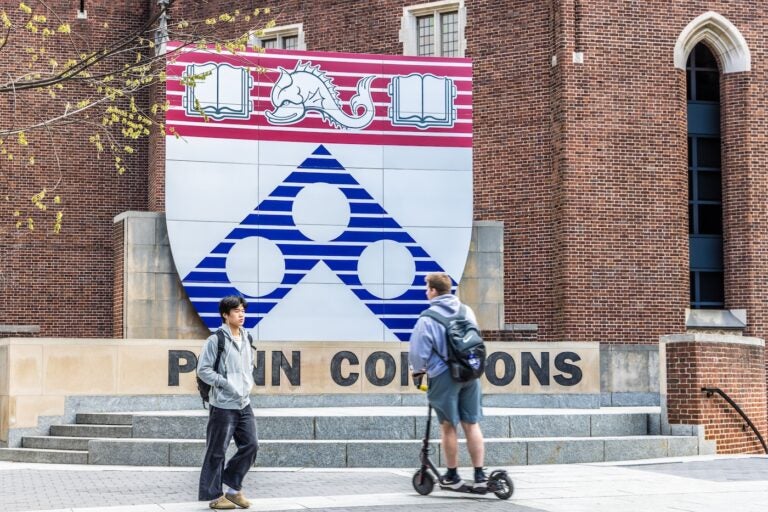
Students head to class on the campus of the University of Pennsylvania in Philadelphia. (Kimberly Paynter/WHYY)
From Philly and the Pa. suburbs to South Jersey and Delaware, what would you like WHYY News to cover? Let us know!
The University of Pennsylvania, Bryn Mawr College and Swarthmore College have signed onto an amicus brief supporting Harvard University in its federal lawsuit against an effort by President Donald Trump’s administration to block international students from enrolling at American universities.
The brief, which was filed on Jan. 20, emphasizes the contributions of international students to the United States, stating “the destabilization of student visa programs via arbitrary cancellations threatens to stymie progress in scientific research, medical advancement, and technological innovation, with untold and irreversible consequences for the United States.”
In statements to WHYY News, Bryn Mawr and Swarthmore reaffirmed their support of Harvard.
“Supporting international students is in the best interest of our college due to the significant value they bring to our campus community,” Charity Alinda, director of international student advising at Bryn Mawr, wrote. “We are committed to assisting any student who has chosen the U.S. as their destination for academic growth. Collaborating with other institutions on this journey benefits everyone involved.”
Alisa Giardinelli, vice president of communications at Swarthmore, wrote that the amicus brief “aligns with our mission and our deeply held belief that all of us benefit from engaging with diverse perspectives.”
“Every day, our international students enrich our campus community and society more broadly in countless ways,” she wrote. “Their experiences and world views deepen our understanding of complex global challenges, strengthen learning for all students, and help create an educational experience that prepares graduates to live and lead thoughtfully in an interconnected world.”
The University of Pennsylvania declined to comment on ongoing litigation.
The brief follows a lengthy legal battle between the Trump administration and Harvard. In May 2025, the Department of Homeland Security stripped Harvard of its Student and Exchange Visitor Program certification, blocking the university from enrolling international students. That included already-enrolled international students, who were told they “must transfer or lose their legal status.” According to DHS statements, the university leadership had created an unsafe environment for students by allowing “anti-American [and] pro-terrorist” conduct.
A week after the announcement, a federal judge issued a preliminary injunction, which allowed the university to continue enrolling international students.
Following the injunction, Trump issued a proclamation that barred individuals on nonimmigrant visas from studying or participating in exchange programs at Harvard for six months. U.S. District Judge Allison D. Burroughs issued another preliminary injunction, blocking the president’s proclamation. Since then, the Trump administration has appealed the decision to the U.S. Court of Appeals for the First Circuit. The American Council on Education’s amicus brief urges the court to uphold the injunction.
Related Content
The judge, a President George W. Bush appointee, likened the administration’s rationale for removing the panels to the authoritarian regime in George Orwell’s novel "1984."
1 month ago
Penn, Bryn Mawr and Swarthmore join 48 higher education institutions in signing the brief, which touts the benefits of international students to the U.S. The document states, in part: “Those who come from abroad to study and research in the United States enrich and strengthen our country in innumerable ways. These benefits are unattainable when schools are prohibited from enrolling international students because they do not pass the government’s ideological litmus test.”
International House Philadelphia has been an advocacy group for Greater Philadelphia’s population of international students since 1918. Its executive director, Bill Keyes, said that higher education institutions supporting Harvard in court “likely recognize that any policies jeopardizing international enrollment represent an existential risk.
“We cannot afford for students from around the world to second-guess whether their futures are secure here,” Keyes said.
Keyes noted that the federal government’s immigration crackdown and its position on international students has resulted in a 17% decrease in enrollment from overseas at U.S universities, as of fall 2025. According to a study from NAFSA: Association of International Educators, this drop is estimated to have cost the U.S. economy $1.1 billion and 23,000 jobs.
“The policy changes affecting employment-based immigration are already leading to the hemorrhaging of early-career talent the American economy really can’t afford to lose,” Keyes saod.
Jesse Ruhl, director of Philadelphia House, another advocacy organization, said international students are currently facing “overwhelming, troubling and even heartbreaking” levels of anxiety.
“That was already in place, of course, [due to] moving to a new country, a new school, a new language, new friends. But now on top of that, we have this sensation that international students are unwelcome here and that Big Brother is looking over their shoulder to see if they’re going to step out of line in any way, including their freedom of speech opportunities,” he said.
A study conducted by Campus Philly and International House found that more than 20,000 international students enroll in colleges and universities in the Philadelphia area annually. Ruhl said there is a “difference between looking at the international community as statistics as opposed to meeting with them, having fellowship with them, sharing with them.”
Working with the international community is “a wonderful opportunity to serve our brothers and sisters throughout the world,” he said.
The brief warns of the potential future implications of stripping universities of their student visa programs.
“Lingering uncertainty over whether student visas will remain available has already led many talented foreign students to seek opportunities elsewhere. ” the brief states. “Cancelling student visas—even at one university—risks undermining the entire system, and with it, all the ways visa recipients contribute to the United States.”
It is not clear when the court will rule on the lawsuit.
Editor’s Note: This article has been updated to make clear that the brief was filed by Harvard.

Get daily updates from WHYY News!
WHYY is your source for fact-based, in-depth journalism and information. As a nonprofit organization, we rely on financial support from readers like you. Please give today.
Part of the series

Transgender runner Evie Parts sues NCAA and Swarthmore College for removal from track team
The claim states the NCAA is not a governmental organization and doesn’t have jurisdiction over Pennsylvania state law or Title IX.
7 months ago
The settlement does not include the University of Pennsylvania and six other colleges, which are continuing to defend themselves against the class-action lawsuit.
2 years ago
Penn accused of illegally favoring students of wealthy families
The lawsuit alleges they conspired in a scheme to “price fix” financial aid and college admissions in violation of federal antitrust laws.
2 years ago