
‘Rewilding Philadelphia’ greening project brings pocket forest to Kensington
A coalition of conservation groups and artist Pete Angevine plan to plant 1,500 trees on a vacant lot.
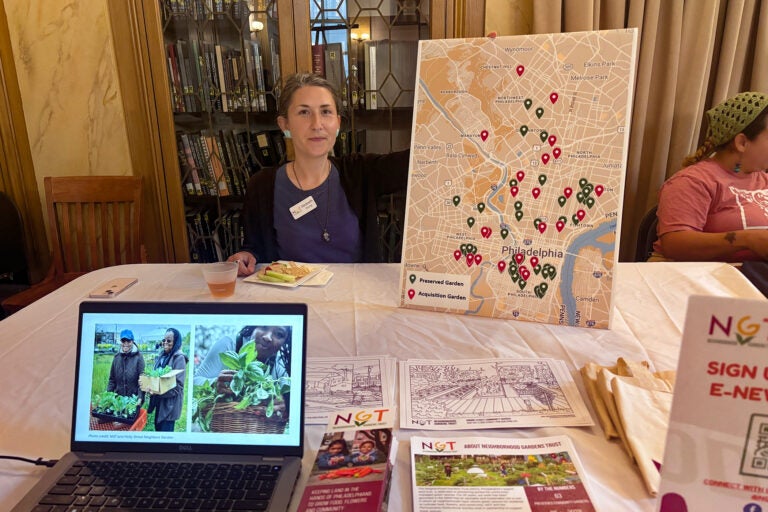
Philadelphia’s Neighborhood of Gardens Trust display of preserved gardens in the Philadelphia region. (Chelsea Lubbe for WHYY)
From Philly and the Pa. suburbs to South Jersey and Delaware, what would you like WHYY News to cover? Let us know!
Philadelphia is getting a new green space in Kensington.
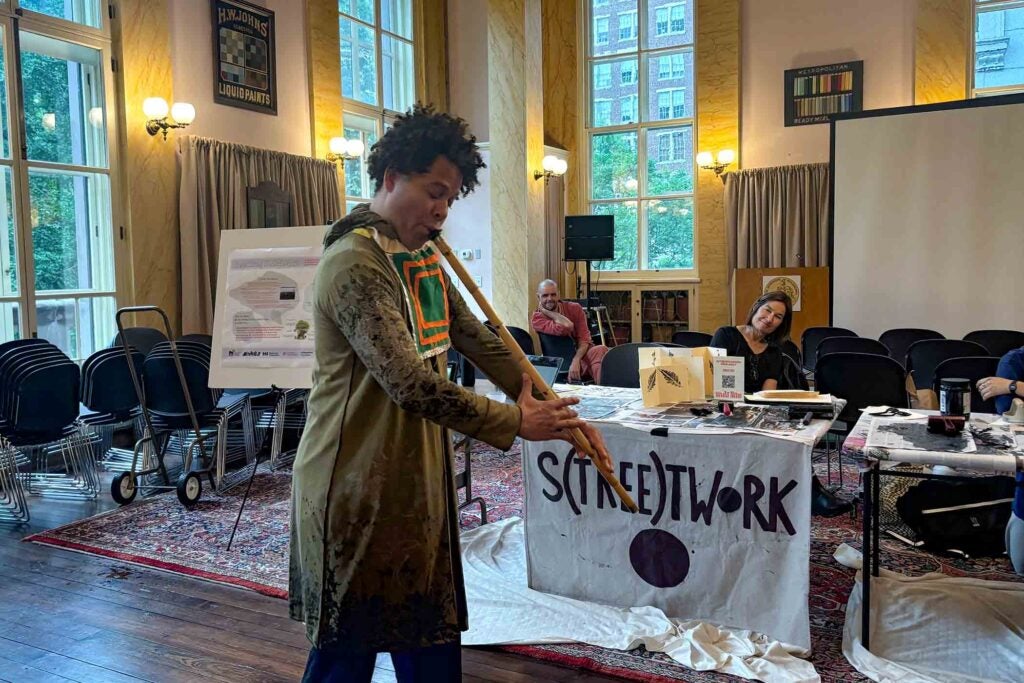
The project, Rewilding Philadelphia, is a collaboration among several Philadelphia-based urban conservation organizations and artist Pete Angevine. It was highlighted Tuesday during ArtPhilly’s “What Now: Salonish” event, which explored ideas for keeping Philadelphia unique and sustainable after the nation’s 250th anniversary.
Angevine has been developing Rewilding Philadelphia for years. The William Penn Foundation awarded the initiative a grant this spring.
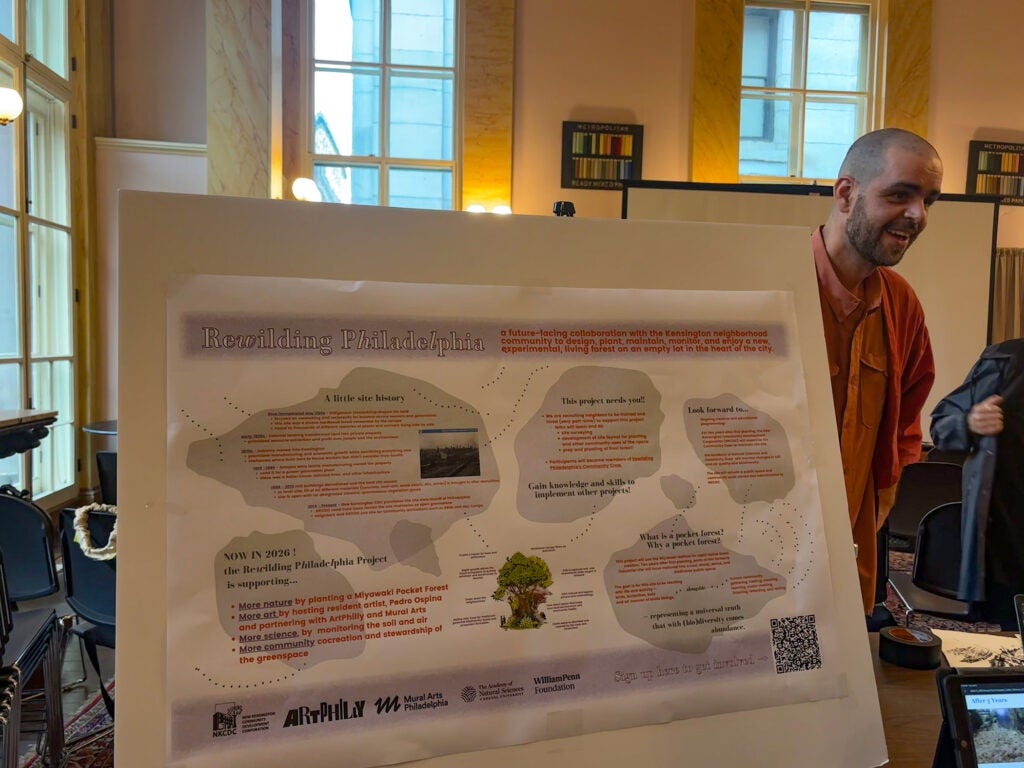
The goal is to transform urban areas into thriving ecosystems that support biodiversity. Using the Miyawaki Method, a technique that creates dense forests quickly on degraded land, Angevine plans to plant 1,500 trees at 2717 Jasper St. in October.
“Kensington is a place where there are layers and intersecting environmental justice issues and economic justice issues. We are creating paid opportunities for neighbors,” Angevine said. “We are going to be able to build an example here and show data, with scientific monitoring about why this is effective.”
Rooted in Kensington
Kensington ranks in the 97th percentile for lack of green space, placing it among the city’s highest-need areas, according to environmental justice mapping developed by the Academy of Natural Sciences of Drexel University, a Rewilding Philadelphia partner. Thirty-five species of plants and animals have been documented around the site, reflecting relatively low biodiversity.
And according to a 2019 study, Kensington ranked last among 46 neighborhoods in overall health factors.
The Jasper Street lot is a former industrial site that’s the size of about a dozen typical Philadelphia rowhouse lots. It has space for the components residents say will help the community most, such as outdoor classrooms, picnic tables and stages.
“When it really all came together was when we met with New Kensington [Community Development Corporation], who’s the property owner. It really aligns with the community greening initiatives that they are already doing. The tagline for this project is ‘We heal the land, the land heals us,’” Angevine said.
Angevine said Colombian-born sculptor Pedro Ospina will be the artist in residence for the Rewilding project, working in partnership with the New Kensington CDC, as well as the Recycled Artist-in-Residency program out of Northeast Philadelphia.
“Pedro will be working with the neighbors to make the space more beautiful and functional. We are going to have some paid opportunities to work with Pedro,” Angevine said.
Related Content
Kensington’s Peace Park opens with new Mural Arts sculpture made from disassembled firearms
The park’s centerpiece is its Gun Violence Memorial Sculpture featuring disassembled weapons collected during gun buyback events in 2024.
1 year ago
Listen 1:07Community engagement found that residents hope the new pocket forest will contribute to the development of welcoming public spaces, reduce urban heat effects, support wildlife and provide educational opportunities.
“I think [Angevine] has taken into account all the different steps that need to happen to make [rewilding] successful,” said Andrew Bunting, vice president of Pennsylvania Horticultural Society. “A lot of the work we do can be replicated and it can be scaled up.”
Rewilding Philadelphia builds on a broader network of neighborhood greening efforts.
“Hundreds of residents dedicate their time to growing healthy fruits and vegetables and we work with them to figure out pathways to permanently protect the land so it won’t be lost to development,” said Jenny Greenberg, executive director of Philadelphia’s Neighborhood of Gardens Trust, or NGT, one of the organizations invited to ArtPhilly’s Salonish event.
NGT has logged upwards of 500 community gardens in the city. Some are preserved by NGT, and others are controlled by the city’s Department of Parks and Recreation. NGT has been able to permanently protect 63 gardens around the city from redevelopment. Their goal is to reach 80 protected gardens by 2028.
Growing community investment
Investing in spaces like these can reduce violent crime in urban environments, according to the Philadelphia Department of Public Health. Philadelphia’s fiscal year 2025 budget included investments in parks, recreation centers and other clean-and-green initiatives.
Groups such as the Sunrise Movement in Philadelphia have continued to advocate for additional funding for neighborhood green spaces and people to maintain them.
Sunrise Philadelphia’s Sultan Smolly said staffing and funding are among the main hurdles Philadelphia must overcome to sustain these spaces.
“A volunteer is not a worker. They are not required to come in at any point,” Smolly said. “It is not a realistic replacement. People and community leaders deserve to be compensated for the work they do.”
Angevine said he considers the Rewilding project an experiment and believes Kensington is the right place to start. He said he is well into collaborating with community members on the project’s design.
“The big vision is that this is the first of many such projects. We can take what we learn from this, the data and the community science monitoring,” he said. “Kensington is not the only neighborhood that is lacking safe green community space.”
Editor’s note: The William Penn Foundation is among WHYY’s financial supporters. WHYY News produces independent, fact-based news content for audiences in Greater Philadelphia, Delaware and South Jersey.
WHYY is your source for fact-based, in-depth journalism and information. As a nonprofit organization, we rely on financial support from readers like you. Please give today.

400 trees and 12 new gardens: Nicetown-Tioga residents celebrate neighborhood greening initiatives
As part of the “Love Where You Live” program, the Pennsylvania Horticultural Society has helped transform 1.2 million square feet of land and plant 400 trees.
1 year ago
Listen 3:11
Children among 6 injured in fire that spread to multiple Kensington homes
The fire was reported just after 6 p.m. on Reach Street. Philadelphia officials say the injured include three adults and three children.
1 year ago
Kensington’s Peace Park opens with new Mural Arts sculpture made from disassembled firearms
The park’s centerpiece is its Gun Violence Memorial Sculpture featuring disassembled weapons collected during gun buyback events in 2024.
1 year ago
Listen 1:07