


Philly homeowners are about to receive new property assessments. Here’s what to know
The new valuations will be used to calculate property tax bills that will be due next March.

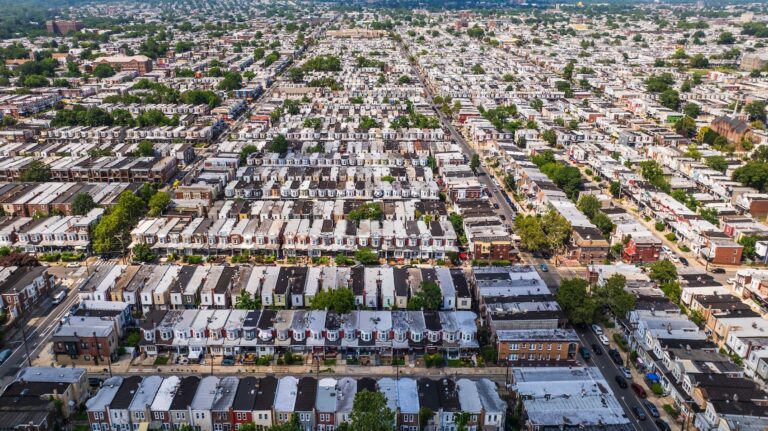
West Philadelphia rowhomes. (Kimberly Paynter/WHYY)
Have a question about Philly’s neighborhoods or the systems that shape them? PlanPhilly reporters want to hear from you! Ask us a question or send us a story idea you think we should cover.
In the coming weeks, potentially by the end of the month, residential homeowners across Philadelphia will — with a healthy dose of dread — start opening envelopes from the city containing their new property assessments.
That’s because the majority of them will be higher than the valuations sent out more than two years ago, the last time the Office of Property Assessment completed a revaluation of every property in the city.
“Some people are going to see a decrease. That’s great. Amen. Most people are going to see some kind of increase,” said Montgomery Wilson, a supervising attorney at Community Legal Services.
The assessments, which will also be posted online, will dictate how much homeowners will pay in property taxes in 2027. Which means thousands of residents will seek to lower the amount before their bills are due next March.
Here’s what to know about that:
2 options to appeal a property assessment
When it comes to property assessments, the city is not infallible. Mistakes happen. Homeowners who believe their valuation is inaccurate can file an appeal.
On this front, there are two free options, neither of which require an attorney.
“File both,” Wilson said. “There’s no reason to wait to do one and then the other.”
Homeowners can file what’s known as a First Level Review with OPA. This is considered an informal appeal, akin to asking the city to take a second look at the new assessment.
There’s no hearing. The city simply reviews the request — and any supporting documents — and reaches a decision.
According to the city, a homeowner must be able to prove one of the following:
- Their valuation is too high or too low and/or the characteristics of the property that affect the amount are “substantially incorrect.”
- The property’s valuation is “not uniform with other properties throughout the city.”
- The exemption or abatement listed for the property is incorrect or missing.
A form to file a First Level Review will be included in the mailing with the new assessment. Typically, recipients have 60 days to respond after the notices go out.
A city spokesperson said the OPA is aiming to release the new assessments at the end of June.
At the same time, property owners can file a formal appeal with the city’s Board of Revision of Taxes. This is essentially a request to have a third party review the assessment.
Unlike the informal appeal, homeowners get a hearing where they can argue that the city made a mistake.
This option takes time, with some cases taking a year or two to complete. In the meantime, homeowners are required to pay property taxes on the current year’s assessment, with the understanding that they may have to make an additional payment if the board decides the property is worth more than that amount.
“The worst thing you can do is pay nothing,” Wilson said. “At the very least, you have to pay last year’s taxes, the lesser amount, and wait to find out what level of difference you need to pay.”
This year, the state-imposed deadline to file an appeal with the board is Oct. 5.
Related Content
The bill is part of a broader effort to increase the capacity of the Fair Housing Commission, which is responsible for policing a variety of renter protections.
5 months ago
Listen 1:05Homestead exemption and LOOP
In Philadelphia, property assessments are supposed to equal — or at least closely mirror — the current market value of that property. And most of them do.
So while assessors do make mistakes, many of their new valuations will be considered accurate.
For many residents, that will present a problem if their new assessment is higher and they can’t afford to pay the taxes. This is why the city offers a menu of tax-relief programs designed to offset property reassessments, in addition to the option of entering into a payment agreement or installment plan.
The most popular program is the homestead exemption, which is available to all homeowners, regardless of their income.
Under the program, most homeowners are eligible to reduce their property assessment by $100,000. That means residents can reduce the taxable value of their home by that amount.
Under the Longtime Owner Occupants Program, certain homeowners can cap their property value for as long as they remain eligible.
According to the city, residents are eligible if:
- They own their home and have been living there for at least 10 years.
- Their assessment has increased by at least 50% over the last year, or 75% over the last five years.
- They have an income below the limit for their family size.
- They are current on their property tax payments, or have a payment agreement or installment plan.
If a homeowner qualifies, the city’s Department of Revenue cannot bill them above the cap, either 50% or 75%, respectively. For example, if your home’s value increases from $150,000 to $250,000 between 2025 and 2026, LOOP would freeze the valuation at $225,000.
A homeowner cannot be enrolled in LOOP or the homestead exemption at the same time, requiring residents to choose which program is more beneficial to them under the circumstances. The homestead exemption provides upfront savings while LOOP provides long-term savings.
Senior Citizen Real Estate Tax Freeze and Low-Income Freeze
These offer eligible homeowners the opportunity to permanently cap their property tax bill.
To qualify for the senior freeze, homeowners must be at least 65 years old. They are also eligible if their spouse is 65 or older and living in the same household, or if they are a widow who is 50 or older and their spouse was 65 or older when they passed.
Individual applicants cannot have an income greater than $33,500 a year. The maximum for a married couple is $41,500.
The freeze can be applied retroactively to 2018, meaning a homeowner who was at least 65 years old that year can apply the freeze to the tax bill they received then.
The Low-Income Real Estate Tax Freeze, the city’s newest initiative, largely mirrors the program for older adults, but only considers income eligibility.
Eligible homeowners can freeze their tax bill at the previous year’s amount, and there is a look-back window to 2024 for the next 10 years.
Participants of this program can take advantage of the homestead exemption.

Subscribe to PlanPhilly
WHYY is your source for fact-based, in-depth journalism and information. As a nonprofit organization, we rely on financial support from readers like you. Please give today.
Brought to you by PlanPhilly

PlanPhilly
In-depth, original reporting on housing, transportation, and development.
Philly’s new crime lab takes shape as City Council approves borrowing $40 million more
The Police Department's $95 million facility in University City will replace what is widely considered an undersized, outdated lab in North Philadelphia.
1 week ago
Listen 0:47
While there’s widespread support for saving the pop art mural, its future remains uncertain due to its condition.
2 weeks ago
Listen 1:09
Philadelphia real estate developers argue a 20-year tax abatement would boost city revenues
Critics contend tax breaks deprive the city and schools of badly needed funds, while proponents say that’s a misconception.
2 weeks ago
Listen 1:23