

Lessons learned from Ida: Philadelphia must brace for next big storm, Penn researchers say
During the aftermath of Hurricane Ida, the Schuylkill River rose to levels that hadn’t been recorded in more than 150 years.
Listen 1:04
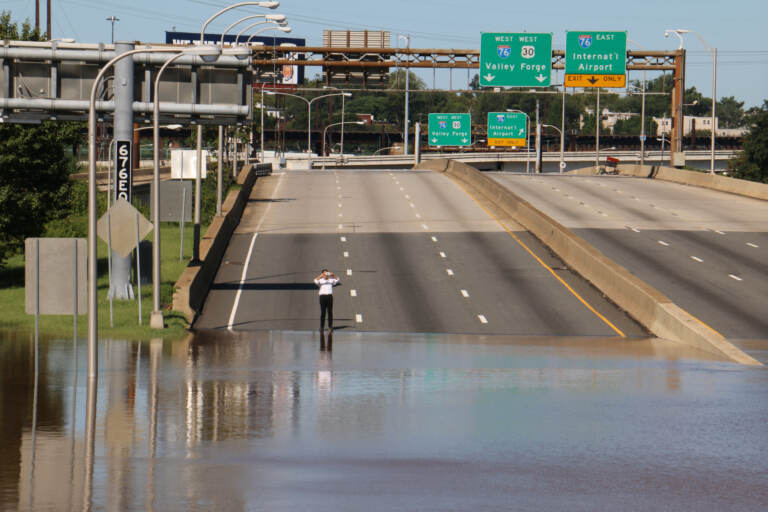
Flooding caused by the remnants of Hurricane Ida closed the Vine Street Expressway. (Emma Lee/WHYY)
This story is part of the WHYY News Climate Desk, bringing you news and solutions for our changing region.
From the Poconos to the Jersey Shore to the mouth of the Delaware Bay, what do you want to know about climate change? What would you like us to cover? Get in touch.
As the remnants of Hurricane Ida hit Philadelphia in 2021, the Schuylkill River rose above 16 feet, flooding nearby roads, businesses, homes and landmarks.
Parts of Boathouse Row were encompassed by flood waters, the popular Schuylkill River Trail was submerged and the high-traffic Vine Street Expressway closed down as murky water rose almost as high as the overpass.
Researchers at the University of Pennsylvania say these intense storms, once expected only a couple of times in a century, are projected to happen every three years.
The study, published in npj Natural Hazards, finds that the effects of climate change compounded by paved surfaces and outdated drainage systems threaten increasingly damaging floods in Philadelphia.
The team of scientists used hydrological and climate models to assess the future risk of intense storms and rainfall along the Schuylkill River.
“Today they’re record events, but if we continue to warm the planet, because we continue to burn fossil fuels and generate carbon pollution, then events today that are singular, that are unprecedented, become commonplace,” said Michael Mann, one of the study’s authors and an environmental science professor at Penn and the director of the Penn Center for Science, Sustainability, and the Media.
Related Content
NOAA is rolling out an experimental tool to help emergency planners predict extreme rain events in 60 cities, including Philadelphia and Dover, Delaware.
3 months ago
Listen 1:08‘Screwed as a society’
The researchers collected data using self-driving boats that scanned the bottom of the river at high resolution. The data, along with technology like laser scanning, helped the scientists conduct street-level modeling to recreate Ida’s steps.
The results showed that because Philadelphia is highly urbanized with vast areas of impervious surfaces, water is less likely to be absorbed by the ground. The effects of the storm were also intensified because the soil in the area had been saturated by two previous rainfall events.
In addition, the flood accumulated in pockets of the city that trapped the water because of the surrounding infrastructure in low-lying neighborhoods.
“This is rainfall happening in a sort of maze,” said lead author Hugo Ulloa, an environmental science professor at Penn. “It’s a very complex structure set by the buildings. So, the water also gets trapped through the city.”
From there, water moved through the sewer system and emptied into the river, which has been confined by surrounding infrastructure like roads and walls, preventing the water from being absorbed by permeable banks. As a result, the channelized flow rises until it spills out over the walls and floods nearby roads.
The results of the study are not surprising because extreme precipitation events are on the rise and impervious surfaces like roads and parking lots are expanding, said Upmanu Lall, a professor of engineering and the director of the Columbia Water Center at Columbia University who was not involved in the study.
“With warming, you have more moisture in the air, and you have higher tides because the tidal levels have been going up, and so these two together with the landscape changes increase the vulnerability to floods,” he said.
The research found that Ida impacted high-income residents in highly developed areas and low-income residents with limited resources to prepare for major storms.
Lall said most cities are unprepared to mitigate against extreme flooding events, and residents are not protected because the cost of obtaining flood insurance is often too expensive. In addition, flood insurance companies are failing to pay out claims, according to reports. Lall said it requires collective action to reduce climate-warming emissions and ensure cities are more resilient against extreme weather events.
“I would say we are screwed as a society, because the ability to control these floods is not there. And even with the efforts that are being done to mitigate the impacts of floods, there’s not going to be a significant mitigation,” he said.
The city’s drainage system was designed to help remove runoff from paved surfaces, but it was not designed to handle large storms, said Franco Montalto, a Drexel University environmental engineering professor who was not involved in the study.
Philly’s Green City, Clean Waters plan
In 2011, the Philadelphia Water Department launched a 25-year plan, known as Green City, Clean Waters, to reduce the amount of sewage entering the city’s waterways by using green infrastructure and expanding stormwater treatment capacity. The project has been estimated to cost up to $4.5 billion over time, which is partly funded by increasing ratepayers’ water bills, in addition to state and federal grants.
However, it was not designed as a flood mitigation program.
“The green stormwater practices it produced can reduce flood risks during small-moderate [rainfall] events, but they are not designed to detain, retain or infiltrate the larger flows associated with the bigger storms being triggered by climate change,” Montalto said.
A spokesperson for the Philadelphia Water Department said the city is reviewing the study. The department is working with the Office of Sustainability and other partners to handle the issue of climate change, a spokesperson said, pointing to several programs aimed at addressing the impacts that climate change has on drinking water, wastewater and stormwater systems, and to improve climate resilience.
Ulloa, the study’s author, said cities must be designed and modified in a way that makes them more resilient to flooding, including improving sewer systems and installing green infrastructure that soaks up water.
“We need to start thinking on how to be able to capture this water, mobilize this water and have a more resilient landscape where we could have capacity to absorb these flood waves,” he said. “We need to live with this river, and we want to have a healthy Schuylkill River, and we want to stay close to it, but that means that we need to have innovation and think about smart solutions.”
Montalto said engineering strategies that aim to trap water, or social efforts such as relocating residents away from flood zones, each have pros and cons.
“The right approach for a particular community can only be developed through a collaborative and deliberative process, informed by science and modeling,” he said. “We generally look for no-regrets strategies that can be effective against a variety of future conditions. It takes time for teams of stakeholders to understand all the different points of vulnerability, and in many cases climate change is creating new flooding pathways.”

Get daily updates from WHYY News!
WHYY is your source for fact-based, in-depth journalism and information. As a nonprofit organization, we rely on financial support from readers like you. Please give today.
Part of the series
Part of the series
Watershed
Preserving Our Water: How we use our Delaware Watershed.
The project is funded by The William Penn Foundation.
Researchers find microplastics in insects from Schuylkill River watershed
The researchers found that microplastics were as prevalent in forested parts of the watershed as they were in urban areas.
3 days ago
Listen 1:21
Opposition to data center construction is rising sharply, survey says
Opposition has jumped significantly among both Democrats and Republicans, according to a recent Penn poll.
2 weeks ago
Listen 1:07
Environmentalists say contaminated waterways in Philadelphia are caused by raw sewage overflows.
2 weeks ago
Listen 1:19