
Federal judge finds Trump violated First Amendment by ordering NPR, PBS defunded
The decision leaves the future of federal funding for public media “unresolved,” WHYY’s CEO said Tuesday, but it’s a positive sign.
Listen 1:15
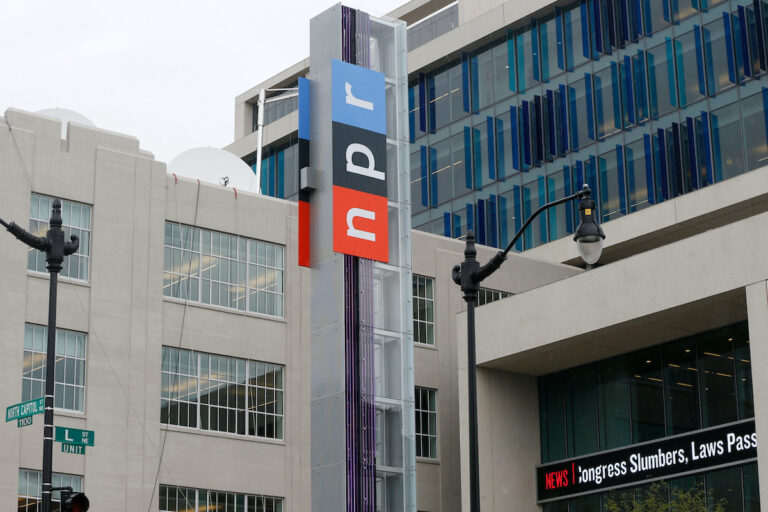
FILE - National Public Radio (NPR) on North Capitol Street in Washington, April 15, 2013. (AP Photo/Charles Dharapak, File)
From Philly and the Pa. suburbs to South Jersey and Delaware, what would you like WHYY News to cover? Let us know!
A recent court ruling reaffirming the editorial independence of public media organizations offers a legal victory for local stations like WHYY, but does little to address the industry’s financial uncertainty.
A federal judge issued an opinion Tuesday blocking President Donald Trump from implementing an executive order ending federal funding for National Public Radio and the Public Broadcasting Service. The directive had already led to the shutting of the Corporation for Public Broadcasting, which distributes that funding, and came ahead of congressional efforts to claw back money that had already been appropriated.
NPR and a handful of affiliates sued the administration, which led to Tuesday’s decision.
Bill Marrazzo, president and CEO of WHYY, Philadelphia’s NPR and PBS affiliate, said the decision leaves the question of future funding unresolved.
“There’s nothing in this decision, as far as I can see, that offers us a chance of seeing the restoration of federal funding,” Marrazzo said.
However, Marrazzo said that he felt “quite positive” about the court’s ruling on free speech grounds.
U.S. District Judge Randolph Moss said Trump had violated the First Amendment because the decision to defund public media was punishment for past speech.
“The message is clear: NPR and PBS need not apply for any federal benefit because the President disapproves of their ‘left wing’ coverage of the news,” Moss wrote.
Marrazzo said the decision helps “clarify and support the notion that public media is able to unequivocally make editorial decisions without interference from other parties, including the federal government.”
“That’s a very good thing,” he said. “If people can rely on what we do and how we do it, knowing that it’ll be fact-based and truthful and valuable to their decision making in their own community.”
Related Content
Court settlement calls for NPR to get $36M in government funds to operate US public radio system
National Public Radio will receive approximately $36 million in government funding to operate the nation’s public radio interconnection system under the terms of a court settl
11 months ago
Independent public media
While NPR’s and PBS’ finances have been significantly impacted, there has been more concern that individual radio and TV stations, largely in rural communities, are the most affected, with some facing shutdowns, layoffs and reduced programming.
Some stations, such as WHYY, have raised money through individual contributions, donors, underwriting and grants to supplement federal funding. In WHYY’s case, federal funding has accounted for 7% of the company’s total budget.
Marrazzo added that for several years, the diversity of WHYY’s income stream has kept the station on solid footing during what he called a “rollercoaster ride” of funding, including federal dollars.
“I don’t see that changing, so long as we continue to create content that is useful to our audiences and different from the other thousand channel choices people have around the dial,” he said. “So I’m pretty bullish about WHYY’s continued ability, not just to survive, but to thrive.”
WHYY may also expand its reach. Federal funding cuts had put WPSU, a public radio station in central Pennsylvania, at risk of becoming the first in the state to shut down.
Now, WHYY is working to acquire the station from Pennsylvania State University, which had already planned to close it.
“We’re probably somewhere on the fifth-yard line in being able to complete that deal in the next couple of months,” Marrazzo said. “If we can get that done, we will have preserved public media for 1.5 million people in central and northern Pennsylvania.”

Never miss a moment with the WHYY Listen App!


WHYY is your source for fact-based, in-depth journalism and information. As a nonprofit organization, we rely on financial support from readers like you. Please give today.
Trump again appeals to Supreme Court on mail-voting restrictions with midterm elections looming
The high court's conservative majority previously allowed the president’s plan to move ahead, but they have not decided whether it is legal.
1 month ago
Grand jury refuses to indict Democratic lawmakers in connection with illegal military orders video
Rep. Chrissy Houlahan and other Democrats had said the Trump administration was investigating them over the video.
8 months ago
Judge dismisses Comey, James indictments after finding that prosecutor was illegally appointed
The orders make Lindsey Halligan the latest Trump administration prosecutor to be disqualified because of the manner in which they were appointed.
11 months ago