

At Philly’s Eastern State Penitentiary, a synagogue reveals prison’s long debate over religious freedom
“Freedom Through Faith” at the historic prison’s original synagogue shows how Philly’s Jewish community stepped up for the incarcerated.
Listen 1:23
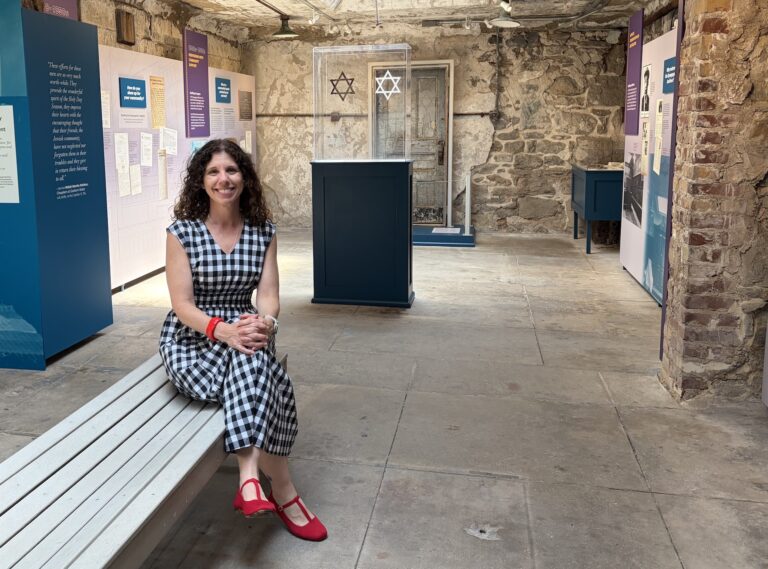
Kerry Sauter, president and CEO of Eastern State Penitentiary, sits in the historic prison's exhibition 'Freedom Through Faith.' (Peter Crimmins/WHYY)
From Philly and the Pa. suburbs to South Jersey and Delaware, what would you like WHYY News to cover? Let us know!
The Eastern State Penitentiary in Philadelphia is using its restored prisoner’s synagogue to show how engaging in religious practices while incarcerated has never been simple or straightforward.
The historic stone prison, now a museum and visitor attraction, was the first to establish a dedicated synagogue in 1922. The overall design concept for Eastern State was influenced by religious ideas of penitence, its isolating cells intended to push inmates into contemplating their past criminal acts in a spiritual light.
Josh Perelman, consulting curator for “Freedom Through Faith: Judaism at Eastern State and Beyond,” said the religious underpinnings at the penitentiary were Christian.
“Historically, prisons have always been faith communities,” he said. “What this synagogue does is become a real-life testament to what is a growing legal expansion of the rights of inmates to religion of their own.”
Rocky legal road for religious practice in prison
Although the First Amendment guarantees religious freedom in America, when a person is incarcerated, those freedoms become murky, at best, and often disappear. The exhibition describes the 1871 Virginia Supreme Court decision in Ruffin v. Commonwealth, which held that all personal rights are forfeited when a person becomes a prisoner, becoming “a slave of the state.” By the mid-20th century, courts allowed certain rights to be retained.
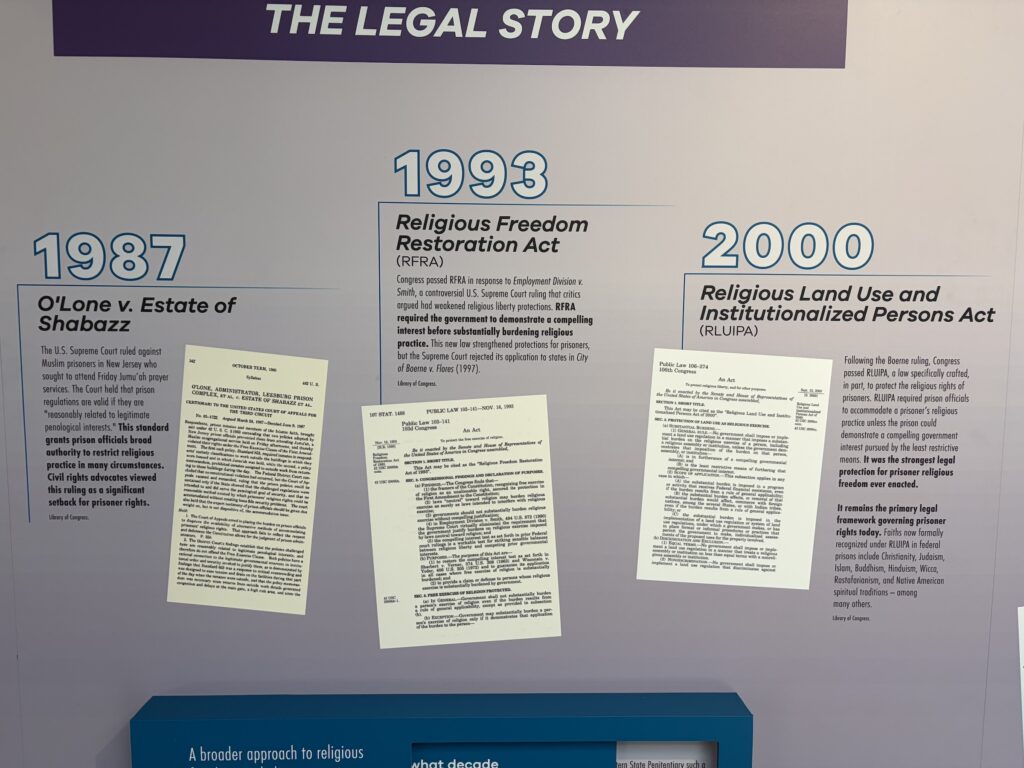
Since then, courts have gone back and forth over how much religious liberty can be extended to prisoners. For example, judges have ruled that inmates can have religious texts, such as a Quran, in their cell, but also that prisons can restrict inmates from congregating for Muslim prayers.
The uncertainty of practicing religion in prison is ongoing. In 2022, the Supreme Court ruled that inmates sentenced to death have a right to a spiritual leader with them at the moment of execution, but to this day some states do not comply.
Days before “Freedom Through Faith” opened at Eastern State, the Supreme Court made a mixed ruling on a case involving a Rastafarian inmate whose dreadlocks — a recognized part of that religious practice — were forcibly cut off by guards. The court ruled the plaintiff had a right to dreadlocks but did not have the right to sue the individuals who cut them all.
Perelman said the creation of a dedicated space for Jews inside a prison in 1922 was remarkable, given the national mood at that time.
“It was a very complex time in our nation’s history: The height of the eugenics movement, the height of an anti-immigrant movement, legislation against immigrants,” he said. “Here in Philadelphia, a community came together, an interfaith community, to create a sacred space for Jews imprisoned in Eastern State.”
Perelman added that as the United States celebrating its 250th anniversary, the space shows that “no matter what is happening in the larger context of our nation, local communities have real power.”
The circus performer who helping people reenter society
Supporting the Jewish community inside the penitentiary involved a motley crew of Philadelphians inside and outside the prison. Beginning in 1893, Rabbi Sabato Morais, leader of Mikveh Israel in Philadelphia, began personally visiting incarcerated Jews inside Eastern State to act as a go-between for the prisoners and their families outside.
The relationships built by Morais led to the creation of the synagogue. Shortly after it was built, Alfred Fleisher became president of the prison’s board and began using his own money to create prison workshops to allow inmates to earn money. According to a 1945 study of Philadelphia prisons conducted by the Jewish Welfare Society, about half of all incarcerated Jews were skilled or semi-skilled laborers.
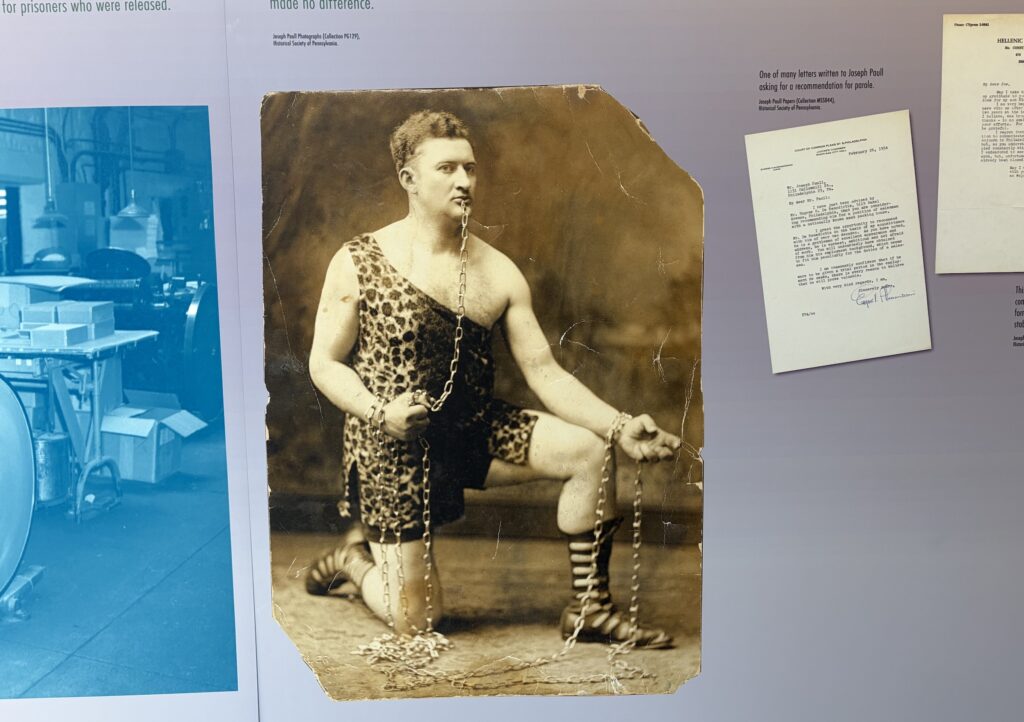
To entertain the inmates, Fleisher brought in a circus strongman named Joseph Paull to perform. Paull’s day job was a kosher butcher in South Philadelphia. He immediately became heavily involved in rehabilitation efforts to ensure people returning to society had a chance to become reestablished with jobs, homes and families. He advocated on behalf of prisoners who were denied parole for lack of a reentry plan and is believed to have personally assisted about 300 people at Eastern State Penitentiary and Graterford Prison.
‘This is what you do for people who are your neighbors’
The walls of the “Freedom Through Faith” exhibition are sprinkled with excerpts from letters expressing gratitude to Paull by formerly incarcerated people.
“Maybe we can repay you by becoming decent citizens, and like you and your wife, reach out a hand to those that need help,” wrote Sydney Bleecher, formerly incarcerated in Eastern State, in 1948.
The Philadelphia Jewish Welfare Society created the Personal Aid Bureau to give material support to incarcerated Jews and those reentering society.
“They were doing reentry work that we can’t even get right today, but they’re doing it in the 1910s and the 1920s,” said Kerry Sautner, Eastern State president and CEO. “They’re buying houses. They’re teaching people skills while they’re incarcerated. They’re supporting their families on the outside so their families aren’t falling apart.”
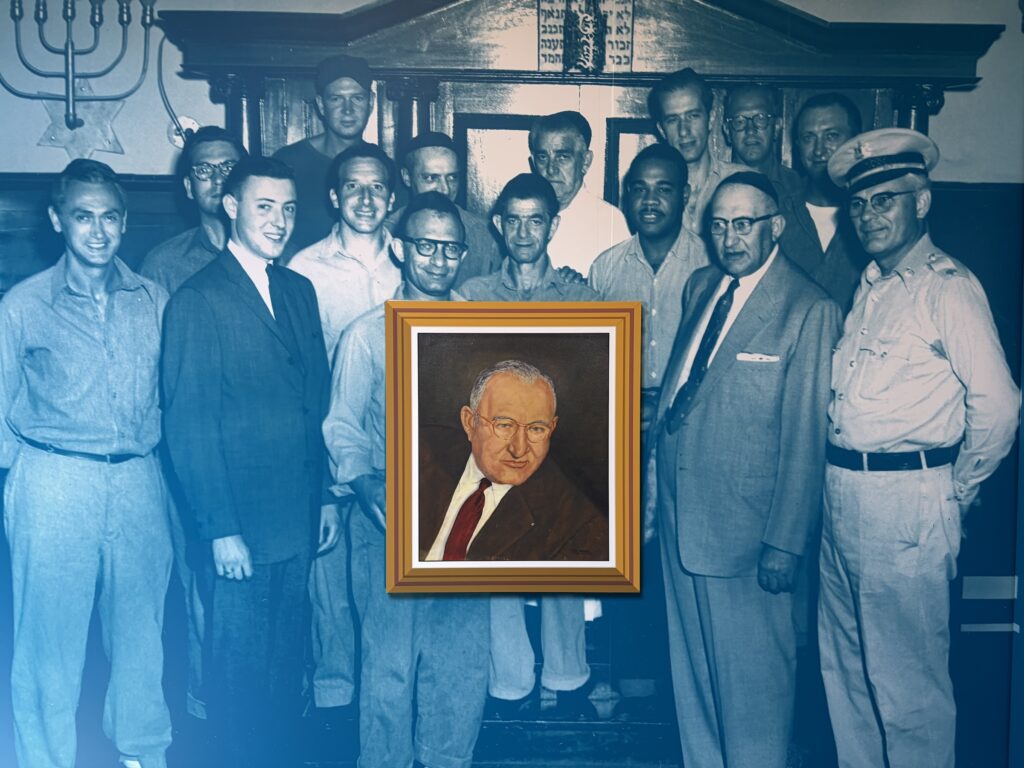
After Fleisher died in 1928, inmates named the penitentiary’s synagogue after him. After the prison was abandoned in the 1970s and then revived as a visitor attraction, the synagogue was restored and reopened in 2009. It is still used for Jewish worship.
“Alfred Fleischer didn’t tell his kids these stories,” she said. “Their family has a seder here once a year. We had been in the archives and I shared one of the stories. The family, 125 people, are staring at me going, ‘What are you talking about, Kerry?’ I’m like, ‘You didn’t know this story?’ This wasn’t to get the credit. This was: This is what you do. This is what you do for people who are your neighbors.”
“Freedom Through Faith” is a new permanent exhibition at Eastern State Penitentiary, available to visitors during the site’s regular opening hours.
Editor’s Note: The article has been corrected to reflect that the 1871 Virginia Supreme Court decision in Ruffin v. Commonwealth held that all personal rights are forfeited when a person becomes a prisoner.

Get daily updates from WHYY News!
WHYY is your source for fact-based, in-depth journalism and information. As a nonprofit organization, we rely on financial support from readers like you. Please give today.
A giant glass box has landed at Philly’s Independence Mall. Who are those people inside?
A new pop-up installation in Center City advocates for clean slate laws using life-size stacks of paperwork.
3 years ago
Listen 1:06
Eastern State Penitentiary has launched a family-friendly offering for spring break
A former Philly penitentiary, now a museum, is presenting a spring break exhibit highlighting sports and recreation behind bars.
3 years ago
For the first time in 29 years, Eastern State Penitentiary museum has a new leader
Kerry Sautner will take over the historic prison museum in Philadelphia.
3 years ago