

Cape May County Zoo’s new red panda could help protect endangered species
The 1-year-old newcomer offers a window into habitat loss, species survival and wildlife conservation efforts underway at the zoo.
Listen 1:10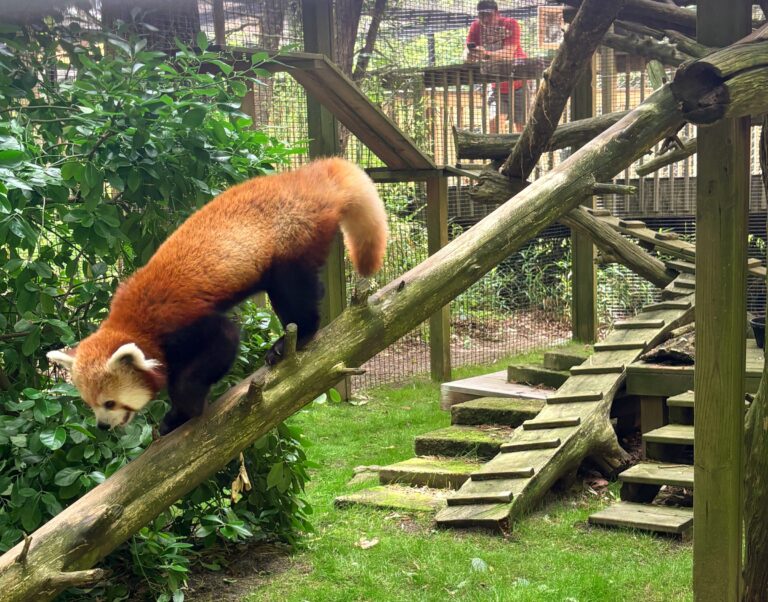
Wally has been well socialized and is ready to greet visitors. (Rebecca Acevedo for WHYY)
From Camden and Cherry Hill to Trenton and the Jersey Shore, what about life in New Jersey do you want WHYY News to cover? Let us know.
The Cape May County Zoo has a new red panda, and zoo officials hope the fuzzy newcomer will someday help secure the future of his species.
Wally, whose full name is Dr. Stephen Wallace, arrived in May from Zoo Knoxville and celebrated his first birthday June 3, according to zoo officials. Just a few feet away in a separate yard lives Ember, a female red panda that came to Cape May from New York’s Trevor Zoo in February 2026 and will turn 1 on June 16.
Zoo officials say the pair’s arrival is about more than introducing visitors to a cute new animal. They are part of a broader effort to protect the future of a species facing threats in the wild.
“It’s all about protecting the genetics for future generations,” said Kendra Verity, education department supervisor at the Cape May County Zoo. “The way I like to describe it is it’s almost like an insurance policy on their wild counterpart.”
An endangered species facing an uncertain future
Wally was named after the paleontologist who discovered fossils in Tennessee belonging to ancestors of the modern red pandas that now live in the eastern Himalayas. Today, red pandas are found in dense mountain forests stretching across Nepal, India, Bhutan, China and Myanmar, where they rely on bamboo for survival.
That habitat is disappearing. The species is listed as endangered by the International Union for Conservation of Nature, which estimates red panda populations have fallen by roughly half over the past 18 years. Experts consider habitat loss and fragmentation to be among the primary drivers of that continuing decline.
For Verity, the biggest threat facing the species is straightforward.
“Deforestation. So habitat loss,” she said. “Their environment is being threatened.”
The loss of forest habitat is especially challenging because red pandas are arboreal animals that spend most of their lives in trees. Their wrists can rotate nearly 180 degrees, helping them climb and descend trees with ease. Sharp claws help them grip branches, and scent glands in their paws allow them to leave scent marks that help them communicate and identify territory.
“They would really only come down to the ground to use the bathroom and then they want to be up in the trees,” Verity said.
As forests disappear, red pandas are often forced to travel on the ground to find food and new habitats, increasing their exposure to predators and other risks.
Verity said visitors often assume red pandas are closely related to giant pandas.
“A lot of times people, because their name is panda, get them confused with the giant panda,” she said. “They’re actually not related to the giant panda at all.”
Instead, red pandas belong to their own taxonomic family and were identified decades before giant pandas, making them the original panda.
Related Content
Beyond Anthropomorphism: The Science of Animal Emotions
We explore the inner lives of animals, from pain in lobsters to odd-couple friendships to empathy in baboons.
Air Date: February 27, 2026
Listen 49:34Why Wally came to Cape May
Wally’s arrival was carefully planned through the Association of Zoos and Aquariums’ Species Survival Plan, which helps accredited zoos maintain genetically diverse populations of endangered animals.
The goal is not simply to have animals on exhibit. The program is designed to ensure healthy genetics remain available for future generations.
In Wally’s case, that meant finding a genetically appropriate match for Ember. The two red pandas are not related, making them potential breeding partners in the future.
Still, zoo officials say there is no rush.
“They’re both too young,” Verity said. “We’re just looking to get them both settled here.”
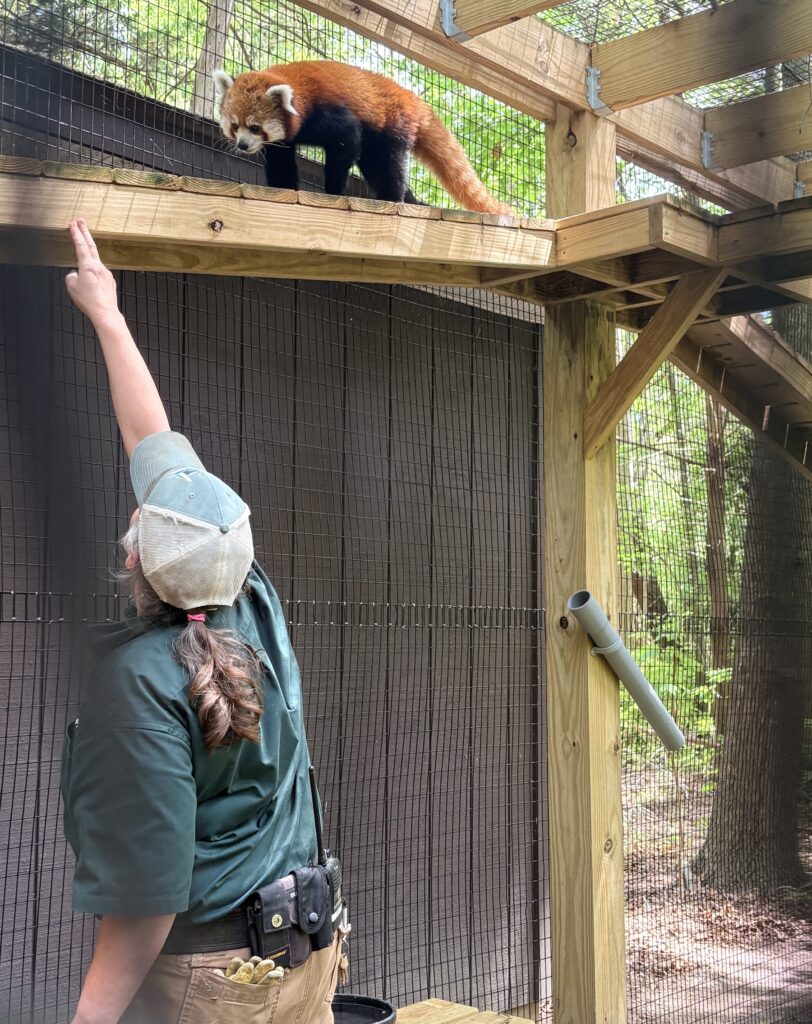
Before any introductions occur, staff use a gradual process that allows the animals to see, smell and eventually interact through protected barriers.
“We go at their pace,” Verity said.
The process reflects the animals’ natural behavior. Red pandas are generally solitary in the wild and typically come together only to breed.
If Wally and Ember eventually produce offspring, those animals would likely be placed at other accredited zoos based on the needs of the Species Survival Plan.
Building trust, one interaction at a time
Helping a red panda adjust to a new environment involves more than providing food and shelter. For keepers, building trust can take weeks, or even months.
Amy King, one of the zoo’s red panda keepers, said it took patience for her to develop a relationship with Ember.
“At first she would just stare at me,” King said. “And then after a while, she would get comfortable enough that she wouldn’t approach me, but she would just be in the yard, eating bamboo.”
King spent weeks simply sitting in the habitat and allowing Ember to become accustomed to her presence.
Eventually, she began offering fruit from the end of a bamboo stick.
“I would slowly creep my hand up the stick,” King said. “This is over, like, weeks.”
The process gradually led to direct interactions.
“Now she’ll come over to me. She’ll grab my hand with her paw. And she’ll let me touch her,” King said.
Wally’s transition has been different.
“Very social. Super social,” the zookeeper said.
Because Wally is already comfortable around people, King has begun working on behaviors that support routine health care.
Both red pandas voluntarily step onto a scale each week. Staff are also working on crate training and other husbandry behaviors that can make veterinary care less stressful.
Related Content
Meet Chick Pea, a Brahma chicken at the Philadelphia Zoo who’s poised to predict Super Bowl winner
The zoo’s ambassador animal will peck her pick on Friday. Will she side with the Seahawks or pray for the Patriots?
9 months ago
Encouraging natural behaviors
Much of the zoo’s daily enrichment program is designed to mimic behaviors red pandas would naturally perform in the wild.
“For enrichment, we focus on trying to bring out natural behaviors in them,” King said. “Since they’re arboreal, important ones are climb, and since they forage a lot, it would be explore, climb and forage. Those are the behaviors we try to do the most with enrichment.”
The approach encourages the animals to stay active while reinforcing behaviors essential to their survival in the wild.
According to zoo staff, about 95% of a red panda’s diet consists of bamboo. Much of the bamboo fed to Cape May’s red pandas is grown on zoo grounds.
King said red pandas typically live eight to 10 years in the wild, though those in human care can live significantly longer. The zoo’s former red panda, Luna, lived more than 22 years.
Conservation beyond the zoo
The Cape May County Zoo’s conservation efforts extend beyond caring for animals on site.
Verity said the zoo supports the Red Panda Network, which works to protect red panda habitat in Nepal, educate local communities and reduce threats to the species.
Last year, the zoo raised more than $6,000 for the organization.
“A lot of times making a connection with an animal, even if it is just because it is so cute, might inspire people to learn more about them, learn more about their habitat and then hopefully want to help,” Verity said.
The zoo also participates in conservation initiatives supporting other species, including bison and snow leopards.
Cape May County Administrator Kevin Lare said the zoo is funded through a combination of county tax revenue and private donations. The county receives an average of about $1.5 million in donations each year to support the facility. In 2026, salary, wage and operating expenses totaled $3.1 million. Admission has always been free, and the county says they intend to keep it that way.
For now, visitors may simply see Wally exploring a new habitat, climbing through trees and getting comfortable in his new surroundings.
Zoo staff see something more.
His arrival is another step in a long-term effort to protect a species whose future depends on preserving its habitat and its genetic diversity for generations to come.
“People have to think bigger than our neighborhood,” Verity said. “This is an animal that we do not want to go extinct.”
The Cape May County Zoo, which was recently named one of the nation’s best free attractions by USA Today, is open daily from 10 a.m. to 4:30 p.m. The zoo welcomes about 750,000 visitors a year.
WHYY News is partnering with independent journalists across New Jersey to spotlight the people, communities, cultures and distinctive places that shape the Garden State. This work is made possible with support from the Geraldine R. Dodge Foundation.

Get daily updates from WHYY News!
WHYY is your source for fact-based, in-depth journalism and information. As a nonprofit organization, we rely on financial support from readers like you. Please give today.
Part of the series

New Jersey diaries: From shore towns to small towns
WHYY News is partnering with independent journalists across New Jersey to spotlight the people, communities, cultures and distinctive places that shape the Garden State.
From beach wheelchairs and access mats to beach taxis and accessible restrooms, here's where to find accommodations down the shore.
4 months ago
How the Wildwoods became a Jersey Shore staple — across 4 separate towns
What do cattle, railroads and neon motels have in common? They helped shape the barrier island’s evolution into a summer vacation destination.
6 months ago

2026 Jersey Shore beach tags: What they cost and where beaches are free
More shore towns in Atlantic and Cape May counties are moving to digital beach badges. In several communities, you can buy them before you hit the sand.
6 months ago