

Camden nonprofit plans to keep bus riders cool with shade and pollinator gardens
Neighborhood Collaborative Community Gardens’ bus shelters will include shade trees, pollinator-friendly plants and air quality monitors.
Listen 1:11
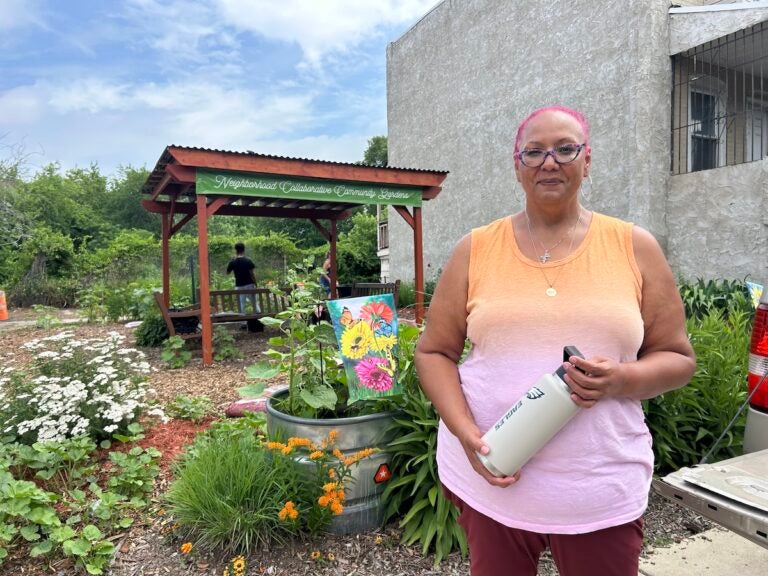
Jacqueline M. Santiago-Vicente stands in the Byron Street community garden her nonprofit cares for in Camden's Cooper Point neighborhood. (Sophia Schmidt/WHYY)
This story is part of the WHYY News Climate Desk, bringing you news and solutions for our changing region.
From the Poconos to the Jersey Shore to the mouth of the Delaware Bay, what do you want to know about climate change? What would you like us to cover? Get in touch.
Wanda Lopez remembers sitting on her front step when there was no shade to be found on her block in the Cooper Point neighborhood of Camden.
“The sun [was] directly frying you,” Lopez remembered.
That was before the New Jersey Tree Foundation and Neighborhood Collaborative Community Gardens planted cherry trees along her sidewalk. The nonprofit also built a community garden with a pergola, sunflowers and watermelons behind her house.
“I can actually sit out there now,” said Lopez, a program assistant with Neighborhood Collaborative Community Gardens. She added that 90-degree days would probably feel like 100-degree days without the trees and garden. “It’s a major difference.”
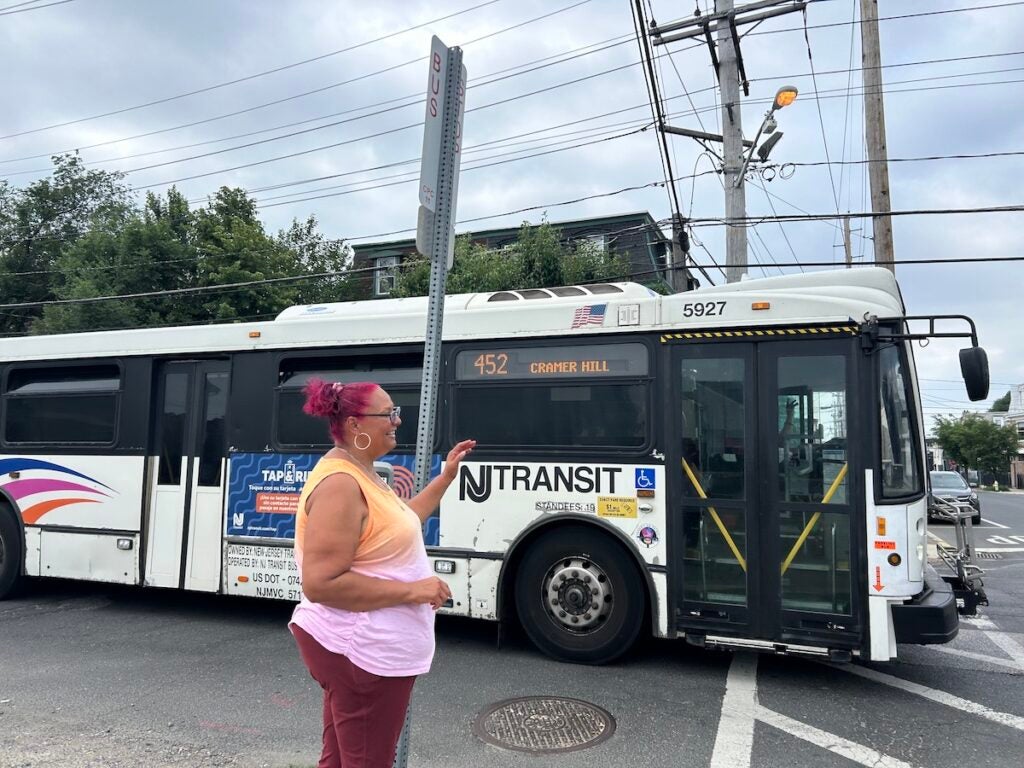
The nonprofit Neighborhood Collaborative Community Gardens plans to spread this shade to more parts of Camden next summer by building four “blooming bus stops” throughout the city. These vegetated bus shelters will include shade trees, flowering plants and painted pergolas, said Jacqueline M. Santiago-Vicente, executive director of Neighborhood Collaborative Community Gardens.
“It’s much more than just a pretty bus stop,” she said. “It’s really taking care of people’s health.”
Fighting the urban heat island effect in Camden
Neighborhood Collaborative Community Gardens’ bus shelter project is funded by a grant from the New Jersey Board of Public Utilities for reducing the urban heat island effect in overburdened municipalities.
The urban heat island effect refers to the way that pavement, concrete and buildings in areas with few trees trap heat and radiate it out at night, making these areas hotter in the summer compared to rural areas with more vegetation. This effect can raise temperatures by 7 to 9 degrees Fahrenheit, a growing concern as human-caused climate change makes dangerous heat waves more common.
Related Content
North10 is helping contractors and households pay to dispose of waste legally, diverting thousands of pounds of trash from illegal dumpsites.
1 week ago
Listen 0:59Researchers have found a link between the urban heat island effect and redlining. In Camden, a Columbia University analysis found that areas including Lopez’s neighborhood of Cooper Point that had been graded “hazardous,” the lowest grade on the federal government maps from the 1930s that influenced racist lending practices, had the hottest land surface temperatures during the summer months between 2013 and 2023.
Dr. Elizabeth Cerceo, an internal medicine physician at Cooper University Hospital who specializes in environmental health and is consulting on the blooming bus stop project, said this heat puts stress on the body. She said warmer temperatures can affect student learning, drive more workplace injuries, worsen mental health and result in poor health outcomes.
“We’ll see, routinely, exacerbations of underlying conditions, exacerbations of asthma or … chronic obstructive pulmonary disease or congestive heart failure, because of that additional stress,” Cerceo said.
Cerceo sees the blooming bus stop project as a “stepping stone” toward larger-scale interventions that can improve Camden residents’ health and well-being.
“Increasing the tree canopy however we can is really, critically important,” she said.
Bus shelters aim to shade, beautify and clean the air
Santiago-Vicente said many Camden residents rely on buses to get around, but most bus stops in the city lack bus shelters.
“So, if you’re standing there waiting for the bus stop, there’s no tree, there’s no shade, there’s no alcove,” she said.
The shelters will be located near schools. Each will include a bench beneath a pergola, flanked by a tree and pollinator-friendly plants.
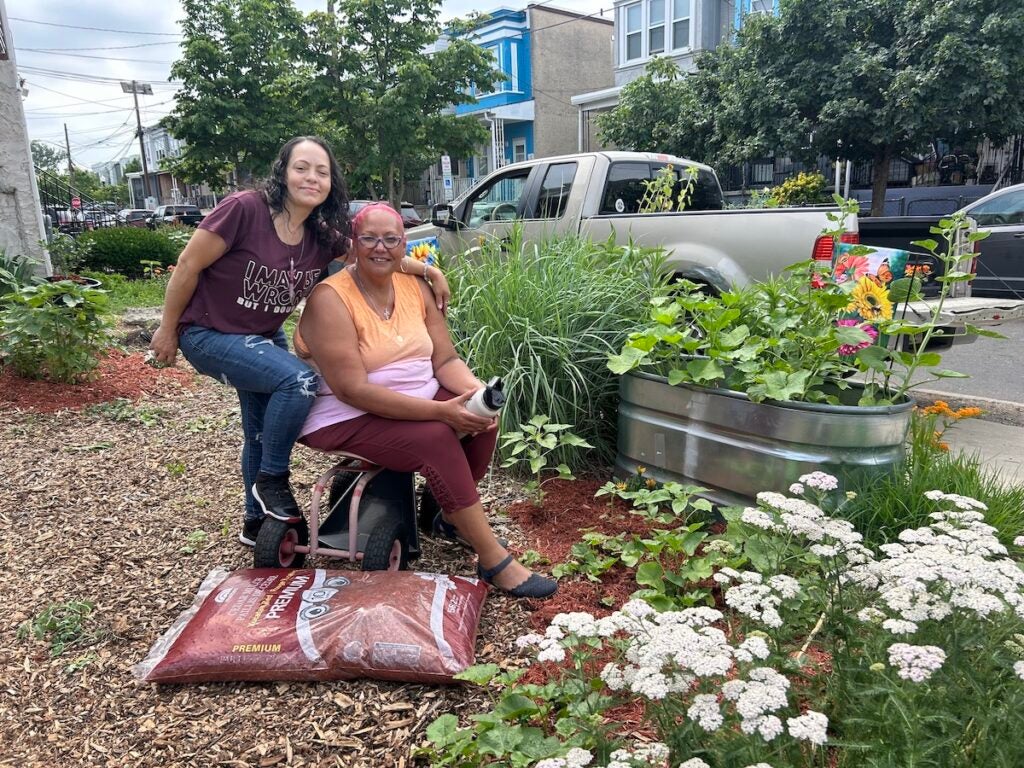
Santiago-Vicente said the structures will include a rain catchment system designed to reduce runoff, a feature she said is important in a city that frequently floods. Santiago-Vicente hopes the trees will also help improve air quality for people sitting near traffic. The shelters will be equipped with temperature and air quality sensors that will measure fine particulate matter, monitored by Rowan University professor Mahbubur Meenar.
Santiago-Vicente envisions the bus shelters looking “vibrant and exaggerated,” with flowers and pergolas painted by students.
“You’re breathing in beautiful oxygen,” she said. “You’re looking at beautiful plants. The pollinators are coming in — the bees and all the other stuff. It’s a full loop.”
Neighborhood Collaborative Community Gardens plans to install the bus shelters next summer. Santiago-Vicente said after the first round is built and planted, she hopes to replicate them throughout the city.

Get daily updates from WHYY News!
WHYY is your source for fact-based, in-depth journalism and information. As a nonprofit organization, we rely on financial support from readers like you. Please give today.
Part of the series

Plymouth Township, Conshohocken-area residents shout, boo, as hearing for data center begins
Residents say they’re concerned the new data center will reduce property values and impact their quality of life in the suburban Pennsylvania towns.
3 days ago
Vineland data center makes case for on-site power generation during 6-hour hearing
Developers for the New Jersey-based center plan to use on-site fuel cells, saying the new plan will not draw power from the grid or increase residential rates.
4 days ago
Red knot populations improve slightly along Delaware Bay, but remain fraction of historic levels
Biologists in New Jersey and Delaware spotted more red knot birds this year, but levels remain significantly lower than before the 2000s.
1 week ago
Listen 1:18