



The rise of peptides: How the wellness craze is outpacing the science
Peptides, once confined to labs and medical settings, can now be found anywhere from wellness spas to neighborhood smoke shops.
Listen 20:53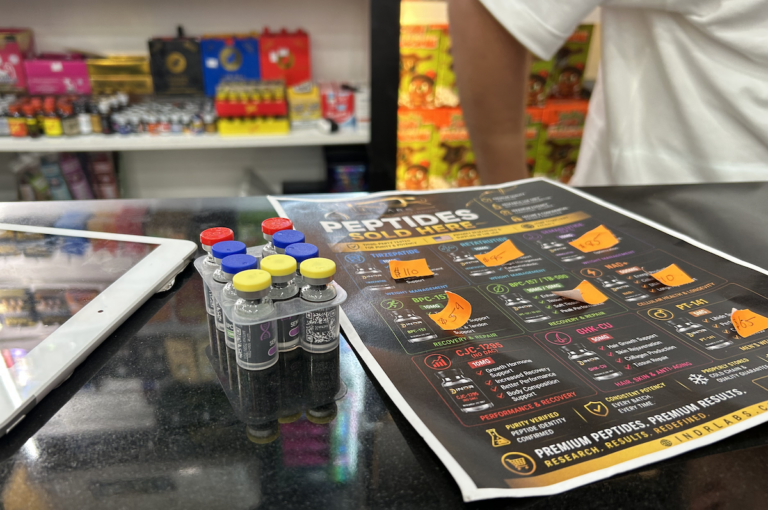
Consumers are purchasing unregulated peptides, often labeled for research purposes, online, at select health clinics, and at tobacco and specialty shops. (Bruce Gil)
This story is from The Pulse, a weekly health and science podcast. Subscribe on Apple Podcasts, Spotify, or wherever you get your podcasts.
Find our full episode on peptides here.
At a smoke shop in Williamsburg, Brooklyn, a poster hung in the window saying, “PEPTIDES SOLD HERE,” promoting one of today’s biggest and most controversial fitness trends.
“It’s been like two months since we first started selling them,” said the clerk behind the counter, when I asked him about the poster in July.
He said customers come in asking about them at least every other day.
A small flyer on the counter listed about a dozen peptide products promising to help with everything from weight management and muscle recovery to hair growth. Most cost around $95 a vial.
The clerk grabbed a tray of small vials from a shelf behind him. Each is filled halfway with white powder, covered with a black label, and topped with a brightly colored cap. Surprisingly, the packaging doesn’t look too out of place alongside the colorful vapes and nicotine pouches sold in the store.
The clerk explained that the powder needs to be mixed with water, typically bacteriostatic water, before being injected.
“Then you could just buy a needle from CVS or anywhere that you can find and just inject it,” he said.
These injectable peptides have been used in bodybuilding and biohacking circles for years but have recently started hitting the mainstream. They’re now popping up as treatments in wellness spas, being hawked over social media, and apparently even sold in smoke shops.
Notably, the vials carry an important disclaimer in small print: “Research Use Only.”
The label suggests these products are intended for laboratory research rather than human use, however, simply writing “Research Use Only” on a vial doesn’t allow sellers to get around drug laws.
This year, the Food and Drug Administration sent warning letters to several peptide companies using similar disclaimers, saying other evidence, including claims on their websites, showed the products were actually being marketed for human use.
But that hasn’t stopped this gray market from growing in popularity despite safety risks.
Subscribe to The Pulse
In New Jersey, 22-year-old registered nurse Azeem Anjum said that he started taking peptides last year to help with ankle pain and later to lose a couple of pounds.
At a busy cafe next to Hackensack University Medical Center, where he works, Anjum explains the process of mixing and injecting peptides. He said that some people add extra bacteriostatic water to make the injections burn less. Anjum, wearing navy blue scrubs and a scrub cap covered in cartoon raccoons, admits the process can be rather intimidating for someone who doesn’t work in healthcare and could lead to mistakes.
“I think that’s where the danger starts because people are people — and people make mistakes,” Anjum said. “So, it’s very important to know how to do something before you do it.”
He said the peptides have worked for him and that he knows plenty of other people taking them, including some doctors.
“I can probably tell you like 20 people off my head that I know personally are taking peptides,” Anjum said.
What are peptides?
Peptides are short chains of amino acids, which are often called the building blocks of proteins. Many act as signals in the body, helping regulate processes such as hormone release, tissue repair, and inflammation.
Some peptide drugs are well established. Insulin is one. So are popular GLP-1 medications such as Ozempic and Zepbound. Those drugs, however, have gone through several clinical trials and the FDA’s drug approval process.
But many of the peptides now promoted online and sold in New York City smoke shops have not. Some of these same sellers also offer the active ingredients in GLP-1 medications without a prescription, again claiming they’re meant for research purposes.
One of the most popular peptides is BPC-157, which users claim can help heal injured tendons, ligaments, and muscles and speed up post-workout recovery.
It’s gotten so popular that Dr. Flynn McGuire, a sports medicine fellow at the University of Utah, and his colleagues reviewed the research behind it last year.
McGuire says BPC-157 was developed by Croatian scientists in the 1990s who were studying compounds found in gastric juice. They wanted to know whether substances that help protect the stomach tissue from digestive acid could also help other parts of the body recover from injuries quicker.
“There’s lots of studies in rodents to say that with various different tissue injuries and skin, tendon, muscle, that using this BPC-157 might help accelerate that healing or improve it. But that’s essentially it,” McGuire said.
However, McGuire emphasized that there’s a huge gap between what works in animals and what works in humans.
McGuire and his colleagues found just one small, published human study involving BPC-157 for a musculoskeletal problem. But he says the study was too poorly designed to tell researchers much.
“There was no control group. There was no standardized dosing. People received more than one substance,” McGuire said. “They were asked months down the line, just: ‘Did you get better? Did your symptoms improve?’ with no tracking in between. So you can’t really say whether or not their symptoms got better due to random chance, because of the peptides that were injected. Were they doing different physical therapy exercises in the interim? Were they taking other things? You just don’t know.”
Still, McGuire’s conclusion is not that BPC-157 is ineffective. It’s that researchers still don’t have enough reliable evidence to determine whether it works in humans or what its long-term risks might be. The same is true for many of these peptides.
On top of that, products bought through this gray market may contain the wrong dose, impurities, or no peptide at all.
Last year, two women were hospitalized in critical condition after receiving peptide injections at a booth during the Revolution Against Aging and Death Festival in Las Vegas. Both experienced difficulties breathing and required ventilators. They have since recovered. Investigators were unable to determine whether the women reacted to the peptides themselves or whether the injections were contaminated because they couldn’t obtain the substances for testing.
More recently, CBS News reported that the FDA had received reports of two deaths involving people who took products claiming to contain retatrutide purchased through the gray market. This peptide treatment is currently being developed by Eli Lilly for weight loss and diabetes but has not been approved by the FDA. Still, “Reta” is widely available through the gray peptide market. CBS noted that the reports had not been verified and that it was unclear whether the products were responsible for either death.
Despite the risks and unanswered questions, injectable peptides continue to grow in popularity, thanks in large part to social media.
How peptides went mainstream
Dr. Alexander Weber, chief of the University of Southern California Epstein Family Center for Sports Medicine, said patients ask him about peptides nearly every day. He co-authored a review of injectable peptides earlier this year and believes two major cultural shifts have helped bring them into the mainstream.
“I think Covid and the Covid vaccine and the way that was handled in this country really changed people’s perspectives on healthcare and where they got their healthcare information, number one,” Weber said. “And number two, I think GLP-1s, which are FDA approved peptides, have been incredibly successful, incredibly successful.”
He said the combination of growing mistrust of the medical establishment following the pandemic and the rise of injectable weight-loss drugs has made more people comfortable taking peptides they buy online.
These products are also being pushed by hundreds of fitness and wellness influencers on social media platforms like Instagram and TikTok.
“I don’t even know how, but they were showing up on my algorithm,” said Conor Gorman ,32, who lives in a suburb of Chicago. “I mean, left and right. I really didn’t follow a lot of health focused pages. I was following Barstool Sports, your stereotypical major content, the influencers, but they just started showing up on my algorithm.”
Earlier this year, Gorman began documenting his firsthand experiences with peptides on Instagram. He says he spends between $350 and $450 a month on several different peptides. So far, he says they’ve worked for him.
“Ever since I started taking them and working out, I’ve noticed my body recovers a lot faster. I feel a lot healthier,” Gorman said. “I used to suffer from migraines. I have not had a migraine in over three months.”
For some peptide users, taking one or two compounds is just the beginning.
Adrian Maldonado, a 29-year-old firefighter and online fitness coach in Brooklyn, started taking BPC-157 and TB-500 after a workplace injury worsened his hip pain. He eventually needed a hip replacement, but believes the peptides helped improve his mobility before surgery.
He still uses them occasionally for maintenance but has since started taking other peptides too. He said he does his own research, looking at clinical studies and other users’ experiences online since there is limited human studies.
“So those two together was where the whole peptide journey started pretty much, focusing on just healing. And then I went down the rabbit hole and then I started going into all of them,” Maldonado said.
He now also takes KPV, thymosin alpha-1, and GHK-Cu.
When asked whether he worries about side effects that may not show up for years, he doesn’t sound too concerned.
“We don’t know what will happen in the long term until the long term comes,” Maldonado said. “I already crossed that line. So, am I worried about it? No. I already made the decision.”
WHYY is your source for fact-based, in-depth journalism and information. As a nonprofit organization, we rely on financial support from readers like you. Please give today.
Brought to you by The Pulse
Philly-area cancer survivors, doctors say new, nonhormonal menopause drug expands treatment options
Certified menopause doctors say elinzanetant, a nonhormonal drug for hot flashes, could be a new option for women who can’t take hormone treatment therapies.
1 year ago
Listen 4:20
The FDA approved updated COVID-19 vaccines for people 65 and older and younger adults and children with underlying medical conditions.
1 year ago
Listen 1:22
As of September 10, all mammogram centers and providers are required to inform patients if they have dense breast tissue, which can make screening more difficult.
2 years ago
Listen 5:56