
Bonus Episode Three: Eastern State Penitentiary
A panel of experts and advocates gathered at the nation’s oldest penitentiary to discuss the history of incarceration and the realities of prison for women today.
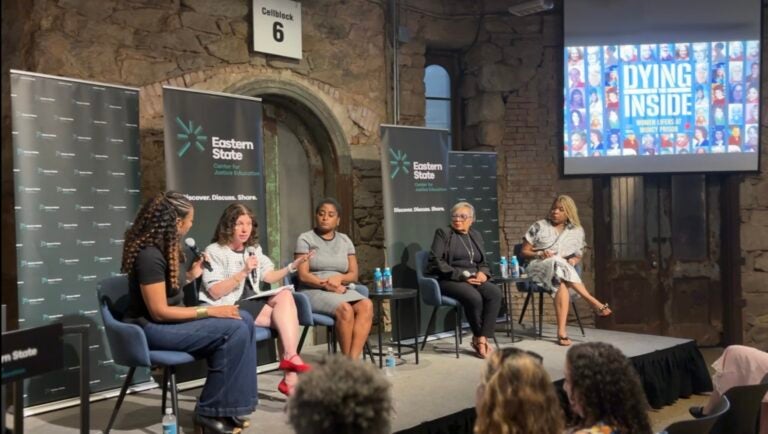
A panel of prison experts and advocates, moderated by Cherri Gregg (left), discussed the history of women’s incarceration at Eastern State Penitentiary on May 20, 2026. | JOLYNE BYRD This episode is from Dying on the Inside: Women Lifers at Muncy Prison, a podcast production from Create Genius Media (founded by Studio 2 co-host Cherri Gregg) and Temple University’s Logan Center for Urban Investigative Reporting.
The United States penitentiary system was born in Philadelphia at Eastern State Penitentiary in 1829 and has since grown to become the largest in the world. More than 900 women were incarcerated at Eastern State over a nearly 100-year period. A panel of prison experts and advocates gathered at the penitentiary, which closed in 1970 and later reopened as a historic site, on May 20, 2026 to discuss the history of women’s incarceration and the impact of the criminal justice system on them today.
Kerry Sautner, the president and chief executive officer of Eastern State, said despite the prison’s early focus on reform and rehabilitation for male prisoners, that concept did not apply to women, who were compelled to do domestic labor. Keisha Hudson, the Chief Defender at the Defender Association of Philadelphia, said the makeup of women who have entered the criminal justice system has remained similar over time, with many experiencing childhood physical or sexual abuse prior to incarceration. Hudson added that there is little emphasis today on reform and rehabilitation for girls and women. Sameerah Shabazz, a political strategist who experienced incarceration as a teenager, said women are judged more harshly for being impacted by the criminal justice system than men. Tonie Willis, the founder and executive director of Ardella’s House, a service and advocacy organization for women and girls with criminal justice histories, said progress on legislation to reform the criminal justice system is slow because politicians do not want to pass too much at once.
-
Episode Transcript
Cherri Gregg: This is a bonus episode of Dying on the Inside: Women Lifers at Muncy Prison. I’m Cherri Gregg, Host and co-Executive Producer of the podcast.
collapse
What you’re about to hear is a live conversation recorded on May 20th, 2026, at Eastern State Penitentiary Historic Site. It was part of their Justice 101 series. The event was titled “Dying on the Inside: The History of America’s Incarceration of Women.” Throughout this series, we have explored the lives of women serving long and life sentences at Pennsylvania’s SCI Muncy. We’ve heard stories of aging, illness, loss, accountability, resilience, and of hope. But this conversation asks a totally different question: how did we get here?
The program began with my co-Executive Producer Yvonne Latty reading a letter from Sarita Miller, one of the women featured in this podcast. Sarita is serving a life sentence at SCI Muncy. She is also the co-Founder and co-Editor of Daughters Magazine, a publication created by and for incarcerated women. She asked Yvonne to share her words with the audience. Here’s that conversation.
[music]
Yvonne Latty: There’s a woman we met named—who’s also in the podcast, her name is Sarita Miller. And she actually runs a prison magazine that just won a Society Professional Journalist Award as Best Prison Magazine. And when I presented the same opportunity to say something to you guys, being a journalist, she had a lot to say. And I want to share that with you, because I think it’s really impactful. Sarita is also serving a life sentence without parole. And she says:
“Unfortunately, we still live in a society that believes in a, quote, “lock them up mentality” and it’s just not working, nor has it ever, nor will it ever. Criminalizing people for addiction or hurting them through a three-month prison program will not cure addiction’s pull or make society more safe. I realize that it’s difficult for people who have been affected by senseless violence. Our world has become a scary place. No one wants to hear about second chances when they have lost loved ones. Yet we have to start fighting back and minimize the carnage that comes with addiction.
There is still hope. We should never place our trust solely in the hands of our government officials. The healing fight for our communities start within our communities. Whether we acknowledge one another or not, we are all one human race, subject to the very same pitfalls and calamities that comes with life. It is human nature to judge until calamities falls at one’s doorstep. People are so misinformed, guided by a mental leash, that people believe everything the system tells them. For instance, people who commit all sorts of hardcore crimes are released every day in this country. Some people who are sitting on death row or serving life sentences are innocent, or have culpability in their crimes, but yet are not the primary perpetrators. This injustice is due to a system who only wants to incarcerate, leaving a lot of victims’ families never receiving the justices they truly deserve. May God bless us with his wisdom, his love and his strength. May we stand together in healing, rebuilding for our communities.”
And I wanna say like for those of you especially who are old enough to remember the crack epidemic that kind of just like swept through cities, Sarita was suffering from an addiction to crack when she did her crime. And so now I wanna introduce my partner in all of this. You may know Cherri Gregg as the co-Host of Studio 2 at WHYY. She’s an attorney, a journalist who focuses on social justice and stories impacting marginalized communities. She is also the creator and executive producer of the Emmy Award-winning Good Souls Project, WHYY’s effort to highlight individuals and organizations making a positive impact on this region. Two years ago, Cherri asked me to coffee to discuss an idea she had, and here we are. She is the seed this work has sprouted from. I am proud to call her my partner in this incredible life-changing project that literally has changed how I see the world, to be honest, and I’m also proud to call her my friend. Cherri Gregg.
[applause]
Cherri: Thank you so much for coming out. I’m so glad you got in before the rain started to pour. Thank you so much, Yvonne, for that wonderful introduction. This has been an amazing collaboration, working with you for the past couple of years. A true highlight, and it’s work that I will never forget. And also thank you to all the women, their families, and so many others who shared their stories for Dying on the Inside Women: Lifers at Muncy Prison.
So over the past several weeks, through Dying on the Inside: Women Lifers at Muncy Prison, we’ve explored what happens when women grow old behind prison bars. The physical toll, the emotional toll, the impact on families, and the complicated questions surrounding punishment, accountability, and redemption. But tonight, we wanted to take a step back and really ask a broader question: how did America come to incarcerate so many women in the first place? Because women’s incarceration is not new. For nearly two centuries, women have been incarcerated in this country, including right here at Eastern State Penitentiary, one of the most influential prisons in American history. And from the very beginning, women were often punished differently than men. But over time, the system expanded dramatically. And since the 1980s, the number of incarcerated women in America has exploded, increasing by more than 600%. Today, women are the fastest-growing incarcerated population in the country. And the reasons are complex. And while prisons were largely designed for men, women behind bars often face unique realities, and there are similar realities that are very unique when we talk about re-entry as well. And so tonight’s conversation is about history, but it is also about the present. We’re gonna examine how incarceration for women has evolved, what changed, what didn’t, why reform has been so difficult, and what lessons history may offer us now. And we’ve got a wonderful group of panelists that I now would like to introduce. Are y’all ready? All right, can we give a nice round of applause to welcome them?
First, I’d like to introduce Dr. Kerry Sautner, the president and CEO of Eastern State Penitentiary here, which interprets the legacy of American incarceration and criminal justice reform from the site of the nation’s first penitentiary. Kerry, come on up. Our next panelist is Keisha Hudson, the Chief Defender of the Defender Association of Philadelphia. She’s a nationally recognized criminal justice advocate. Keisha, come on up. Next we have Tonie Willis, the Founder and Executive Director of Ardella’s House. And I have to call her a personal friend. I’ve known her for well over a decade at this point. She supports justice-impacted women through housing, advocacy, family reunification, and re-entry services. And last but not least, I want to introduce a woman who I have been impressed by from the moment I met her several years ago. Sameerah Shabazz is a political strategist. She’s an advocate. She’s founder of the Lizzy—of The Carter Lizzy Group?
Sameerah Shabazz: Yes.
Cherri: Yes. After experiencing incarceration as a teenager, she transformed her life. She has two master’s degrees, okay? Has taught all over the world. And now she works to advance opportunity, civic engagement, and justice reform for underserved and justice impacted communities. Can we give this panel a round of applause? Come on up, Sameerah.
[applause]
And so I wanted to start this conversation with-by rewinding the clock back. When Eastern State opened in the early 1800s, Kerry, what was sort of the philosophy behind incarceration itself? And then explain how we looked at, or how this place looked at incarcerating women versus incarcerating men.
Kerry Sautner: And you laid it out really perfectly there. So much of when they’re looking at incarceration in America, they’re really centering it on men. So shocker, they’re building systems and designs in America centering on men. You can put that statement for so much of every system set up in America. When we look at the medical system, we look at so many of those systems. So that is not unheard of and especially in American history. I mean, they did not understand why so many women were dying on the operating table for heart surgeries until the 1970s. Women’s heart surgeries and men’s heart surgeries are completely different, because they were only looking at how men’s hearts worked, not women’s. That really didn’t start shifting until the ‘50s and ‘60s and then putting into practice to the ‘70s.
But when they were looking at this and they were coming up with these ideas, and, you know, really prisons don’t exist in the early 1800s. Around 1787, kind of a big year for America and the Constitution, they’re looking at how do we do things a little differently? And they’ve got these prototype prisons, but they’re looking at, how do we incarcerate men and how are we going to do this? And there’s a huge battle going on in Philadelphia and Pennsylvania is actually the center stage of this battle. And they’re like, Do we do it in a way that is public and violent, like cutting off ears and flogging and shameful, that had been the pattern? Or do we do it in a way that is behind the scenes and supposed to be reformative? This is the idea for it. And they start to experiment at Walnut Street, which is right behind Independence Hall. So all this is in such close proximity, and that really matters. But they’re coming up with these ideas to do this, even though women are in these jails, Walnut Street Jail at the time, but they’re really looking at how they center men, because that’s who they believe they’re bringing back to citizenship. And so they’re saying, and let’s be real clear about, they’re talking about white men. And so, they’re saying how do we bring white men back to citizenship? This is who we’re going to reform. Everybody else is not really on the reform list for them.
But Eastern State is beginning to be built. The idea is 1787, and then it really gets its huge momentum in the early 1800s, and it’s built in 1822, opened with its first incarcerated person, his name was Charles in 1829, first incarcerated woman in 1831. So John Haviland, who designed this, he did think of ideas about how to put women in here. Women were first brought in and held in Cell Block Two and then held in Cell Block Seven. So there was this idea behind it. But when they’re thinking about this, they’re not talking about reform. They’re not talking about giving a trade. It was, how do we contain?
Cherri: Yeah.
Kerry: And then how do we give them domestic chores to take care of things?
Cherri: Take care of the prison. And we’re gonna come back to the way women were treated while they were incarcerated. But my follow up question to you, Kerry, is what were women being incarcerated for? Because women typically are incarcerated for crimes and things that are very different from men.
Kerry: They are, and when we look at this today, it’s a huge difference, so looking at the system, but we know in the records, our first four women that are incarcerated here, they are incarcerated for manslaughter. We need to unpack that a little, and we need to understand that the similarities between then and now are the same. Are they incarcerated for manslaughter because of self-defense? How do we really understand that? That wasn’t a viable discussion in 1829, 1830. Incarcerated for self-defense against her husband did not exist. And so you cannot understand the incarceration of women at this time without understanding the laws that did not protect women at all. And again, which women are you? Are you a wealthy white woman? It’s very different than if you’re an African-American woman, if you are an enslaved woman, all of these pieces matter. And so we do not have to go into coverture tonight, which is the-the rules and laws around who has the right to who you are as a woman, but it’s so much of that is impacted in it. But those first four women were manslaughter.
Cherri: Manslaughter, thank you for that. So Keisha, listening to this history, what stands out to you in how women were incarcerated and why women were incarcerated and then the differences that you see today?
Keisha Hudson: So what I find not surprising, the women who are incarcerated, it was a lot about morality and what’s the idea of a woman and how should women behave in society. I often point to the earliest iterations of the Diagnostic Statistics Manual, which is, I believe, we’re on number five, that the American Psychiatric Association uses to diagnose various mental illnesses and the fact that hysteria was an actual diagnosis, right? That women were to behave a certain way, to look a certain way, to dress a certain way, act a certain way in all manner of spaces and any deviation from that was seen as immoral and needed to be corrected.
And so these spaces, they were brought into spaces by the early penitentiaries to be controlled and to kind of be, to the extent any reform, right, there was no attempt to reform. It was really to control and silence. The earliest designs around solitary confinement was to separate them from men because when they were housed in institutions with men, there was violent abuse. Many of them came into the system because of domestic violence, because of abuse. That hasn’t changed very much to what we’re seeing now in terms of who’s coming into the system and the women who are coming into the system. We have an issue here around the fact that we don’t understand that there are so many women who are incarcerated, who are exposed to severe childhood, sexual trauma, and physical trauma. And that is in their background. Every single woman client that I have represented in my 23 years as a public defender had child sexual abuse in their background, every single one, right? And—and physical abuse, and/or severe physical abuse.
And so we’re seeing that not much has changed in terms of who’s coming into the system, but certainly a little bit more of understanding of their background, but not a willingness to actually be empathetic and to have mercy in terms like sentencing—
Cherri: Yeah.
Keisha: Right? And so, we haven’t seen an extension of mercy in terms of how we’re sentencing women, how we’re housing women. One of the things that is not very well known, is that in the state of Pennsylvania, we have no minimum security placement for girls, right? And so one of my youth girl clients could come in on a very simple matter, like driving-an unauthorized use of an automobile, but be placed in a high security facility that is just not equipped to understand and treat and reform and rehabilitate. And the Juvenile Justice Act is all about rehabilitation. We don’t see it for girls, we don’t see it for women, that-the emphasis on rehabilitation.
Cherri: My follow up to you, Keisha, is I kind of laid this out in the introduction as we talk about the history of incarceration and I specifically mentioned the 1980s. When we started to see this spike in the number of women who were put behind bars and we saw that it went up 600% over the course of just a few decades. And so, you know, as someone who follows policy, what have you seen as far as like the big changes in law and law enforcement that you would attribute to this huge spike in such a short period of time when we look at the history of women and incarceration?
Keisha: It very much was built by legislation. There are a lot of different policies. We live in a city that leads the nation in the number of Black and brown children that are separated from their families. Philadelphia is number one. And so we know the evolution of the child welfare system was very much codified in terms of when they introduced removal of children. Was it about abuse and/or neglect? Neglect was added very late in terms of the legislation. But then neglect, really when you look deep down and dive deep down, it’s about poverty, right?
Cherri: Yeah.
Keisha: And so we’re removing children from their homes because of poverty. And the involvement in the child dependency system recurs generation after generation. And so that’s something that we see in a lot of our women clients is that they have been involved in and/or have had their own children removed. So so much, you know, the war on drugs, in terms of legislating and the different-the treatment and sentencing around cocaine versus crack cocaine and the sentencing guidelines that were just incredibly harsh. And you would see so many of our women clients, when they came in through the system because of the war on drugs, played very, kind of, very minimal roles. They were holding the drugs and/or they were hiding the drugs and it was that they were not like major drug dealers running extensively complicated empires, right? They were really side characters, but treated and sentenced in a way as if they were the mastermind—
Cherri: Yeah
Keisha: Behind these operations. We have so many mothers that are in the system and those children that grew up without their mothers have a trajectory unfortunately to be involved not only in the child dependency system but ultimately in the juvenile delinquency system and then the adult system.
Cherri: So there’s a ripple of just—
Keisha: It’s just ripple effects. I did death penalty work for 10 years at the Federal Defenders. And we always-we use this word called mitigation. And so every time we get a client who’s on death row, we go back three generations to understand how did this client get here. And all of our clients have multi-generational–it’s poverty that recurs generation after generation.
Cherri: Yeah.
Keisha: It is having a parent who’s incarcerated, that repeats generation after generation, child dependency involvement. And so, you know, we, we–
Cherri: It’s a ripple effect.
Keisha: It’s ripple effect.
Cherri: And we’ll-we will continue the conversation about some of the impacts and the tentacles that happen when you separate a mother from her children and the repercussions of that.
Sameerah, I wanted to bring you into the conversation because of something that Keisha mentioned. Young people being put in the system, you are far removed from those days. But you actually became justice-impacted as a young person. And they put you, you were like basically a child and were put into a system with full grown adults.
Sameerah: Yes.
Cherri: Could you take us, first of all, introduce yourself to the audience a little bit and then take us into what that must have been like and how you’ve seen things shift over the years now that you’re an advocate working in multiple spaces.
Sameerah: Okay, I’m a little hoarse today. I’m Sameerah Shabazz, first let me say—
Cherri: Use your microphone.
Sameerah: First, let me say this. Tomorrow marks 30 years post-incarceration—
[applause]
Sameerah: With no other contact with law enforcement, not even a speeding ticket.
Cherri: And can we give her another round of applause? She is proud of this moment.
[applause]
Sameerah: Looking back, I was 16 years old. I was convicted of manslaughter. At the time, it was no other female juveniles that were charged as adults in Philadelphia. I got moved from the Youth Study Center to State Road. And because I was a juvenile, although I was certified as an adult, I was locked in 22 and two until trial.
Cherri: And explain to people what 22 and two means.
Sameera: Locked in a cell for 22 hours a day. I was let out, I would get a choice. So those two hours, I got a choice, shower, phone, shower, outside, it varied. It depend on, I guess, whoever the guard was at the time. I didn’t quite understand a lot of what was going on because I was so young. I remember sharing with, whether it was Tonie, even my friends, I remember the start of my trial and the judge asking me did I want to have a jury trial or a non-jury trial, and I didn’t really understand. So she said it would be a jury of my peers. So I said, Would it be kids that I went to school with? And she was like, No, sidebar. So I was so confused about the whole process. I was convicted and I was sent to SCI Muncy at 17.
I am so grateful today that they have a Youthful Offender Unit so the young adult offenders aren’t just mixed in. I was thrust into population. I didn’t have, it wasn’t a Youthful Offender or Young Adult Offender Unit at the time. However, I was very fortunate. The women at Muncy kind of put a cocoon around me and mothered me. So I didn’t have a harsh experience in that regard. I was very fortunate. I got my GED. I received a letter, which was so ironic, and I shared this with you, Cherri. When I first got the letter, it said, Congratulations. You passed the general equivalency test. However, you’re not 18 yet, so we can’t send you your diploma. And I’m thinking to myself, I’m in a state penitentiary. I can’t have my diploma?
When I got out, I had one goal, not to return. I didn’t have a set plan. I didn’t know what I was going to do tomorrow. I just knew I did not want to go back to prison. I started at community college, taking classes. I transferred to Pierce and then to Lincoln. I got my undergrad at Lincoln. I did both master’s degrees at Lincoln, I studied abroad in American College of Dublin, and that’s where I got my master’s degree in international business management. I got my MBA. I graduated at the top of my class. I got inducted into the International Business Honor Society. The following year, I taught in a village called Khayelitsha, which is right outside of Cape Town, South Africa. I worked for Cape University. I taught sustainability classes to an organization, [Beppe Moulay?] From there–I was always afraid of doing this work. Jamila, Theresa Battles, who was a part of Dying on the Inside–
Cherri: She was featured in, Theresa Battles, a lifer at Muncy Prison, featured in episode four. And she was one of your mentors at SCI Muncy.
Sameerah: And became like a bonus mom to me. She invited me up to a Ted Talk in 2014 at SCI Muncy. And I said to her, I don’t know how long I can stay because coming there and then it’s one thing to visit you but to actually have to go inside the prison?
I went in, I got a huge panic attack at 12 o’clock and [gestures at Tonie Willis] this one says, Are you leaving too? I just met her. I said, Yes. She said, which way are you going? I said, Well, you might not want to follow me, I’m stopping to get Roy Rogers chicken. And this became my friend over Roy Rogers chicken.
[laughter]
Jamila got sick with terminal cancer, and she had a life sentence. Like you said, women aren’t always the perpetrator. It can be a small minor role. She drove a car. It was her boyfriend who actually committed the crime. For 31 years, she was doing a life sentence. She got terminal cancer. And I worked extremely hard to get her a compassionate release.
Cherri: And we’ll put a pin in that because we’re going to talk about some of that advocacy work. But my follow up question to you, Sameerah, is you came home and I met you as a reporter years ago in one of your first interviews talking about your story and just some of the work that you’ve done. And can you talk about what it’s like to rebuild your life and as a woman? And we’ll talk about some of the historical aspects of that because—the way, do you think the way women are viewed after incarceration is different? Did you feel, how did you feel about this part of your story?
Sameerah: It’s interesting because I don’t think women and men are viewed the same. They’re not. I think women are judged more harshly than men are. For me—I guess even when I became a mom, one of the hardest things for me was I was not able to take my son on school trips. I—that was extremely hard. It was extremely hard. I became a widow at 29, and my son was three years old. So I was his only parent. So I had to get other people, you know, I would have to call family members because I couldn’t pass a background check to take my son on a school field trip. That was extremely difficult. It was extremely difficult. And it was always like, well, Mom, why—Oh, I have to work. Oh, I have to work. That was always my excuse to my son, is I have to work.
Cherri: Yeah.
Sameerah: So, it’s very hard for women. You have to rebuild everything.
Cherri: Yeah. And so Tonie, I want to bring you into the conversation. You founded Ardella’s House. And one of the things that came up, and I think Keisha brought this up, and as well as Kerry, sort of the ripple effect. Like once you, the way, you know, how incarceration of women sort of impacts community. And you’ve seen that firsthand, having helped hundreds of women over the years. So, how do you see incarceration, not just affecting the women, but also families and communities?
Tonie Willis: One of the things I like to touch on is the youth also, because we work with juveniles. We have young girls with ankle monitors on, and the youngest one we’ve had is 12 years old. And a lot of time it comes from their home life, like you said. A lot of these girls have been touched inappropriately, so it was important for me to start working with them so they don’t come through my program as adults. And when I talk to them, I always ask them, What are y’all so angry about? Because these young girls are angry. And it goes back to their home life. They’ve been touched appropriately. Nobody believes them. Nobody has time for them. So that’s why it’s so important for the work that we do, working with them, again, to show them that somebody does care and love for them and that there is life after incarceration.
Cherri: Yeah.
Tonie: Because a lot of women think it stops right there. You know, it’s over. It’s like having the scarlet letter on your head that you can’t do anything and you can’t grow and be productive when you come home.
Cherri: Yeah.
Tonie: So it’s important for us to show them that it’s more to life after incarceration. I remember one time I’m in Kintock, which I go to a lot. I opened up the door and I said, all right, if you can anywhere in the world, where would you want to go? One woman said, Ishkabibble’s on South Street. I’m like, Ishkabibble’s on South Street?
[laughter]
Cherri: They so good.
Tonie: I know. That’s what I said, too.
Cherri: I want to say, cheesesteaks? Chicken cheesesteaks?
Tonie: I said all right, listen to what I’m saying. If you can go anywhere, anywhere, where would you wanna go? So then I realized it was important for me to show the women things that they had probably never seen before. We gotta read. We gotta see things and know what we want to see and what we wanna do.
Cherri: And my quick follow up to you, Tonie, is just sort of how you’ve seen public policy sort of playing out. Because I don’t think, a lot of times, as a reporter, I would cover lawmakers making rules and laws. Or it would be some old dusty rule or law on the books. And it’s actually impacting communities. But when that law was passed, people could not have imagined the actual impact of that rule or law. Have you seen public policy sort of shift and impact lives in real time?
Tonie: I think so, but not enough. They-a lot of politicians don’t want to pass too many criminal justice reform bills at the same time. So when I was working the Dignity Bill we were trying to add another bill to it and basically that’s what they said.
Cherri: Yeah, and the Dignity for Incarcerated Women Act did a lot of things if you could just quickly explain for people who may not know.
Tonie: Okay. The Dignity Bill, which is a bill that I led on and it took us five years to get the bill passed and it was to give women feminine hygiene products and to stop shackling women during labor and to stop putting pregnant women in solitary confinement, those were the main things on the bill. But I just couldn’t believe that it took us as long as it did to get the bill passed. So it was House Bill 900 that took us five years to pass and it was signed into legislation December the 14th, 2023. So what it took–
Cherri: And can we give Tonie a round of applause for her tenacity in getting that bill passed?
[applause]
And I’m gonna come back to you, Tonie, because I want to–you see how long it took to get a bill passed? And this was at a time, by the way, when Tonie was working on this bill, when criminal justice reform was attractive. It was sexy, okay? In the teens, the 20 teens, criminal justice reform was hot. You could get stuff funded, you could get laws passed, everybody was talking decarceration and change, and that took five years, for some feminine hygiene products and not shackling women during pregnancy.
Tonie: Because where are the women going to run to?
Cherri: Yeah, yeah.
[music, midroll]
Voiceover: At Klein College of Media and Communication, at Temple University, we believe the best way to learn it is to live it. From day one, students get real world experience in sports media, journalism, communication, production, PR, advertising, and more. Guided by industry pros and fueled by Philly’s energy, Klein prepares you to lead in media and communication. Learn more at klein.temple.edu.
Cherri: And so, Kerry, when you–I wanna go back to the history of this. You’ve heard sort of how we’ve traversed through time, went to the ‘80s. We saw this big spike. We time traveling today, Kerry. And so now we going back. And you know, Tonie talked about shackling women and during pregnancy, putting women in solitary confinement during pregnancy. Even having access to basic hygiene products for women. What was it like in the early days of incarceration for women who were put behind bars? What type of-what was life like for them?
Kerry: So, and so many, so many similarities. And you would think again, that things aren’t linear. They don’t always get better. Like that’s the lie we tell ourselves, you know, that things are always getting better. And it’s not true. It’s actually most of the time when you look at rights and responsibilities and gaining of access, it’s more like a zigzag.
Cherri: It sounds ziggy-zaggy, what we just talked about.
Kerry: Yeah, it’s a lot of zigzags lately. But the only time that it seems to get better is when you’re, it’s that great MLK line, that the arc of the moral universe bends towards justice. If you keep reading and listening to the rest of the speech, basically he’s saying, when you pull on it to bend towards justice, like that energy it takes.
So when you look back at that time period, what you see and just kind of reflecting on both of what you both shared there is you both see moments of isolating women during pregnancy. We see dozens and dozens of births here, of women having babies here, and the babies growing up here to a certain age. And you see very little documentation. Women are really not mentioned much because they don’t matter in the warden’s records. And so much of this site, again, it’s what you said, it’s power, it is control. They’re not mentioned, they’re not noted. There’s a few references to the children. One of the comments is the warden made sure that the doctor came and saw the little boy because he wasn’t feeling well. And that by morning he was so much better and his cheeks were rosy again and he was running around. So you hear these moments and—
Cherri: Wait, children were sort of raised here?
Kerry: Raised here, both the warden’s children and incarcerated women’s children. And there are stories to your point of being protected by other women. There are stories of women here taking care of each other. There was a woman, her name was Bessie, she labored here, had a child here, and after about a year, one of the other women went home. She took the baby home with her and held the baby at home for her until she got out. We don’t have enough records to understand what really happened, was there reunification? What happened after that? But we know that was a relationship that the women had together to make sure the baby could be raised at home. But what did that look like at home? What was, to Tonie’s point, what was that scarlet letter at home?
Cherri: So once a woman, you know, we’re talking 19th century here, women go to prison, they’re incarcerated, some have children incarcerated. We don’t know how those, we know how things happen, but things were happening and they come home. What did re-entry look like at the time?
Kerry: So, and it changes over time, because remember, this place is a living 200 years of incarceration. It sees all of these things, 1800s all the way through to 1971. So every up and down of that roller coaster of those policies and those laws, Eastern State’s a part of that. It’s capturing that history. So if you look at that plaque over there and those of you online, I’m sorry, there’s a numbered plaque of World War I and everybody’s numbered. This was the intentionality. That you wouldn’t have a scarlet letter, that you would come in and be numbered. At first, when I first saw that, I was horrified at having numbered people, it was just triggering and thinking of the Holocaust and thinking how wrong it was, but it was this idea that you would be numbered and not named, that nobody would know your name, that it would be in isolation. That makes no possible sense. So like, you know, [Curry?] just all of a sudden left the neighborhood, and is gone for two years. Like, where did she go? There was no way that it’s going to be like that. So.
Cherri: So it’s almost, it seems like women were disappearing and some were—
Kerry: Disappearing, coming back. Women were allowed to move around the site. They weren’t in full isolation. Some were, and men, when they were in isolation, were allowed to learn a trade and a skill. And we have on the record that shows that women were left, when they were left in isolation, were left idle with no training, nothing to read, nothing to support them, weren’t being visited by what we know as the prison society today and other advocates. So isolation being so mentally damaging was even more painful for women when they were left in isolation.
Cherri: And then when they come home, what did that look like?
Kerry: Very little documentation on women when they came home, but also left-coming home, no skills, no support structure, no net, unless they had family, unless they had that support structure of the women that supported them inside, they had very little to come home to.
Cherri: Wow.
Kerry: No laws to support them. And when you leave to go to incarcerated settings in the 1800s and the 1900s, and you’re a man, you lose all rights, you lose all property. When you were a woman, you didn’t have any rights and property, not to your children and not to anything when you went in. You don’t have property, not even to yourself. And so you come home to nothing. So re-offending is quite common because your only ability to protect yourself, protect your child, to survive is survival.
Cherri: Yeah, and you’re thrust into a situation. By the way, in working on this project, we had a social media campaign where we talked about the history of incarceration. And one of the most shocking facts that I learned was during World War I and World War II, to keep men, the soldiers from getting venereal disease, they incarcerated thousands and thousands of women for having an STD. So I don’t know if y’all knew that. But I was very shocked, there were posters, populist-looking posters, all sorts of things from the early 20th century where they were incarcerating women because of an infection. So anyway, we’ll go back into that.
Kerry: One more note, we only have one record of a woman leaving here to go to the hospital to have a birth and that is 1917 and that was because there was a state law passed saying that women were allowed to leave the prison to go to have medical treatment if they really needed it
Cherri: And giving birth is-yeah. And so, Keisha, back to the law and policy, legally speaking, we’ve seen the way women have been incarcerated, we’ve seen protection sort of spring up. Now, we see how programs have put in place–I mean, Sameerah was so lucky. She was able to get her GED, come out, start school. Her whole, there were some, some, you know, protections in place for her during her time. Just, you know what you’ve seen as far as policy shifts, even though the numbers of incarcerated women were still going up.
Keisha: I mean, I have to say philosophically, right, and when we look at the birth of the prison and we look at the role that the Quakers played in the birth of the prison, it was always meant to be very short stays, right? And we’ve evolved now in the history of mass incarceration and where we are today that life without parole is an acceptable sentence or a 25 to 50, or a 30 to 60, right? We’re sending people away for essentially their life, right? Our brains, our frontal lobe, everything that controls our executive functioning, like right here, doesn’t fully develop for women until 27 and for men until they’re 28. And so when we look at sentencing children, they’re trying children as adults and in the Defender Association, we’ve been working very hard with legislators in Harrisburg to ban certification because they’re not adults, right? Their brains haven’t fully developed.
And so I philosophically do not believe that we should send people away for the rest of their lives. I do believe that everyone is capable of rehabilitation and redemption, and that’s the conversation we should have. But also the system wasn’t built to be able to support someone in their evolution and growth. There are not nearly enough resources. There are some resources. And the juvenile lifer population was testament to this. They didn’t think that they were ever going to come back home–
Cherri: Yeah.
Keisha: But case, after case, after case, some of them are here in the room today where they got high school degrees and graduate degrees and master’s degrees, wrote books, they’re fantastic artists, right? And they went there as children, but managed to access the bare minimum resources that they had to be able to attain growth. Women, there’s just not enough, I think, mental health available treatment in our prisons. When you look at why women come into the system and that history that we talked about, there’s just not enough understanding of who they are, how they got here, and how do you address that. And mental health care is just not where it needs to be. And though there are more programs now, I would like to see not so much an emphasis on the programming and more of an emphasis of like, why are we sentencing people to–tens of years of incarceration and perhaps life.
Cherri: And on that note, I mean, the podcast Dying on the Inside: Women Lifers at Muncy Prison is about women who are aging, getting ill, and dying behind bars. And so prisons were not made for aging bodies, definitely not aging women or men. Just your thought on the policies, because, you know, and we’re gonna go back to Sameerah who worked tirelessly to get two people out so that they could get–end their life in dignity. Just your thoughts on some of the policies that are currently in place and what needs to happen. Because Tonie talked about the fact that politicians don’t like to pass laws that relate to criminal justice reform.
Keisha: We haven’t moved on from the soft on crime. A lot of politicians are wary of being seen as soft on crime. We have legislation around compassionate release, and we have legislation right now around a geriatric bill that is in Harrisburg. We don’t have a functioning pardon and parole board. It does not function the way that one parole board should function. And I could talk about why that is and the fact that it’s by design, but we have such an aging population as you’ve explored in the podcast, and they are not a danger to themselves or certainly not a danger to their families or communities, and they’re not getting the proper medical treatment where they are, and it’s almost impossible to get a motion granted for compassionate release.
I won relief for a capital client who served over 20 years on death row. And we won him relief and he was set to come home in October, of 2024, and he had really severe medical issues and we could not get the judge, he was going to come home, what difference did six months make? And for this judge it was, we could not get it granted and he died on the row never having come home.
Cherri: Wow.
Keisha: They just, it’s almost, it’s truly difficult to get those petitions passed. And it’s, again, the fear, right? I don’t want to be the judge or I don’t want to be the politician who’s on the news because someone who’s 84 and ailing and dying may do something and that may jeopardize my political and/or judicial career.
Cherri: Yeah. And so Sameerah, we’re getting close to wrapping up, but I want to sort of talk to you about why. I mean you–it’s 30 years tomorrow since you’ve had contact with the criminal justice system. Congratulations again. But throughout those years, you kept in contact with the women that protected you.
Sameerah: Yes.
Cherri: And you worked really hard, and you were successful in getting two women, Theresa Battles—
Sameerah: And Debra Ward.
Cherri: And Debra Ward released.
Sameerah: Yes.
Cherri: Debra Ward is out right now.
[applause]
She’s ill, but—
Sameerah: She has stage four cancer.
Cherri: She has stage four cancer. You were successful in doing that.
Sameerah: She served 43 years.
Cherri: 43 years. And hold your microphone while we speak. But just explain why, as someone, you could have easily just moved on from this part of your life, but you did not. You would visit. You stayed in contact. You poured resources. And then when they needed you, you hired whatever attorneys you had-you raised the money, did whatever you had to do to get them out. Tell us why and tell us a little bit of that story.
Sameerah: They are the reason why I’m sitting here. They were my biggest cheerleaders. They stepped in as mothers when my mother wasn’t-couldn’t be available. I just know it’s more Sameerahs. I’m not an anomaly, I’m not-it wasn’t. It’s other young girls who are still there. It is women that are still there who don’t have a voice. And I wanted to illuminate their voices.
Debra, like you said, it was very hard. Hers was a lot harder than Theresa Battles. The District-Assistant District Attorney, Keir Bradford-Grey, is an amazing person. She, argued the motion before Judge Charlie Ehrlich. The Assistant District Attorney wanted her to stop taking a medication called Keytruda really quick. And she said that she didn’t want it to prolong her life. It was, I could not believe that we were in court going back and forth. Then she wanted to know, it was about hospice, palliative care, and what was the, it was this, it was so bizarre. The judge gave us the continuation and I don’t know what happened. I asked her, I said, Can I speak to you for a second? And she was like, Sure. I said, Are you okay today? She said, What do you mean? I said, You stood in there and you argued, this woman has terminal cancer in both lungs that’s irreversible, we know this. We know that the Keytruda is only for pain management. The Keytruda is not for immunotherapy for her. So what’s wrong? She agreed to take whatever medication that the doctor deemed appropriate, and you still stood there and said-you kept moving the goalposts, then—
Cherri: So just to be clear, for people who don’t know the case, she was on medication, and they wanted her to stop taking the medication in order to be released. And that would have left her in a lot of pain.
Sameerah: Because she has lung cancer. It causes like a drowning sensation. So the medication that they were giving her, it minimized it. She wanted her to stop the medication. I just didn’t understand. So you want her to be in pain? I just thought that was so cruel. And she stood there and I just walked away. She called Tonie Willis. She said, Tonie, I’m gonna withdraw my opposition. And next thing you know, I got a call. Keir said, Sameerah, I don’t know what you said to her, but the motion has been granted. And I was just like, What?
Cherri: And Debra Ward is home now.
Sameerah: She is home.
Cherri: And we hope that she’ll live as long as she’s able and is not in pain.
Sameerah: Yes.
Cherri: And so you have been a really staunch advocate for women incarcerated. You’ve helped draft policy and legislation. And I want to ask all of you, as we get ready to wrap it up and open it up to questions, sort of-what would you like to see when it comes to women in incarceration, especially when we zoom out and we look out from where we have been to where we are now and all that we’re dealing with, what you’re seeing in front of your eyes, Sameerah, with women aging in prison, women who took care of you during those very vulnerable years. What would you like to see, what reforms do you think are necessary?
Sameerah: The first one is to humanize. Look at them as humans, as people, as women, as mothers, grandmothers, sisters, not just a number, like she said. Oftentimes, you think, Oh, someone committed a crime. They’re incarcerated. Muncy is, what, three hours away? Cambridge Springs is maybe nine hours, nine hours away? You’re separating mothers from their children. You’re disrupting–it’s like you’re disrupting a whole—
Cherri: Ecosystem?
Sameerah: Yes!
Cherri: A family, a community ecosystem.
Sameerah: It’s difficult for the caregivers that are home to bring the children to see their parents. So now the residual is the angry girls that are in Tonie’s program. I’m angry, I want-at 50, I still need my mother. When I have anything difficult going on, I call my mom. If I couldn’t have found a parking space outside, I would have called my mother at 50. I’m calling my mom! So imagine you have these children, these babies, you get a 15 minute phone call twice, two or three times a day, visits are scarce. Tonie and I have, we have tried to pull teeth to raise money, to take bus trips up to Muncy. I remember it was a kid, oh my goodness, he wanted to see his mom so bad, he hadn’t seen his mother physically in five years. He had literally just turned 18. He didn’t know how to navigate from Port Richmond to West Philly to 30th and Market. It was so-we held the bus up for an hour just so he could get to the bus, him trying to navigate to 30th Street. And when he got to the bus, he was like, Ms. Sameerah, Ms. Tonie, I’m going to see my mom today. And it’s stories like that that push me, that fuel me. And I wish more people would get involved and understand about laws and-and policies that impact women and children. And I’m not saying people shouldn’t be held accountable, but not to the degree and the magnitude in which we do.
Cherri: Yeah, thank you Sameerah.
Sameerah: You’re welcome.
Cherri: Your passion is felt. Tonie, Keisha, and then of course Kerry will wrap it up. Just sort of—just knowing what you’ve known and what you’ve seen over the years. What reforms do you think need to happen, as we-as we deal with this grey tsunami, as we deal with this separation of families, and finally deal with this third rail of justice reform?
Tonie: First of all, I feel like a proud mother sitting over here looking at her, because you know I could never get her to talk about what she went through. She never wanted to talk it. And I understood that. Because I don’t know her trauma. And I would always try to push her to talk. She used to be my policy person. She’s still my policy person. She doesn’t know it. We’ve been joined at the hip since we met each other. And I will be like, I can’t make it. And I told them, I’m on this panel. Can you go? Or can you go speak? And she would be so mad at me, and look! But now she tells me she’s ready. And she is ready because she’s so knowledgeable, and she has so much to share, and even with the compassionate release, I would have never even thought about doing compassionate release until she brought it to me. And I thank you for that because there’s so many more women we need to get home–
Sameerah: Yes
Tonie: To come home and die with dignity. I would like that bill to pass, and women who are dying, that we don’t have to jump through hoops to get them home, to come and die–
Cherri: The medical release bill.
Tonie: Yeah. Matter of fact, we are, we just got a third house and that’s what I want to do with that house. It’s a smaller house than the other two houses we have, it’s a three-bedroom house. I would like for women who have no place to go or if we can’t put them in a facility like you had Theresa in, we can have them come there and die with dignity and not go through all this.
Cherri: So a special Ardella’s House specifically for women at the end of their life so they can die–
Tonie: Come home and die.
Cherri: Can we give a round of applause for that?
[applause]
That’s a beautiful idea. And by the way, I visited Ardella’s Houses. It’s three houses now. And they are absolutely beautiful. And you say it’s not a halfway house. It’s a safe house.
Tonie: Safe house—
Cherri: For women, where they can come. Did you want to add something?
Sameerah: Yes, really quick. I went to Tonie Willis and I said, We need money to pay for the lawyer for Debra Ward. She said, Come get the check. It was 10 o’clock at night. She said Come get-she didn’t question it. She didn’t ask. She just said, Come get the check. I’m like, Whatever I got left, y’all can have it. She paid for the attorney for Debra Ward to get out.
[applause]
Cherri: Yeah, teamwork.
Sameerah: Yes.
Cherri: Teamwork. And we’re about to open it up to questions. Keisha, Kerry, the reforms you’d like to see?
Keisha: I would like-for a city, I always say a budget is a moral document. I’m exhausted by budgets that don’t prioritize upstream investments, and I say that when my clients come to the doors of the public defender’s office, it’s because every other system has failed, and public defenders around the state and around the country are deeply under-resourced and deeply underfunded, and we cannot solve poverty and we can not solve homelessness, We cannot solve poor education systems, right? Yesterday, we had children in school where we know that there’s no air conditioning. It was the hottest day on record. And you expect our mostly Black and brown children to learn? They’re falling through the cracks. And when they fall through the cracks, they come to us.
And I would love to see the budget flipped, right? Policing should not be at nearly a billion dollars when our education system is not nearly approaching that level of funding or our social welfare systems or our community mental health systems, education. All of that is deeply, deeply underfunded in favor of policing. So if I, I’ve always said I would love to not have a job because we have like five cases a year. You don’t need 250 public defenders because only five cases happen. But my clients, and what I love about your podcast is journalism does play a role in terms of, like, how people see our clients. And the headlines are damaging and they’re harmful. And the story has a very limited space. And so people and the public see that headline and they’re terrified or they see a picture and they’re terrified. And when you unpack the story of how did this client get here and you humanize them, then it makes complete perfect sense. Of course you’re gonna end up in the system, right? Because this has been the trajectory of your life. But the reader, the average Philadelphian is never gonna see that story. It doesn’t sell papers, it doesn’t get people to tune in, it’s not sensational, But that’s-that’s the truth. There’s a human being there who’s worthy of understanding and mercy and redemption and rehabilitation. And we’re not investing as a city, as a country in what we know would work and what other countries are doing. And that’s why we have the population that we have. And that would be my reform, would be just to flip.
Cherri: The system—
Keisha: And the budget on its head.
Cherri: Investments and not, yeah, yeah. A lot of work.
Kerry: I’ll go real quick. And so we work with Workforce Development. We have a re-entry program here. It’s unbelievably important. Everything we do here is talking about the incarcerated system and what we should do, need to do better. But really where I would put my energy and to kind of tip off of yours. I’m an educator at heart. Education, we need to stop it before people get into incarceration. And I do not understand when we’re in a society, when you know a baby cries, you pick up the baby. You say, what do you need? Do you need food? Do you need to be changed? Do you need sleep? I don’t understand when a 15-year-old has a problem or a 16-year old has a problem, we say, You’re not listening, go to punishment. Don’t listen.
We are not giving kids what they need to be successful. We are-we are not helping children understand how to survive. We do it for certain age brackets and we don’t do it others. We are the adults. We need to support our kids and we need to help them. We need stop sending them to jail. And it is our responsibility to take care of our babies in every age that they are. We are setting them up. When you expel a child from school, they’re 12% more likely to wind up in jail. Don’t expel them. Stop doing the things that put kids in jail. When you don’t look at what’s going on with their brain, then why do you think they have that behavior? Stop looking at behavior and thinking that there’s something wrong with them and understand they’re trying to communicate to you what is happening. We need to start looking at our role as adults in society and supporting our youngest people and fix it before it even happens. We need to do that there and then the flip side of it is when we are engaging with people we see the whole human in front of us and do not single-story them. None of us want to be single-storied. All of us are human beings with hopes and dreams. And back to Tonie’s point, like Langston Hughes says, we have big dreams. We need to just expand them, but we have to have the ability to be allowed to dream in the first place. So we need to fix it on the front end and the back end. Dreaming and education.
Cherri: Thank you, thank you for that. And so I just wanna say thank you to you all for this. This is a conversation that we tried to string together that sort of took us through time. So people have an understanding. Of what incarceration with women looked like 200 years ago, how it has evolved and changed, but how change still needs to happen. And I think you four ladies helped us piece that together. And so I wanna say thank you so much to Dr. Kerry Sautner, to Keisha Hudson, to Tonie Willis, and to Sameerah Shabazz. Thank you so much for this conversation.
[applause]
Cherri: Thanks for listening to this bonus episode of Dying on The Inside: Women Lifers at Muncy Prison, held and originally recorded at Eastern State Penitentiary in Philadelphia.
Dying on the Inside is a production of Create.Genius.Media and Temple University Klein College’s Logan Center for Urban Investigative Reporting.
I’m Cherri Gregg, Executive Producer and Host.
The podcast’s Executive Producer, Producer, and Script Writer is Yvonne Latty, the Director of The Logan Center.
This bonus episode was produced by Natalie Reitz
Original music and additional mixing and mastering by Theodore Damascus Merz and Jarvis Cain.
Our Podcast Art is by Tracy Agostarola.
Funding support comes from The People’s Media Fund, Women’s International Media Foundation, Jonathan Logan Family Foundation, The Lenfest Institute for Journalism, Eppchez Yo-Sí Yes, and Temple University’s Klein College of Media and Communication.
Thanks to WHYY’s Head of Digital Studios Tom Grahsler and Audio General Manager Joan Isabella.
Thank you to the events team at Eastern State Penitentiary, with a special thank you to Dr. Kerry Sautner, Cari Whittenburg, and Jim Fraatz, and to Abby Kleman of Cashman & Associates.
Please rate and review this podcast wherever you are listening and hit us up on social media, our handle is @dyingontheinsidepodcast. We would absolutely love to hear from you.
And check out all of our stories on mass incarceration issues and solutions at whyy.org/dyingontheinside. And join this conversation.
This podcast is presented by WHYY. Thanks for listening.
WHYY is your source for fact-based, in-depth journalism and information. As a nonprofit organization, we rely on financial support from readers like you. Please give today.