
More than 80% of resident doctors in Philadelphia region now covered by union contracts
Resident doctors at Temple Health and Jefferson Health organized to form unions more than a year and a half ago, and recently ratified their first contracts.
Listen 1:29

Residents doctors and fellows from CHOP, Thomas Jefferson University Hospital, Temple Hospital and Einstein Health announce their intent to unionize outside the now closed Hahnemann hospital in Center City on Nov. 21, 2024. (Kimberly Paynter/WHYY)
From Philly and the Pa. suburbs to South Jersey and Delaware, what would you like WHYY News to cover? Let us know!
Resident doctors at Temple Health and Jefferson Health recently ratified their first union contracts. This means that more than 80% of resident doctors in the Philadelphia area are now covered by union contracts.
The residents at Penn Medicine ratified their contract in late 2024, making them the first unionized residency program in Pennsylvania. Residents at all three programs organized with the Committee of Interns and Residents, or CIR-SEIU.
According to CIR-SEIU, the highlights of the new contracts at Jefferson and Temple include salary increases of around 20%, equal pay for doctors doing similar work at different hospitals and protections against using residents to do important but nonclinical work that doesn’t require a doctor’s expertise such as drawing blood and scheduling appointments.
CIR-SEIU representatives highlighted the salary increase as a key win, saying that many residents live paycheck to paycheck. The majority of medical students graduate with student loan debt, and the average is more than $200,000, according to education researchers at the Education Data Initiative.
The salary increases will relieve some stress for doctors, which ultimately means better patient care, said Adrian Kase, a resident doctor in physical medicine and rehabilitation at Jefferson Health.
“Having physicians who are treated well, have time and money to get their car repaired, go to the doctor, see their families … those things are going to make patient care better,” she said. “They allow people the ability to free their parts of their brain from thinking about these, like, material things that we just need to get done.”
She said this matters because the first doctor who patients see when they go to a hospital is most likely a resident.
Related Content
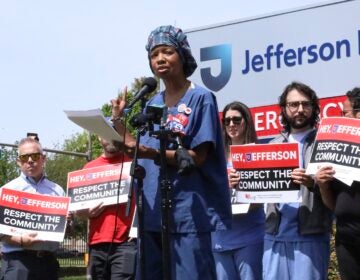
Einstein Nurses United members say they want the hospital to commit to safer staffing levels, stable benefits and other upgrades in a new contract.
3 months ago
She also noted the pay disparity that existed before the union contract, saying that residents at Jefferson Einstein Philadelphia Hospital were paid less than their counterparts doing similar work at other Jefferson locations.
Kase said medicine is a tight-knit community, and the new unions in Philadelphia are part of a nationwide trend of medical residents unionizing that has been going on for years.
“It’s hard to ignore the momentum that resident unions are having throughout the country,” she said. “People see what the union is doing for us and what being a part of the union can do for residents, and they are interested in it.”
Residents at Penn Medicine were the first residency program in the region to unionize in 2024, which also made them the first in Pennsylvania. Lane Kantor, an internal medicine and pediatrics program resident at Penn Medicine and the Children’s Hospital of Philadelphia, said that as a result, the unionized residents at Penn Medicine now have a formal process to talk to hospital management about workplace issues like how to handle federal immigration agents trying to enter hospitals, and making sure that the call rooms, where residents sleep during overnight or long shifts, are clean.
Kantor, who is also a regional vice president for CIRSEIU, said the residents at Jefferson and Temple managed to get contract terms that the organization had not seen before. For instance, the contract at Jefferson says that if medical residents come from medical schools outside of the U.S. and have visa disruptions, Jefferson will still pay them while they wait for their visa issues to be resolved.
In a statement, a Jefferson Health spokesperson said they look forward to moving ahead together with residents to support their patients. A Temple Health spokesperson said the ratified contract is “a fair contract that appropriately supports our residents and Temple Health and preserves our ability to provide our patients with the high-quality care they deserve.”

Get daily updates from WHYY News!
WHYY is your source for fact-based, in-depth journalism and information. As a nonprofit organization, we rely on financial support from readers like you. Please give today.

Nurses at Jefferson Bucks Hospital, Einstein Center One and Jefferson Health Willowcrest plan to join PASNAP.
2 weeks ago

Four longstanding pediatric offices will close June 30 and three others will become part of the True North Pediatrics group, based in Pennsylvania.
5 months ago
Listen 1:30
As Pennsylvania health systems rapidly adopt AI, lawmakers take steps to regulate the technology
Health systems and insurance companies are using artificial intelligence to analyze CT scans and MRIs, update electronic health records and review coverage decisions.
11 months ago
Listen 5:08