
New Jersey ranks last in regional business climate report for 8th straight year, while Pennsylvania scores best
The analysis looked at six factors, including a range of taxes and the minimum wage in seven northeastern and mid-Atlantic states.

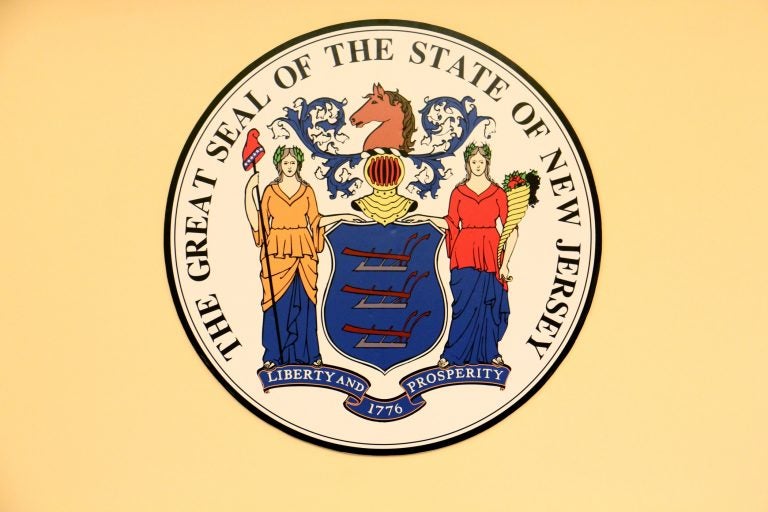
The Great Seal of the State of New Jersey. (Emma Lee/WHYY)
From Camden and Cherry Hill to Trenton and the Jersey Shore, what about life in New Jersey do you want WHYY News to cover? Let us know.
A new report ranks New Jersey last among seven Northeast and mid-Atlantic states for business climate, marking the eighth consecutive year it has finished at the bottom of the list.
The New Jersey Business and Industry Association analysis found Pennsylvania had the region’s friendliest business climate, while Delaware ranked third.
The report looked at New York, Connecticut, Massachusetts and Maryland, as well.
Taxes and costs drive ranking
Chris Emigholz, chief government affairs officer for the New Jersey Business and Industry Association, or NJBIA, said the analysis looked at six factors that affect the cost of doing business, including corporate, sales, income and property tax rates, payroll tax rates, and the state minimum wage.
“We are the worst in the region in two of these factors: property taxes and corporate taxes,” he said.
The analysis found New Jersey has the top corporate tax rate, at 11.5%, and the highest property tax paid as a percentage of personal income, at 4.38%, in the region.
Each state was given a score between 1 and 7, from least competitive to most competitive, for each factor considered in the report. New Jersey’s overall business climate score was 12 points, making it the least competitive state. Pennsylvania, which was third overall three years ago, finished in the top spot for a second straight year with a score of 34.
“Pa. actually has the lowest minimum wage rate in the region. They have the lowest income tax rate in the region. They’re also much more competitive in some of these other factors,” Emigholz said.
He noted that Pennsylvania’s 7.49% corporate net income tax rate will continue a downward trajectory to 4.99% by 2031.
The report ranked Maryland, with 32 points, as having the second-best business climate in the region, followed by Delaware, with 31 points, then Massachusetts with 22 points, Connecticut with 17 and New York with 16.
Michael Busler, a professor of finance at Stockton University, said New Jersey’s high taxes have a negative effect on businesses.
“That typically results in employers having to pay them more, because the employees look at: ‘How much is my disposable income after taxes?’ That’s really what [they] have to spend or save,” he said. “With all that, it makes it very hard for businesses to expand in New Jersey.”
Busler said another cost driver for businesses in the Garden State is its regulatory environment.
“Businesses buy land and then find out they can’t build on a lot of it because of environmental concerns, so they have to buy more land, which drives up the cost of doing business,” he said. “We’re all concerned about the environment, but have they gone too far? It’s an area of concern.”
Related Content

The same bell was rung in 1776 to alert residents about the signing of the Declaration of Independence.
3 months ago
Listen 1:01Location and workforce offset disadvantages
Rutgers University economist James Hughes, dean emeritus of the Edward J. Bloustein School of Planning and Public Policy, said while taxes in New Jersey may be high, they must be weighed against the several advantages the state has.
“A century ago, we had the European waves of immigration that fed our factories, and now our highly educated workforce fills the high-technology jobs of the present and future,” he said. “In many cases, firms treasure their New Jersey employees and don’t want to lose them by moving out of state, so they do keep operations here.”
Hughes said many companies have key markets in New Jersey.
“A typical example would be a very large accounting firm,” he said. “If most of their customers are here and their employees live here, they’re pretty well locked into the state.”
He noted New Jersey’s geographical location offers cultural and financial advantages to corporate officials and their staff.
“Their spouses have opportunities for employment, not only in New Jersey, but in New York and Philadelphia. And New Jersey has one of the best K-12 educational systems in the country,” Hughes said.
Business group warns new policies could deepen challenges
Michele Siekerka, NJBIA president and CEO, said in a statement that while high taxes are a significant issue, pending legislation could make the problem worse.
“Our lawmakers are still considering bills like the Climate Superfund Act that retroactively — and, likely, unconstitutionally— penalize certain lawful companies $50 billion,” she wrote. “It is this combination of high taxation and extreme burdens that only enhances our unfortunate reputation of being one of the least business-friendly states in the nation.”
The New Jersey Policy Institute has also raised questions about the proposed legislation, saying it could increase energy costs for consumers. However, more than 100 environmental, faith, labor and community organizations across New Jersey support it and are calling on Gov. Mikie Sherrill and state lawmakers to pass it.
The report highlights serious affordability and regional competitiveness challenges that businesses in New Jersey are facing, Althea Ford, NJBIA’s vice president of government affairs, said in a statement.
“While we are encouraged that there is more awareness of these competitive challenges, New Jersey really does need to either individually or comprehensively reduce our high business cost-drivers,” she said.
“With the June 30 budget deadline approaching the legislature can’t be sending more taxes to the governor,” Emigholz said. “They must stop sponsoring new taxes and focus on controlling spending and structural reforms to make our state affordable.”

Get daily updates from WHYY News!
WHYY is your source for fact-based, in-depth journalism and information. As a nonprofit organization, we rely on financial support from readers like you. Please give today.

Gov. Mikie Sherrill has defended her growth strategy, but advocates say the state must do more to boost competitiveness.
2 days ago

Businesses give thumbs down to N.J. governor’s proposed transit fee
A top Jersey economist says the governor’s corporate transit fee proposal could hurt the state’s business climate. Business groups agree.
3 years ago
Listen 1:17
Philly Council bill would outlaw cashless businesses
Councilman William Greenlee thinks cashless businesses are classist.
8 years ago