Muncy lifer creates magazine by and for incarcerated people
In collaboration with Let’s Get Free, Sarita Miller has edited Daughters magazine since 2020.
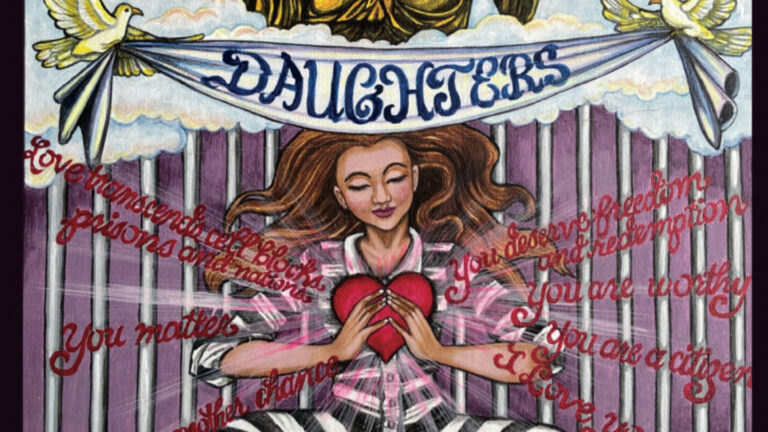
The cover of the July 2024 issue of Daughters magazine features a woman in a striped prison uniform surrounded by words of affirmation. | Cedar Annenkovna
A statue of Lady Justice holds scales balancing a heart and a stack of money. Beneath her sits a young woman in a striped prison uniform, confined and chained to a large metal ball. The woman looks calm and content as she holds a heart in her hands, surrounded by words of love and a magazine titled “Let’s Get Free” at her feet.
This is the cover of one of the many issues of Daughters Magazine, a publication by incarcerated people at State Correctional Institution Muncy, Pennsylvania’s largest women’s prison. Inside, the pages alternate between brightly-colored photographs, hand-drawn artwork and monochrome text blocks of interviews, poetry and personal narratives.
“Our goal has always been to shine the light on the most marginalized population within the prison system, women and girls,” said Sarita Miller, a lifer at Muncy who co-founded the magazine and is the co-editor.
Created in collaboration with Let’s Get Free: The Women and Trans Prisoner Defense Committee, a non-profit prison advocacy organization, Daughters publishes and distributes the voices of incarcerated women to prisons across the nation. The magazine, founded in 2020, recently was awarded first place for best Prison Magazine by the Society of Professional Journalists’ and Prison Journalism project’s Stillwater Award, which recognizes excellence in prison journalism.
Miller founded Daughters with Etta Cetera, one of the founders and co-editor of Let’s Get Free, whose mission is to end life without parole sentences. The pair have published close to 20 issues.
Miller said her inspiration for the magazine came from her turn to faith after being placed in solitary confinement for 60 days.
“While in the hole, I became sick of myself and realized that I was still displaying the same hypocritical toxic behaviors that I would hide behind when I was on the streets,” Miller said. “I was desperate for a change, but I just didn’t know how.”
Miller began attending the prison’s church and heard God’s instructions to her, she said.
“His exact words to me were, ‘Create a magazine for my daughters,’ and thus Daughters Magazine began,” she said.
Born and raised in North Philadelphia, Miller had a tough childhood, with her mother dying when she was a toddler, leaving her to the care of an abusive father, she said. She left her home at 12 years old and started using cocaine two years later.
Miller was convicted of first-degree murder in 2004.
She met Cetera through a visiting program at the prison and proposed to her the idea of starting a prison newsletter. The two later decided to shift to a magazine format to work around Pennsylvania’s prison mailing restrictions. Every piece of prison mail is scanned, whereas magazines are delivered directly to incarcerated people after screening.
“People could have a tangible thing to read in their cells,” Cetera said.
The pages of the magazine are formatted like a collage, with brief “news snippets” and resources for incarcerated readers wedged between text and photographs. Some of the magazine’s content includes personal stories or reflections, book reviews and written playlists of incarcerated people’s favorite songs. The authors’ images are also included.
Since the 1800s, more than 700 prison newspapers have been published. But in the mid-1980s, the amount of prison newspapers and magazines declined. The Prison Journalism Project featured just 21 prison publications across 12 states in its latest directory.
Prison publications also face the challenge of censorship within the prisons themselves, a trend that increased following the COVID-19 pandemic.
“They haven’t ever denied it, but censorship from the prisons is a fear, so we do change the articles depending on what people write,” Cetera said. “That’s part of why we don’t publish 100% everything everybody writes.”
Daughters is published around four times a year. Miller collects work from artists and writers inside Muncy and compiles it to send to Cetera and her team. Let’s Get Free also receives submissions from readers and writers across Pennsylvania and the nation.
A group of approximately 10 to 15 supporters proofread paper and electronic submissions. The magazine is then sent to a graphic designer who lays it out before it is sent for printing.
It can take a month and a half for the incarcerated population to receive the magazine after it’s mailed, Cetera said. Every state has a different mailing system, making it difficult to track whether the magazine is reaching people outside of Pennsylvania.
“A lot of prisoners in Pennsylvania don’t get their magazines and we actually never know why,” said Cetera.
Issue 16, published in 2025, features “Allow Me to Share” by Rhonda Gettle, who is currently incarcerated at SCI Muncy, detailing her battle with addiction that led her to kill someone with her car while driving under the influence.
“An addict is everything I never wanted to be,” she wrote in the piece.
In the piece, Gettle writes about how addiction is a result of unfortunate decisions and life circumstances, but how no one sets out to become an addict.
“Before you write another post bashing people who are suffering; before you lean over to whisper about the junkie who walked by you,” Gettle wrote. “Not only are you hurting the people who have the disease, you could be hurting everyone who loves them.”
Daughters is primarily funded by grants and grassroots fundraising conducted by Let’s Get Free. Each issue costs approximately $6,000 just to print and mail, Cetera said.
“I would say money is the biggest challenge,” Cetera said.
The magazine was recently the recipient of a two-year grant from the Pittsburgh YWCA which allowed the publication to increase to 64 pages and upgrade its quality.
“We did not anticipate how popular the magazine was going to be,” Cetera said. ”I think our magazine creates avenues of information that people wouldn’t normally have access to or choose to.”
Miller said although the magazine is successful, real success would mean there was no need for a magazine to serve women who live in prison.
“It would mean the end of systematic generational profiting due to mass incarceration,” Miller said. “Now that would be something to triumph over. However, in this current reality, success is this interview, and God willing more to come that will help to unveil the dire needs of our communities.”
WHYY is your source for fact-based, in-depth journalism and information. As a nonprofit organization, we rely on financial support from readers like you. Please give today.