

‘Saturating our communities’: Delaware lawmakers debate intoxicating hemp restrictions as federal crackdown looms
Federal law redefining how THC levels are measured could make most intoxicating hemp products illegal starting in November.
Listen 1:35
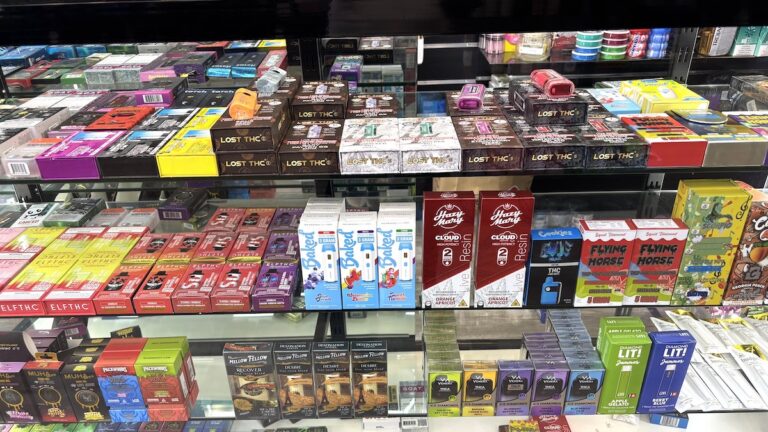
Intoxicating hemp products sold at a tobacco shop in Wilmington (Sarah Mueller/WHYY)
What are journalists missing from the state of Delaware? What would you most like WHYY News to cover? Let us know.
Joseph Daniels says his Delaware smoke shop caters to people seeking relief from mental or physical suffering. He is the owner of Hidden Stash in Laurel, which sells intoxicating hemp products.
“My customers range from the 20-something-year-old construction worker that comes in just to alleviate a little bit of anxiety or pain, up to the 70-something-year-old grandmother that is just having trouble getting out of bed in the morning,” Daniels said.
“We help them, and if you pass this, you’re going to push them to the illicit market,” he told a legislative committee considering a bill that would restrict the sale of intoxicating hemp products outside Delaware’s legal marijuana market.
Daniels said what he sells is safe. But critics argue the hemp-derived cannabinoid industry operates with too little oversight, allowing products that mimic marijuana to be sold in gas stations and smoke shops, often at lower prices than products sold through licensed dispensaries.
Those concerns moved Congress last year to sharply limit intoxicating hemp-derived products, prohibit synthetic cannabinoids and clearly separate industrial hemp from consumable products.
“This new definition is intended to basically exclude most impairing hemp products from legal markets,” said Katharine Harris, a fellow in drug policy at Rice University’s Baker Institute. “That’s the big change.”
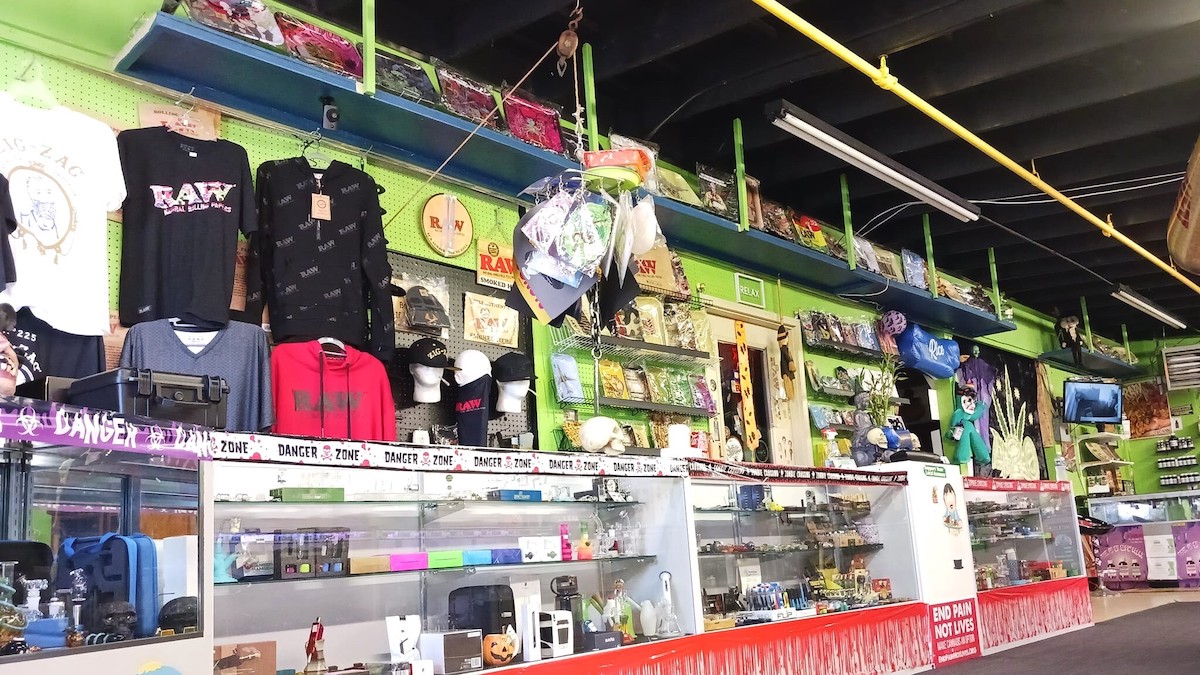
The federal government’s move has left Delaware lawmakers with a couple of options: Pass a law to align with forthcoming federal policy or create a regulatory framework for hemp-derived products on the state level.
Banning the sale of these products except through Delaware’s legal dispensaries could benefit the marijuana industry. Leaving the hemp market in place could mean pot businesses would continue to compete with hemp stores for customers.
The intoxicating hemp market is big business nationwide, having exploded over the past several years. The Brightfield Group, a cannabis data and analytics firm, reported that hemp-derived THC sales went from $200 million in 2020, to a “staggering” $2.8 billion in 2023.
Related Content
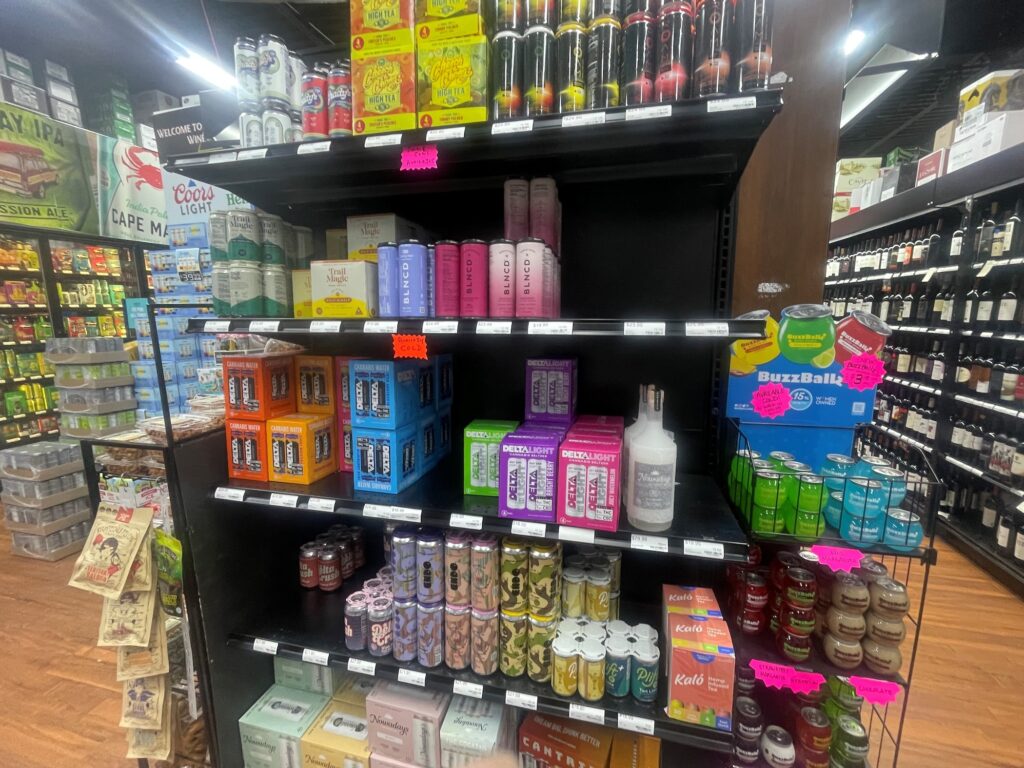
Stores that sell CBD products would not be permitted to offer the intoxicating beverages as lawmakers take a second crack at regulation.
5 months ago
Listen 1:51The legal threshold for hemp and marijuana intoxication
Hemp and marijuana come from the cannabis sativa plant, though hemp is legal at the federal level and marijuana is illegal. U.S. and Delaware law define nonintoxicating hemp as having a concentration of less than 0.3% of delta-9 tetrahydrocannabinol, or THC, on a dry weight basis, the primary substance that produces a high when consumed.
Delaware allows the sale of intoxicating hemp products that contain less than 0.3% total THC through wellness stores and smoke shops throughout the state. Marijuana has more than 0.3% THC and must be sold through the state’s medical and recreational dispensaries.
While the federal government has taken action to reclassify medical cannabis, it still considers marijuana an illegal drug. Delaware and other states have legalized it at the state level for medical and recreational uses. Some Delaware retailers hope state lawmakers will do the same for hemp products.
Related Content
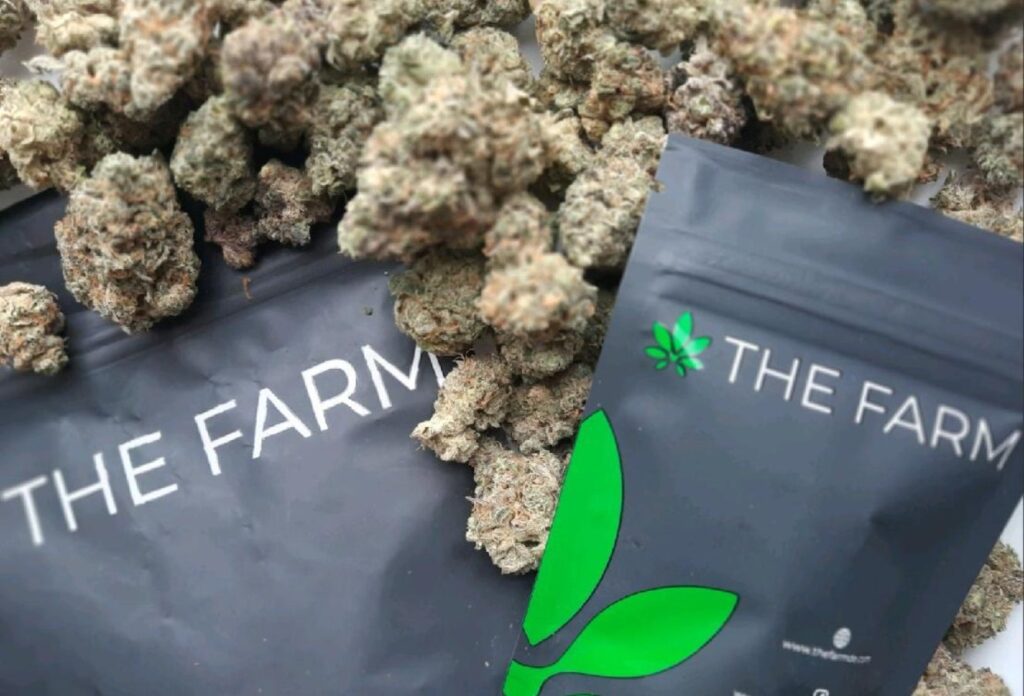
State officials contend the market will expand when new growers, manufacturers and retailers begin operating and prices become more competitive.
7 months ago
Listen 2:13Congress opened the floodgates for intoxicating hemp
The 2018 Farm Bill decriminalized the commercial cultivation of hemp but defined hemp only by its concentration of delta-9 THC.
Harris said manufacturers have used a loophole to make intoxicating hemp products using high concentrations of other THC compounds not clearly restricted by law.
“The cannabidiol [CBD] is a nonimpairing compound, but CBD can be converted into THC, which is how a lot of the hemp products that we have on the market are made,” she said. “CBD itself doesn’t contain THC, but a final product can contain both.”
That helped fuel a market for hemp-derived products containing compounds such as delta-8 THC and THCA, which can produce marijuana-like effects.
A federal law passed last year that will take effect in November aims to close that 2018 loophole. Barring any changes in the 2026 Farm Bill, the way hemp is defined will be based on “total THC” rather than delta-9 THC alone. Hemp-derived cannabinoid products could not have more than 0.3% total THC. Containers would also be limited to 0.4 milligrams of THC.
Intoxicating hemp items sold in Delaware come from other states. In November, such interstate commerce would become illegal. Daniels said criminalizing hemp-derived cannabinoid products could lead to the closure of Hidden Stash and hundreds of similar businesses in Delaware and across the U.S.
Related Content
Legislation filed in the Delaware House last year to increase tobacco prices failed to get a committee hearing.
9 months ago
Listen 0:57Delaware winners and losers: Ban it or regulate it?
Under legislation sponsored by state Rep. Nnamdi Chukwuocha, D-Wilmington, Delaware would align its definition of hemp consumables with the pending federal ban language. He said intoxicating THC consumable products must be sold through the state’s licensed, regulated marijuana market.
“We’re finding these THC vapes that are laced with fentanyl, where marijuana and everything else is being sold in these shops,” Chukwuocha said. “So this unregulated market is really saturating our communities and selling these unsafe products, and they’re ending up in the hands of our children.”
A spokesperson for the Delaware Division of Tobacco and Alcohol Enforcement said the agency has sent 70 cease-and-desist letters to dozens of businesses that sell intoxicating products.
Cameron Gilbert, chairman of the Delaware Health Alternatives Association, said while there are bad actors in any industry, the majority of stores in the state are responsible small businesses that welcome regulation.
“All of our stores, especially within the Delaware Healthy Alternatives Association, are doing everything by the book,” he said. “We’ve been self-regulating for the past however-many years without any real guidance from anybody. We’ve provided the lab testing. We’ve got third-party lab testing. We’ve got age restrictions.”
Amit Vyas, a Dover attorney, said Chukwuocha’s bill would benefit just a handful of marijuana operators.
“This legislation is being engineered to eliminate lawful competition and hand market control to a small handful of preferred operators,” he said. “That is not health policy, that is not consumer protection, that is legislated monopoly dressed up in public health language and rushed through this committee. Every small business owner in Delaware who built something lawful under existing law deserves better than this.”
But Office of Marijuana Commissioner Joshua Sanderlin said it’s not about propping up the marijuana businesses.
“This is what the legislature chose to do, create a marketplace, and you can’t undermine it with another marketplace that doesn’t have any of the things in place that are designed for protecting Delawareans,” he said.
House Bill 401, sponsored by Dover Democrats state Rep. Sean Lynn and state Sen. Kyra Hoffner, creates a new hemp-derived cannabis cannabinoid product retail license under the Office of the Marijuana Commissioner. It also establishes a legal framework for product testing, consumer safety and age restrictions on purchases.
James Brobyn is owner of Field Supply Cannabis in Wilmington and is the director of the Delaware Cannabis Industry Association. He operated a medical dispensary in 2023 before expanding into recreational pot last year.
Like Vyas, Brobyn argued that Lynn’s legislation regulating hemp products would benefit only a favored few.
“HB 401 would build a second cheaper retail challenge for the same intoxicating molecule six months before federal law makes those products controlled substances,” he said. “That is not regulation. That is a state-sanctioned arbitrage, a head start for operators who skipped the line, paid for by the operators who didn’t, like myself and like some of the other people that have spoken today.”
Lynn’s legislation has yet to make it out of committee. But drug policy fellow Katharine Harris said Delaware could set up its own hemp marketplace similar to what it did with recreational marijuana.
“I think that it will depend to some extent on how strong of a stance the [Trump] administration wants to take on this issue,” she said. “If they really want to go after states that allow their own programs, or threaten grant money, then we could see a stricter landscape. But if they leave it to the states, I think you will see those situations where some states have more lenient regulations than the federal government does.”

Get daily updates from WHYY News!
WHYY is your source for fact-based, in-depth journalism and information. As a nonprofit organization, we rely on financial support from readers like you. Please give today.
Part of the series

Delaware election 2026: What to know about the AG race between Kathy Jennings and David Graham
Graham is a Republican who is not an attorney but contends he can run the Department of Justice better than longtime prosecutor Jennings.
2 days ago

Democrat U.S. Rep. McBride and Republican Arminio outline their priorities on the economy, health care, immigration and foreign policy ahead of the Nov. 3 general election.
4 days ago
Delaware Working Family Party candidates defeated five incumbent state lawmakers, four in the House and one in the Senate.
5 days ago
Listen 0:50