

‘Arbitrary caps’: Critics accuse Delaware Senate of gutting bill removing time limits on lawsuits from childhood sexual assault victims
The state Senate amendment capped monetary damages, prompting criticism that it was helping insurance companies, not victims.
Listen 1:02

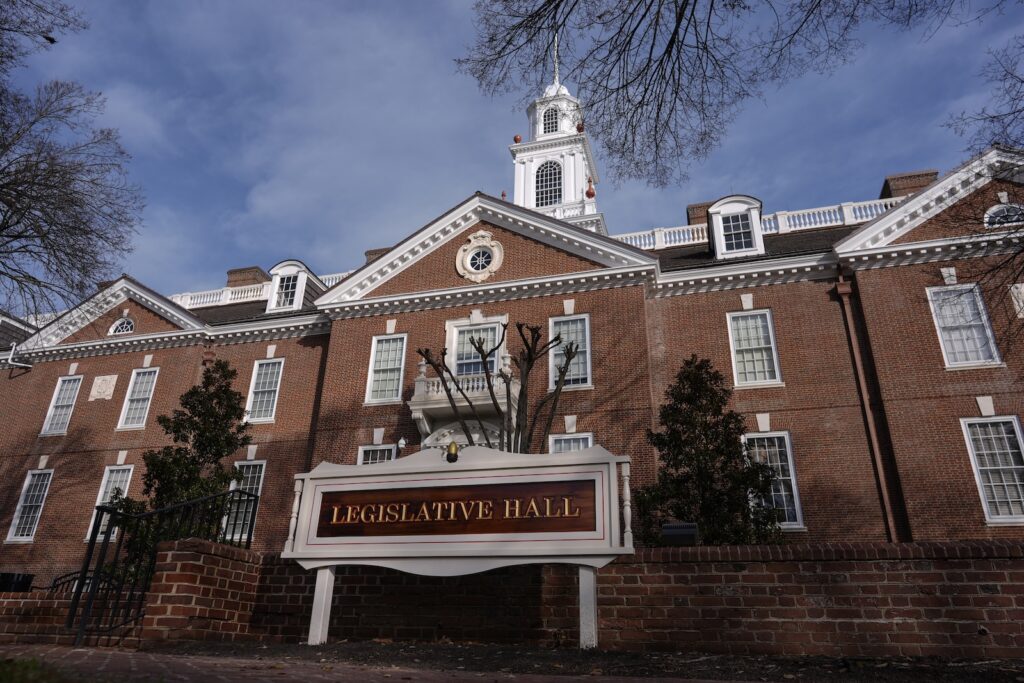
Legislative Hall in Dover, Delaware. (Emma Lee/WHYY)
What are journalists missing from the state of Delaware? What would you most like WHYY News to cover? Let us know.
Legislation that would have allowed Delaware victims of sexual abuse to retroactively file lawsuits has died in the state legislature after the bill’s sponsors said a Senate amendment effectively gutted it.
Delaware currently has a two-year window for legal claims, established in 2007. House Bill 75 would have removed the statute of limitations for the sexual abuse of a minor. It also would have made the state and other institutions, such as charities, school districts and hospitals, financially liable to successful legal actions brought by abuse victims.
The state House passed the legislation without opposition last year. House Minority Leader Tim Dukes, R-Laurel, was the prime sponsor. He also sponsored a similar bill in 2024 that passed the House, but not the Senate.
The Senate amendment to the bill, proposed by retiring Senate President Pro Tempore David Sokola, D-Newark, in the waning hours of this year’s legislative session, placed a $1 million cap on money damages for alleged sexual abuse that occured before 2007. It limited the liability to the purported abuser and the abuser’s employer to up to $500,000 each.
It also more specifically defined who could be legally liable for the abuse and clarified the negligence standard for legal claims.
Related Content
What Delaware lawmakers passed — and what failed — before the legislative session ended
Lawmakers passed dozens of bills, addressing property tax rates, gun dealer regulations, affordable housing and more.
4 months ago
Listen 1:04State Sen. Nicole Poore, D-New Castle, who sponsored the bill in the Senate, objected to the “arbitrary caps” in the amendment authored by her own party leader.
“No other victims of extreme negligence are singled out this way,” she said. “Why should survivors of childhood sexual abuse be treated any differently? It creates separate damage caps for perpetrators and institutions, forcing courts to sort defendants into artificial categories and inviting years of unnecessary litigation over how defendants should be classified rather than focusing on the harm suffered by the survivor.”
Poore said the legislation was needed because it can take decades for victims to understand what happened to them and divulge it to others.
“This bill does not presume guilt. It does not guarantee anyone a victory in court,” she said. “It does not create new causes of action. It simply says that when a survivor is finally able to come forward, they deserve the same thing every Delawarean deserves: a chance to be heard in a court of law.”
Sokola argued the caps on financial awards were necessary.
“If we are truly doing this to allow for all victims of sexual abuse to come forward and find justice, we need to ensure the resources exist to truly compensate all victims,” he said.
The amendment passed with 14 yes votes, 6 no and one absent. The Senate went on to pass the bill, without opposition. Poore voted yes on the amended bill.
Dukes, who has pushed this legislation for the past two years, became visibly emotional as he watched the state Senate vote on the amendment and bill. Because the Senate amended it, it had to go back to the House for approval. But instead of voting on it, Dukes had the bill stricken.
“It’s disappointing, but I think a bill that is as monumental as it is, we want to do it right,” he said. “The amendment really gutted the whole premise of the bill. We’ll come back with another bill and we’re going to keep working to protect victims in the state.”

Get daily updates from WHYY News!
WHYY is your source for fact-based, in-depth journalism and information. As a nonprofit organization, we rely on financial support from readers like you. Please give today.
Part of the series

Delaware recently implemented 2 land-use laws. Here’s what they mean for affordable housing
House Bill 450 and Senate Bill 23 both require Delaware counties and local governments to make changes in the way they approve developments.
2 weeks ago
Listen 1:02
Las tiendas que venden productos de CBD no tendrían permitido ofrecer bebidas embriagantes, mientras los legisladores hacen un segundo intento por regular la materia.
5 months ago

The federal lawsuit charges that the 2012 law serves to “chill free speech," but a state official says the plaintiffs are “trying to keep dark money dark.”
5 months ago
Listen 2:12