SPONSORED
The Delaware Community Foundation Celebrates 40 Years of Community Investment
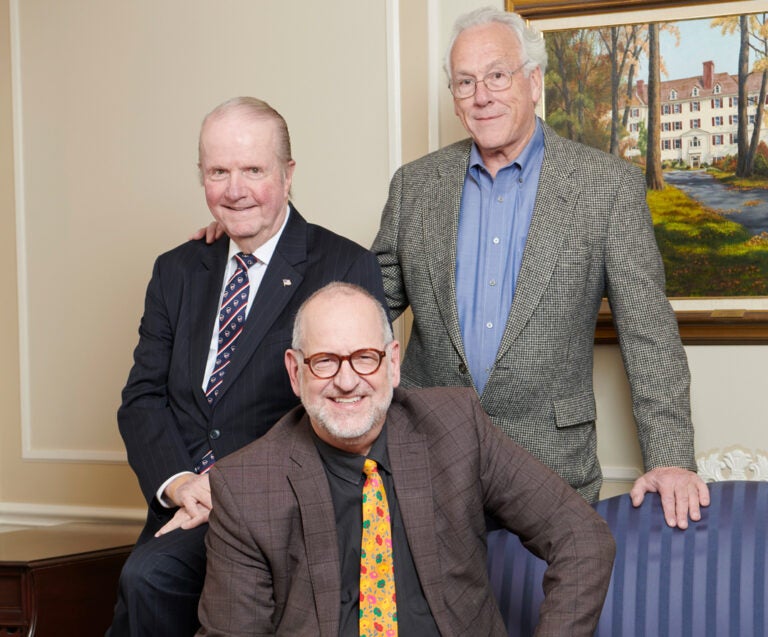
DCF leadership past and present: Fred Sears (President and CEO 2002-2016; left), Collis Townsend (Executive Director 1987-2002; right), and Stuart Comstock-Gay (current President and CEO; seated).
Note: This article is a paid placement and does not necessarily reflect the views or opinions of WHYY.
Sarah Hench had a problem. As the Executive Vice President & Chief of Staff at the Delaware Community Foundation (DCF), she knew the DCF was required to distribute $30 million from its Paul H. Boerger Fund in support of research to prevent and/or cure Alzheimer’s disease — thereby fulfilling the fundholder’s legacy wish.
A nationwide scan led Hench and her team to build geographical parameters and pivot away from direct grantmaking. They recommended an initial investment of more than $6 million to three regional institutions, ultimately awarding $5 million to the University of Pennsylvania to support the development of new molecular therapies for Alzheimer’s disease and related dementias, along with two smaller grants: $500,000 to Delaware State University and $575,000 to the newly established Delaware Center for Cognitive Aging Research (DECCAR) at the University of Delaware (UD).
When it came time to make the next round of investments, DECCAR was more established. Its team, led by Christopher Martens, Professor of Kinesiology and Applied Physiology and Director of DECCAR, had launched the Delaware Longitudinal Study for Alzheimer’s Prevention (DeLSAP), an observational study that explores how health, lifestyle and biology influences dementia risk over time and helps identify early signs of cognitive impairment.
What happened next would transform the future of Alzheimer’s research in Delaware. Hench sent Martens a question via email: Would he and his team like to submit another proposal to further their research?
The resounding yes ultimately led to a five-year $13.1 million investment from the DCF in September 2025, which will help DeLSAP expand from 100 to 500 participants over the next five years and fund the development of a blood test that uses DeLSAP samples to identify biomarkers for better predicting Alzheimer’s progression. The grant will also support the purchase of a $3.2 million state-of-the-art MRI machine for UD’s STAR Campus, improving statewide access to a critical diagnostic tool and expanding research infrastructure.
“Alzheimer’s is a tragedy that touches so many families. The research supported by this grant will help UD researchers come ever -closer to uncovering life -improving and life-saving solutions,” said Hench, who continues to oversee the investment.
The funding comes at a time when the federal government is freezing, delaying and revoking funding for similar research.

The DCF Celebrates 40 Years of Giving
This is one of thousands of investments the DCF has made in its 40 years as a Delaware philanthropic institution. The foundation has granted more than $530 million to 4,000 organizations and provided more than $6 million in scholarships to more than 3,000 students across Delaware since 1986.
“The impact of the DCF cannot be overstated,” said Stuart Comstock-Gay, DCF President and CEO. “Thousands of Delawareans have been, as our tagline says, ‘making more possible’ across our state and beyond, by establishing funds and scholarships and making contributions of all sizes, and their work has transformed lives and communities.”
Additional DCF investments include grants from its Arsht-Cannon Fund, which has awarded more than $12 million to 150 nonprofit organizations across Delaware over the last two decades, with an increasing emphasis on supporting Hispanic communities; and Healthy Communities Delaware, a public-private partnership between the Delaware Division of Public Health, UD and the DCF. Each year, Healthy Communities Delaware supports priorities that strengthen the Vital Conditions, the essential factors that shape communal well-being from birth through adulthood and funding projects that serve some of the most marginalized neighborhoods in the state.
In addition to long-term investments, the DCF also provides philanthropic infusions during times of crisis. From 2020 to 2022, the DCF pooled more than $5.3 million for the Delaware COVID-19 Strategic Response Fund in partnership with Philanthropy Delaware. The fund awarded 294 grants to more than 200 nonprofit organizations and engaged more than 40 volunteers in determining how to distribute the money. This was recognized as the fastest pandemic grantmaking response in the country.
More recently, the DCF’s Meet the Moment initiative provided grants, seminars, and workshops to 100 nonprofits — with an estimated impact of $1 million and growing -– in response to the federal funding freeze. Requests exceeded $3.3 million as nonprofits applied for Meet the Moment grants in record numbers, underscoring need for direct support.
With $450 million in assets, the DCF is one of the largest charitable organizations in Delaware and ranks among the top philanthropic foundations in the Greater Philadelphia area by total giving. Its success is due in part to the visionary service of its donors, from everyday people to renown philanthropists, who, along with the DCF’s leadership, have charted a path of giving that empowers all Delawareans to thrive – now and in the future.
Learn more at www.delcf.org.