
Hope
The fifth episode of “Dying on the Inside: Women Lifers at Muncy Prison” looks at the solutions being proposed to address the crisis of aging prisoners.
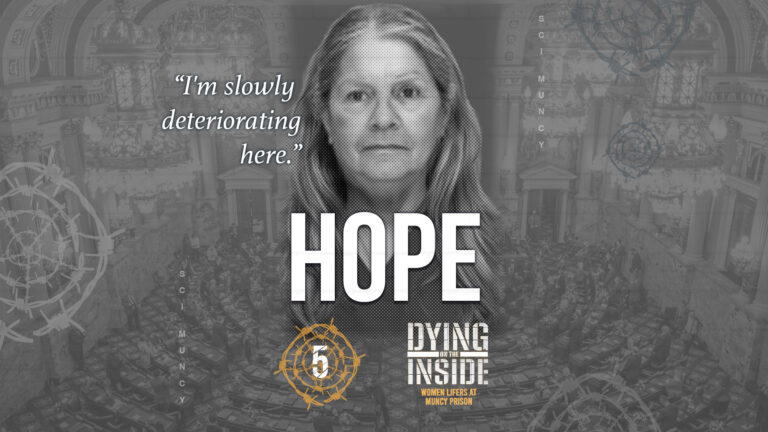
Maria Rodriguez, 68, has spent nearly five decades in prison at State Correctional Institution Muncy. | Illustration by Sheldon Sneed Designs
Maria Rodriguez has spent close to 50 years at State Correctional Institution Muncy after being convicted of second-degree murder. Living in the prison’s infirmary, her body is breaking down with a host of ailments, including diabetes, arthritis and a broken back. Cases like Rodriguez’s are leading some officials to rethink how the criminal justice system handles aging prisoners. The Pennsylvania Supreme Court ruled in March that mandatory life-without-parole sentences for second degree murder are unconstitutional, but the court said it’s up to the state legislature to figure out how the ruling will apply retroactively. For other prisoners, their pathways to get out remain limited, as the commutation process is slowed by a large backlog of applications. A bill to expand eligibility for compassionate release passed the state house but has not passed the state senate. While legislative action on mass incarceration stalls, many lifers are getting sick as they wait and age in prison.
-
Episode Transcript
Robovoice: This is a prepaid collect call from—
Maria Rodriguez: Maria.
Robovoice: An incarcerated individual at SCI Muncy.
Cherri Gregg: So tell me tell me what a typical day is like for you
[music]
Cherri, narrating: Maria Rodriguez is 68 years old. She’s been at State Correctional Institution Muncy for 46 years. She lives in a small single cell in the Muncy infirmary.
Maria: Some days is good, some days is bad. Some days, you know, I can’t, I need to take, you know, something for the pain.
Cherri, narrating: The first time I tried to talk to Maria, she had to end the call early.
Maria: You gotta bear with me because I’m sick. I don’t know what got into me. I had to bring my trashcan with me—
Cherri: Mhmmm…
Maria: Just in case.
Cherri: Ah, Maria.
Maria: Yeah, I’m not feeling so kosher. And every time I go to the bathroom and throw up, come back, then I gotta run back and I gotta throw up now.
Cherri, narrating: Maria is serving a life sentence without the possibility of parole for killing Carlos Rivera in North Philadelphia. Both of them had been drinking at a bar and she knew he had a wad of cash. Drunk and high, she followed him out of the bar and tried to take the money out of his pocket, but instead he attacked her. She pulled out a razor and slashed his arm. Rivera walked away and Maria followed. When he collapsed, she robbed him.
When Maria found out he died she turned herself in. She was convicted of second degree murder. When she arrived at SCI Muncy she was 23. The prison was co-ed, and she got pregnant and gave birth behind bars.Maria: I was young and a little stupid. The guy kept bothering me, Oh come on, you know, let’s just do it one time. And one time I said, You know what? To get you off my back, okay. So, and that’s how my son came about.
Cherri, narrating: Now Maria’s body is failing. She is diabetic, blind in one eye, debilitated by arthritis, and she recently broke her back.
Maria: It’s like I’m slowly deteriorating in here.
Cherri, narrating: She has served close to 50 years for her crime. It’s women like Maria that have got me wondering: is there a point in keeping her incarcerated? Is she a danger to us when she can barely see? When her care costs taxpayers tens of thousands of dollars, is this what justice looks like?
I’ve talked to advocates, lawyers, politicians, doctors, victim families, and women lifers. I’m not gonna lie or pretend that this costly and complex crisis has an easy fix, but countless people are fighting for solutions.
[music]
I’m Cherri Gregg, I’m a journalist and radio host at WHYY. This is Dying on the Inside: Women Lifers at Muncy Prison. A podcast that looks at the national crisis of our aging prison population, and its incredibly high cost. Welcome to Episode 5: Hope.
District Attorney Larry Krasner, archival: This is a press availability in light of a very important decision of the Pennsylvania Supreme Court—
Cherri, narrating: This past March, the Pennsylvania Supreme Court released a major ruling on the constitutionality of life without parole for second degree murder. Here’s Philadelphia District Attorney Larry Krasner.
DA Krasner, archival: There are over 500 Philadelphians who are doing sentences of life without the possibility of parole as a result of a law. Pennsylvania Supreme Court has ruled today that that law is unconstitutional.
Cherri, narrating: Second degree murder is charged when someone is engaged in a felony that results in another person’s death. You can be the getaway car driver, or in the room when the trigger is pulled and be sentenced to life without parole.
Rupalee Rahshatwar: I mean, it’s huge. It’s historic.
Cherri, narrating: That’s Rupalee Rahshatwar, an attorney for the Abolitionist Law Center.
Rupalee: It’s a major movement victory. And it’s one that’s the product of decades of organizing of so many people in the movement, so many family members, so many people inside. And it feels like this really important glimmer of hope for so many people.[music]
Cherri, narrating: The case was argued by the Abolitionist Law Center on behalf of Derek Lee. In 2014, Lee and his friend robbed a Pittsburgh home and forced two residents into the basement. After Lee went upstairs his accomplice murdered the man who lived there, Leonard Butler. Despite not being the one who killed Leonard Butler, Lee was sentenced to life without parole for second degree murder.
In the new ruling the justices wrote, quote “ultimately we find that mandatory sentencing scheme for second degree murder poses too great a risk of disproportionate punishment, and thus, find it to be cruel.”
Rupalee: They said clearly that individual culpability should be considered when thinking about someone’s punishment. And the current framework doesn’t allow that.
Cherri, narrating: Thirteen family members of murder victims spoke out in support of the ruling.Dr. Movita Johnson-Harrell: I am Dr. Movita Johnson-Harrell, I am a five-time co-victim of homicide. Lost both of my sons 10 years apart to gun violence.
Cherri, narrating: Movita uses a common shorthand for life without parole: LWOP.
Movita: I felt very honored to be included. And for me being a part of the brief, it wasn’t just advocacy for me, Cherri, right? So it was a declaration about how second degree LWOP actually erases context. It erases trauma and transformation and it harms survivors, families and everybody involved.
Cherri: A lot of people think that life without parole, mandatory life without parole is justice. What do you say in response to that?
Movita: I think there’s a difference when people take responsibility for what they’ve done. I don’t think that you can actually bring yourself fully to community to be productive until you’ve taken accountability and become willing to change and help change others.
Cherri, narrating: Movita tells me she doesn’t believe people dying in prison solves anything.
Movita: If we can believe in accountability, then we also have to believe in redemption. We know that healing is possible, safety is possible, community restoration is possible and that no human being is disposable. I can tell you, Cherri, that aging in prison is not justice, it’s abandonment.
Cherri, narrating: She says many people who spend decades in prison have changed.
Movita: It forces people to reflect on themselves and their lives and where they sit, what space they sit in in the world. And I think that we all have the potential to heal and to grow and to redeem ourselves.
Cherri, narrating: Christina Reyes had multiple family members murdered and multiple family members have been incarcerated. Like Movita, she spoke out in favor of ruling life without parole sentences for second degree murder cases unconstitutional.
Christina Reyes: I’m from North Philly. It’s so many people that are incarcerated. Or that are affected by, you know, gun violence. So I know that that’s not the solution.
Cherri, narrating: She says aging women deserve to come home.
Christina: They only want them to come home when it’s like they’re dealing with an illness and they’re ready to die. They haven’t even done anything anymore in prison. They’re not violent criminals in prison the way that they-they make it seem off of a paper.
Cherri, narrating: She hopes these men and women who have served decades and did not kill anyone can come home, not only for their sake but the sake of their families.
Christina: We’re keeping families disconnected. We’re also not thinking about the cost that these families have to incur, like between the travel, between making sure that their loved one is eating, that they’re taken care of. And we’re talking about people who are coming also from a low income community that sometimes can’t even afford that. And they’re trying to figure out how they’re paying their bills in their home.
Cherri, narrating: But many victims’ families just can’t forgive.
Christina: I can’t really tell someone how to feel because they have to sit with that. With my father, when he was murdered with my uncle, there was nobody ever charged. And I know the feeling of, like, you don’t have someone to, like, put that anger towards.
[music]
Sandria Elias, archival: So what gives the right, to be out free today as he is? My granddaughter never seen her birthdays, her graduations, her proms.
Tehran Boldon, archival: It’s absolutely not fair. It just makes you relive the whole [crying] incident over again.
Peeyton Trotter, archival: I think they deserve life, I mean, if not more the death penalty.Cherri, narrating: Sarita Miller, who is serving a life sentence without parole for murder, says she understands how the victims’ families feel.
Sarita Miller: In my case, I say to myself, well, what if that was somebody in my family? You know, how would you feel? It’s really—between a rock and a hard place. You can’t really balance the two. It’s hard to say, Well, everybody deserves a second chance when you still have a family that is hurting. It’s just a very hard conversation to have, you know?
[music, midroll]
Yvonne Latty: Hi, I’m Yvonne Latty, the co-Executive Producer and Writer of Dying on the Inside: Women Lifers at Muncy Prison. I’m here to tell you about Release to Die, a new podcast series that explores what it really means to be released from prison, to die on the outside. Over three episodes, Futuro Media Latino USA, document the story of a 93-year-old man who has spent nearly five decades in a Philadelphia prison and is finally granted compassionate release after years of waiting, following a terminal cancer diagnosis. His case highlights one of the fastest-growing trends in incarceration, something experts call the graying of American prisons. Through his story and others, they explore the challenges of Pennsylvania’s compassionate release policies, the ways in which prison healthcare often fails older individuals and potential solutions. Release to Die is coming June 26th, wherever you get your podcasts. Give it a listen.
[music]
Cherri, narrating: The Pennsylvania Supreme Court ruling could bring hundreds of lifers home. The ruling though just applied to sentences going forward. It didn’t say what would happen to people who are already in prison serving a second degree murder charge.
[music]
Instead, it gave state legislators 120 days to pass a bill on what should happen to those people.
Roxanne Horrell: That’s where we’re at right now, and we’re really trying hard to get a bill passed.
Cherri, narrating: Roxanne Horrell is the Legislative Director of Straight Ahead, which is the legislative arm of the Abolitionist Law Center.
Roxanne: There were already two bills that were in the General Assembly, really in anticipation of this decision.
Cherri, narrating: There is Pennsylvania House Bill 443, which is the one the Abolitionist Law Center prefers. It allows people who have already served decades for second degree murder to go before a parole board.
Roxanne: You know, it just gives judges the discretion to decide what the sentencing should be based on the individual’s case.
Cherri, narrating: The Senate has a similar but tougher bill.Roxanne: It’s a 25-year minimum, a mandatory minimum, for people who are going to be sentenced after the bill is passed.
Cherri, narrating: People would have to already have served 25 years to be eligible for parole. This is an election year and so Roxanne says passing either of these bills is going to be challenging. Politicians are often afraid of looking, quote “soft on crime.”
Roxanne: I think generally legislators tend to be a bit cautious about these issues. That being said, the court did say that all of these sentences are unconstitutional, so we do have over 1,000 people inside PA prisons right now who are serving a sentence that’s unconstitutional.
Cherri, narrating: Roxanne says if the legislators act, perhaps in a year people will start getting released. If not, the decision will get punted back to the Supreme Court, which could cause more delays before the parole process can kick in.
Roxanne: I’m not sure, like, how long that parole process will take because this is kind of a unique situation where we’re having hundreds of people who are going to be eligible at the same time. But the parole board has said that they are capable of increasing their capacities to deal with this. That being said, I think nothing runs quickly I think in the government and it takes more time than we would like it to.
Cherri, narrating: But Roxanne is hopeful.
Roxanne: This is a really big deal, because there was no chance for them to get out. So unless like through the commutation process, which is like really, really limited and like, it’s very rare. I think there’s still a lot of reason to be positive about this, but the process does take longer than we would like it to.
[music]
Cherri, narrating: Political will is an issue that has come up in our reporting. It’s just not politically advantageous to advocate for the incarcerated.
John Wetzel was the longest serving Secretary of Correction in the history of Pennsylvania. He also is frustrated by the lack of political will to change. He wrote a letter to the court in support of the Derek Lee case in which he cited the costs of incarcerating sick and elderly inmates. He wrote that medicines for inmates over 50 costs the Department of Corrections $32 million a year.
John Wetzel: You can’t say you’re a fiscal conservative. We do not get a return on our public safety investment on keeping people locked up forever. When someone’s elderly in a nursing home in prison, you’re paying for their needs, you are, the state taxpayer. But then you’re also paying $60, $70, $80 an hour for the officers, per officer, who has to oversee someone.
Cherri: We have made changes with regard to bringing people in. We have more diversion programs. Sentencing has been restructured for a lot of crimes and people don’t get these very long life without parole sentences like they used to happen 30, 40 years ago. So why do you think this, and why do think people haven’t dealt with the thousands of people serving life sentences and are just okay with them being incarcerated till death?
John: People don’t care about what happens to people who are incarcerated. They like talking about it. But when the rubber meets the road, if you’re worried about we’re spending too much money on corrections and we have a nursing home of people we could release, put them on the federal dollar, and they would still be in a nursing home and not see the community and we don’t do it, it’s cause we don’t-we collectively don’t wanna do it. We like our corrections systems to be punitive. We get mad at people, and when we get mad at people, we wanna lock them up, and we wanna lock them for a long time.
Cherri, narrating: Pennsylvania Governor Josh Shapiro has granted more than 1,000 pardons and commuted 15 life sentences during his first three years in office, but there are over 5,000 people serving life sentences in the state. Lieutenant Governor Austin Davis heads the Board of Pardons.
Lieutenant Governor Austin Davis: The commutations process was not intended to address the crisis of mass incarceration. It was designed to consider individual applications for clemency. We’re working really hard at the board to process the increasing number of applicants we receive for both pardons and commutations every year.
Cherri, narrating: He says the board is dealing with the legacy of mass incarceration and will be for years to come. The problem is there are many applications for commutation of life sentences. It’s a very lengthy process, and the five members of the Board of Pardons work on it part-time. In Davis’ three years in office, he says the board has met roughly 32 times to consider pardons, commutations, and merit reviews.
Lt Gov Davis: At a certain point, we have maxed out this process. There’s not more bandwidth that we can do, given you have three other people on the board who have full-time jobs and careers who are doing this part-time.Cherri, narrating: But, he says the board is part of the solution, just not the only solution.
Lt Gov Davis: We should look at options like expanding compassionate release and updating the constitution to return to a majority vote to recommend commutations. Both of those would require legislative action, and in the case of the constitutional amendment, would require going before the voters to decide. So I say all that to say, we need to see legislative action.
Cherri, narrating: And that has been the complication that runs through this issue. It is hard to get politicians on board, because voters of neither party are demanding it.
Lt Gov Davis: I think folks are much more focused on economic opportunity, you know, their kids’ education. They’re much more focused on public safety. And so I think, you know, just allowing it to rise to the level where it’s kind of uniformly supported, it just hasn’t gotten to that level.
[music]
Representative Rick Krajewski, archival: Our bill would create a streamlined, comprehensive process for reviewing and granting early release for very ill incarcerated people who are at no risk to society. It would ensure that another 11 people don’t die while waiting for a court to hear their case—
Cherri, narrating: That’s Pennsylvania State Representative Rick Krajewski announcing the passing of House Bill 150. It creates a stronger process to consider early medical release for the seriously ill. It received bipartisan support and was sponsored by Krajewski, a Democrat, and Representative Torren Ecker, a Republican.
Representative Rick Krajewski: These people are not threats to society. These are not people who will go off and commit, you know, sprees of violence if they were released. These are people who frankly are in pretty poor health. And it’s just a question of, do we want to be responsible for their deaths?Cherri, narrating: Only 54 people have been released since the state started issuing compassionate releases in 2009. Eleven people died while waiting.
Rep Krajewski: It’s an extremely inefficient bureaucratic process that has caused people to pass.
Cherri: How does it save taxpayers money?
Rep Krajewski: So basically for people who have complex medical needs, the average cost per year is $64,000 to provide care. And when you zoom that out, the Department of Corrections spends $40 million a year on sick and elderly people. We’re spending tens of millions of dollars providing medical care for them.Cherri, narrating: The current compassionate release law only allows an inmate to be released if a doctor says they have less than a year to live. It can be a lengthy process and some people die waiting.
Rep Krajewski: It would streamline the process in that, you know, it would allow an inmate or a lawyer on behalf of that inmate to apply for a petition for compassionate release that can then be heard and approved by a court, which is a pretty straightforward process.
Cherri, narrating: The bill also has a more expansive criteria to be eligible. House Bill 150 states you can have a terminal illness, a chronic and debilitating physical illness, or mental condition or disease, a serious functional or cognitive impairment or mental health issue due to the aging process. And people would not have to refuse lifesaving medical care in order to be released.
Rep Krajewski: And so our bill allows for more criteria for people to be able to get the appropriate healthcare they need. And again, it has to be approved by a court.
Cherri: If this bill becomes law, roughly how many incarcerated people do you think realistically would benefit?
Rep Krajewski: Somewhere in the hundreds of people per year could be released on this. It would exponentially be more than the people who are currently being released.
Cherri, narrating: But the bill still has to get through the State Senate.Rep Krajewski: The line that we would hear on the floor was like, Oh you’re gonna allow, like, violent rapists or violent predators to be released, which was just, like, extremely heinous and ridiculous. I should say this bill isn’t like a get out of jail free card.
[music]
Cherri: If House Bill 150 becomes law, what would real success look like for you, for the families, for the prison system, for taxpayers?
Rep Krajewski: I think it would look like having those hundreds of people be able to come home and to be able to get the care they’d need to treat their illnesses, to be able to have a chance at compassion, to have a second chance. You know, this is about not being responsible for death by incarceration. So if we could allow these people to be able to come home and get the care they deserve, that would be a huge win.
Cherri, narrating: Back at SCI Muncy, Maria Rodriguez struggles to survive.
Maria: I would like to give my family some of my time before, you know, God takes me away. Cause I’m getting old, I’m 68 years old. You know, I don’t know how long God’s gonna have me on this dark green earth. And I want to be able to help some of these women. You know, there’s a lot of women in here that should go home. You know, even if I don’t go home, I’m glad to see somebody go.
[Music]
Cherri, narrating: Pennsylvania state politicians are aware of what is at stake. There are clear bills that can help bring home the sick and those imprisoned unconstitutionally for decades. But meanwhile, Sylvia, Terri, Sarita, Sheena, Maria, and thousands of others, they just wait…
[Music]
Cherri, narrating: Dying on the Inside: Women Lifers at Muncy Prison is a production of Create.Genius.Media and Temple University Klein College’s Logan Center for Urban Investigative Reporting.
I’m Cherri Gregg, Executive Producer and Host.Executive Producer, Producer, and Script Writer is Yvonne Latty, the Director of The Logan Center.
collapse
The Podcast Editor is Audrey Quinn.
Sound design, scoring, mixing, and mastering by Michelle Macklem.
Our Data Editor is Colin Evans.
Associate Producer is Natalie Reitz.
Our Community Impact Producer is LaTonya Myers.
Original Music by Theodore Damascus Merz and Jarvis Cain.
Our Podcast Art is by Tracy Agostarola.
This episode used sound from FOX-29, 8 NEWS NOW, and WKRN News 2.
Production Assistants are Leila Oyeku, Caroline Keane and Emiele Beckman.
Funding support comes from The People’s Media Fund, Women’s International Media Foundation, Jonathan Logan Family Foundation, The Lenfest Institute for Journalism, Eppchez Yo-Sí Yes, and Temple University’s Klein College of Media and Communication.
Special thanks to WHYY’s Head of Digital Studios Tom Grahsler and Audio General Manager Joan Isabella.
And to the Dean of Klein College, David Boardman.
We are also grateful to Jack Klotz of Klein College’s Media and Production Department and Audio & Live Entertainment Major, Amanda Stankiewicz, Danielle Martinez and Stephanie McClellan.
Please rate and review wherever you are listening and hit us up on social media @dyingontheinsidepodcast. We would love to hear from you.
You check out our stories on mass incarceration issues and solutions at whyy.org/dyingontheinside and please join us in this conversation.
This podcast is presented by WHYY. Thanks for listening.
WHYY is your source for fact-based, in-depth journalism and information. As a nonprofit organization, we rely on financial support from readers like you. Please give today.