
Prison Can Break a Body Down
The second episode of “Dying on the Inside: Women Lifers at Muncy Prison” investigates healthcare at Pennsylvania’s largest women’s prison.
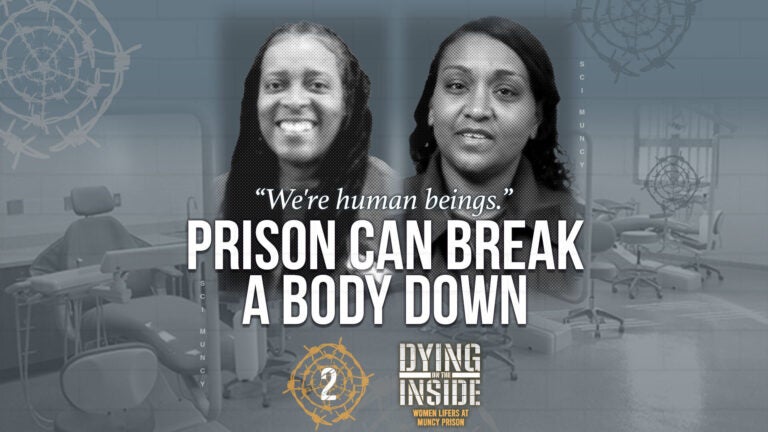
Terri Harper and Sarita Miller are serving life sentences without parole at State Correctional Institution Muncy. | Illustration by Sheldon Sneed Designs
Cherri Gregg talks to lifers at State Correctional Institution Muncy about the challenges of staying healthy in prison. People like Terri Harper, who has served 35 years, feel like their concerns aren’t taken seriously by the medical system. Terri has had seven surgeries in the last 15 years and has had to wait for long stretches to get the care she’s needed.
Nutrition is also a challenge in prison. There’s a black market for vegetables, and many inmates have to buy from the commissary to get enough to eat. These conditions and lack of preventative care results in many inmates being diagnosed with diseases like cancer at late stages and requiring advanced care. About a quarter of deaths at Muncy between 2000 and 2025 were due to cancer, slightly higher than the national average.
All of this is resulting in more costs being borne by taxpayers. Even though Pennsylvania’s prison population has gone down since 2002, the state’s annual healthcare costs have more than doubled, now exceeding $366 million a year.
-
Episode Transcript
Robovoice: This is a prepaid collect call from—
Terri Harper: Terri.
Robovoice: An incarcerated individual at SCI Muncy.
Cherri Gregg: Hi Terri, this is Cherri, how you doing?
Terri: I’ve been better, but let’s not even go there.
[music]
Cherri, narrating: I reached out to Terri Harper, who is serving life without parole at Pennsylvania State Correctional Institution Muncy. I heard she had been through it all when it comes to prison health care.
Terri: In the last 15 years I’ve had seven surgeries, to include the cage that I have from midline down to my crack three years ago, which was my second back surgery.
Cherri, narrating: Terri is 57 years old. She has been in Muncy for 35 years, and she’s got a pile of injuries, pain, and attempts to fix it.
Terri: I have a plate and screws in my right foot and I’m waiting to go see the specialist because now both of my feet are being taken over by heel spurs and I take Toradol shots every five days just to be able to walk normally.
Cherri, narrating: And there’s more.
Terri: I’ve had both hands surgically repaired for carpal tunnel. I’ve had a hysterectomy. What else happened to me?
[music]
Cherri, narrating: It’s unusual when I reach out to a woman serving life at Muncy who is middle-aged or older and their body feels right. In the year that I’ve been talking to these women, it’s been the one thing that is constant. Their bodies are broken down and they rarely feel well. It’s a laundry list of ailments that include diabetes, arthritis, hypertension and back problems, and this is happening in women’s prisons in every state in the country.
I’m Cherri Gregg, I’m a journalist and radio host at WHYY, and this is Dying on the Inside: Women Lifers at Muncy Prison, a podcast that looks at the national crisis of our aging prison population, and its incredibly high cost. Welcome to Episode 2: Prison can Break a Body Down
Cherri, narrating: Terri Harper worked for years on the Muncy Prison paint crew.[music]
Terri: We did everything, joint compound, brown coat, spackle, everything like that.
Cherri, narrating: One day in 2008, Terri was working in a room fixing a wall when she bent down to get a bucket of compound. She heard a pop.Terri: Literally my body froze. And I just started yelling.
Cherri, narrating: Terri’s pain was so bad she could barely walk back to her unit.
Terri: It took me 40 minutes to get from where I was to where I lived at, which should have taken all of two minutes.
Cherri, narrating: By the time she made it to the residential area the pain was unbearable.
Terri: I just started screaming again. And everybody came, the people came running out. They got me, they carried me upstairs to my room. And I lay on the floor for four days.
Cherri, narrating: When nurses finally came to see her, they suggested she go to the infirmary. Terri’s friends helped her get there.
Terri: They put me in the wheelbarrow, which was the wheelbarrows we used for trash. They put me in the wheelbarrow and pushed me to the infirmary. When I got down there, one of the physician’s assistants was like, Terri, I don’t think it’s your back.
Cherri, narrating: And so, the guessing game began
Terri: For a series up to almost three years, they put me on glucosamine and chondroitin, they put me on all kinds of pain meds, everything, nothing works.
[ticking noise]
Terri: One day I went to sick call and the same physician’s assistant said, Can I try something? She grabbed my leg and pushed it back and turned it at the same time. And it made my body shoot up like a projectile, and I shot up swinging. And she looked at me and she said, Terri, I owe you an apology. You were right. It is your back. Two weeks later, I went out for an MRI. As soon as they put me in the MRI machine the technician said, Ooh, that’s bad.
Cherri, narrating: But getting to see a surgeon was still not a guarantee her back would be healed.
Terri: He looked at me and said, I saw the pictures, and I don’t think I’mma be able to fix that. I was like, What? He’s like, You know, you’re still pretty young. If I do something, not much is going to happen. And sometimes down the line, something else might happen. And I’m like, Listen, everybody sit down. We’re not going anywhere until this man listens to me. When I got done talking, we had an agreement that he would see me the day of the surgery.
Cherri, narrating: Terri finally got her back surgery. but soon after, she needed another to fix her deteriorating lumbar. It took a year to get that one scheduled.
[music]
Terri: For women lifers, there’s too much wait and see as a theory and as a practice, there’s way too much of that. It’s also, Well, let’s just try this. Too much of pushing it off and not taking the problem seriously right off the top.
Cherri, narrating: I ask Terri why she believes her health concerns are not taken seriously.
Terri: Well, number one, because I have a life sentence, it’s just that simple. I don’t care what anybody ever tells you.
Cherri, narrating: We reached out to SCI Muncy to talk about healthcare for lifers, but the Department of Correction denied our interview request.[music]
Cherri, narrating: Even though Pennsylvania’s prison population has gone down since 2002, the state’s annual healthcare costs have more than doubled. They’re now at over $366 million a year. And the brunt of those costs are paid by taxpayers.
John Wetzel: Listen, aging prisoners, it’s a really big cost. And just to have context, if you get life in Pennsylvania, it means life, so unlike many states where life means 25 years.
Cherri, narrating: That’s John Wetzel. He was the longest serving Secretary of Correction in the history of Pennsylvania. He is currently the Founding Board Chair of the Keystone Restituere Justice Center.
John: Older incarcerated people cost more from a healthcare standpoint. So overall healthcare is outsourced. So contract costs, is higher, some of it’s because of personnel costs and those kinds of things. Older people are sicker. There’s more acuity from a health, mental health, and physical health standpoint.
Cherri, narrating: He says during his tenure dealing with aging persons, humanely, was important to him and he expanded services.
John: We started a memory loss unit at Rockview for people with Alzheimer’s and other memory loss conditions. If you’re going to have a population that’s now 10% or now 15%, 20% elderly, these are things you need. We started hospice programs along with Penn State at every prison in Pennsylvania. We started that in 2012. You know, there’s dialysis, there are nursing homes. This is when you choose to incarcerate elderly people, these are the things that you need.
Cherri, narrating: He says the mission of prisons is being forced to change.
John: I mean frankly, some of these facilities were built in the 60s and the 70s before we lost our mind about criminal justice policy and got so punitive that we created this geriatric population. These prisons weren’t built to be nursing homes. These prisons weren’t built to provide elder care in the healthcare context. They weren’t designed to deliver this. They were designed to keep dangerous people secure from the community.
Robovoice: This is a prepaid collect call from—
Terri Harper: Terri.
Robovoice: An incarcerated individual at SCI Muncy.
Cherri: Hi Terri, how you doing?
Terri: I’m good. I had some rest today.
Cherri: That’s good.
Terri: Despite all my reading and studying, I had some rest.
[music]
Cherri, narrating: It’s clear during my conversations with Terri that she is whip smart. She’s a mentor and taking college classes at Bucknell University. She’s doing everything she can to live her best life under a life sentence, but she says prison is incredibly difficult on the body.
Terri: Everybody’s sleeping on metal beds with thin mattresses and flattened pillows. The pillow is flat five minutes after you put your head on it. And they don’t realize that that is affecting everybody’s hips, everybody’s back, their posture. You wake up with aches and pains and creaks.
Cherri, narrating: Healthy food options are also an issue at Muncy. The food is so bad there is a black market for vegetables.
Sarita Miller: You have people that work in the kitchen and they bring back onions and peppers. So one pepper or one onion, one whole onion, will go for like $1.50. So since everything is about e-cigarettes in here, you can get three items for an e-cigarette. One e-cigarette is $6.Cherri, narrating: Sarita Miller is also serving a life sentence at Muncy. She says the black market for vegetables is busy.
Sarita: A lot of the women like to cook on their own. So they like things to make a decent meal on their own inside of their room.
Cherri, narrating: When we visited the Muncy kitchen I was struck by how much the food came from cans. There were rows and rows and stacks and stacks of cans.
Sarita: We don’t get real meat unless it’s on like a chicken day. We get baked chicken legs like once a month, and I don’t really like the chicken too much because it doesn’t taste like chicken. So I kind of like stay away from that.
Cherri: What does it taste like if it doesn’t taste like chicken?
Sarita: Well, it doesn’t—it has no taste at all. And that’s not the chicken that I remember.
[music]
Cherri, narrating: The conditions of prison life lead to a phenomenon called accelerated aging.
Alyssa Gordon: The term was coined because incarcerated people experience accelerated aging at much higher rates and that’s due to the nature of incarceration, right? And the many stressors that exist in prison.
Cherri, narrating: Alyssa Gordon is an attorney at the ACLU National Prison Project. She co-authored the report “Trapped in Time: The Silent Crisis of Elderly Incarceration.”
Alyssa: So when you see a 50-year-old incarcerated person with the mobility issues or the cognitive impairments of someone who’s 70 or someone who is 80 on the outside, you can understand why, right? Because chronic stress literally breaks down your body, every part of your body mentally, physically, emotionally, and then when you don’t have the proper foods to be eating or you don’t have proper access to healthcare, your body’s just gonna deteriorate and it’s gonna deteriorate very quickly.
Cherri, narrating: Alyssa has accumulated some grim data.
Alyssa: One study we cited in our report found that for every year you are incarcerated, your life expectancy decreases by two years. And when you think about that god-awful statistic, these are people’s realities. Accelerated aging is very common across the country.
[music, midroll]
Voiceover: At Klein College of Media and Communication, at Temple University, we believe the best way to learn it is to live it. From day one, students get real world experience in sports media, journalism, communication, production, PR, advertising, and more. Guided by industry pros and fueled by Philly’s energy, Klein prepares you to lead in media and communication. Learn more at klein.temple.edu.
[music]
Cherri, narrating: One thing that I’ve been hearing on loop since I started this project was the amount of women who lost friends to cancer.
Robovoice: This is a prepaid collect call from—
Sylvia Boykin: Sylvia.
Robovoice: An incarcerated individual at SCI Muncy.
Sylvia: I wanted to give you the names, I wrote them down, of people who they have said have stage four cancer here. All of these ones are dead except for two.
Cherri: Okay.
Sylvia: Lois Farquharson, Patricia Feagins—
Cherri: Mhmm.
Sylvia: Rose Buckner—
Cherri, narrating: We talked with Sylvia Boykin in the last episode. She’s been at Muncy 33 years.
Sylvia: Sherri, with a “s,” Robinson. Linda Grimes. Sheila Miller. Naomi Blount. Justine Heisey. Deitra Owens. Beth Shivery. Euisson Cho. Lindsy Melnick. Celeste Coles. Shavonne Robbins. Theresa—
Robovoice: [overlapping] You have one minute left.
Sylvia: Teresa Battles…
Cherri, narrating: Our reporting revealed that about a quarter of deaths at Muncy between 2000 and 2025 were due to cancer, which is slightly higher than the national average. Cancer was the second leading cause of death in the United States in 2024. Roughly one in five Americans died of cancer—this is according to the Centers for Disease Control and Prevention.
Dr. Oluwadamilola Oladeru: Historically, we’ve always thought of the leading cause of deaths in the prison setting as heart disease. But it turns out what has happened is that has kind of changed now towards cancer.
[music]
Cherri, narrating: That’s Dr. Oluwadamilola Oladeru, a Radiation Oncologist at The Mayo Clinic in Jacksonville, Florida. She researches cancer among incarcerated people.
Dr. Oladeru: We found that patients are being diagnosed, you know, much later, stage three and four, as opposed to early stage.
Cherri, narrating: She says people in prison need more access to cancer screenings, and once they’re sick, it’s difficult to get timely care in prison. The back and forth to hospitals delays everything. Take breast cancer —
Dr. Oladeru: Well, first, if someone felt a lump, they would need to have a diagnostic mammogram scheduled and then an ultrasound. And then after they do that, they take them back to the prison. Then they wait for a call that, okay, it is cancer, we need to biopsy it. Then they’re transported back to the community to get the biopsy done. And then they may go back to prison and then they’re called and say, We need to schedule a CT scan or a PET scan, or you need even an MRI as well. Then they are transported back for that. Then they have to wait for an appointment to see a surgeon. They have the surgery, they wait for the pathology.
Cherri, narrating: To get their pathology results, people have to be transported back to the hospital again. And they’re not allowed to know when their follow-up appointment is. Prisons say that information could give these patients a chance to plan an escape.
Dr. Oladeru: If they need chemo, this is where it gets complicated.
Cherri, narrating: Dr. Oladeru says chemotherapy means you have to be transported to the hospital every three weeks for treatment.Dr. Oladeru: It can be a whole day of treatment. They’ll wait for a few hours to monitor for side effects, then they’ll be transported back to prison. Within the next 72 hours, all the side effects are gonna kick in: vomiting, diarrhea, discomfort, nausea, you know, numbness and tingling.
Cherri, narrating: This can last four to six months. And then, there is more.
Dr. Oladeru: When it’s radiation time, they have to be transported every day for radiation treatments. They’ll get on the radiation table, handcuffed to the table.
Cherri, narrating: My head is spinning. This is really hard to manage if you’re facing cancer, which is scary enough.
Dr. Oladeru: Regardless of how anyone feels about incarcerated people, they are protected by the US Constitution to get appropriate care. And so we need to live up to that as a profession to make sure that we advocate that they’re getting the same type of care that would be considered standard of care for anyone that’s not incarcerated.
[music]
Robovoice: This is a prepaid collect call from—
Terri Harper: Terri.
Robovoice: An incarcerated individual at SCI Muncy.
Cherri, narrating: I reach out to Terri Harper again to discuss her hysterectomy, which is something else I am hearing a lot about from the lifers I’ve talked to.
Cherri: I wanted to kind of talk to you about your hysterectomy. And I know that’s a really personal thing—Terri: Okay.
Cherri: But can you tell us the story of how you ended up getting one?
Terri: I was 48. And I was like, Oh my God, this—is my period still on? Wait a minute, this is going on too long. So after two weeks, I went to sick call and I was like, Hey, I’ve never had a period lasting this long. He actually took a biopsy. And it came back that I actually had a tumor that was on and off the muscle of my uterus, like inside and outside.
Cherri: Was it like a fibroid or?
Terri: Yes. And it was the size of a three month fetus.
Cherri, narrating: There is no hard data on how many incarcerated women have hysterectomies.
Terri: It’s a lot [laughing]. It’s a lot because at one point it seemed like every time you turned around somebody else you knew that was doing 20 or more years, specifically lifers, it seemed it was like back to back to back to back to back. These tumors and these fibroids were being found. And we were all like, What is going on around here?
Cherri, narrating: Alyssa Gordon of the ACLU says there are countless examples of women being given unnecessary hysterectomies in prison.
Alyssa: Incarcerated women are very vulnerable and they’re often very traumatized. And because of that, when a male nurse or male doctor comes to them and says, Hey, you should get your tubes tied, or you should get this hysterectomy, oftentimes they will say yes and agree to it without actually knowing what it means because of their life experiences with trauma compounding to just accept what a figure of authority or a male figure is telling them. And you just see that a lot with women and it’s heartbreaking.
[music]
Cherri, narrating: Terri Harper says even though she was facing a lifetime in prison it felt like a huge loss.
Terri: I had to make that decision because I just, I did not feel well. I think initially the first six or seven months, I actually mourned it because the one thing I’ve always wanted was a baby. And to have to know that it was absolutely, absolutely impossible now. You know, it wasn’t sentence-wise impossible. It was physically impossible. It hurt me. And it really took something out of me.
[music]
Cherri, narrating: Terri is a former Philadelphia Police Officer. She graduated high school with honors. She’d then joined the force because she wanted to help people. But instead, she and her boyfriend were robbing homes. They were in the midst of a burglary when the home owners, a couple, came home. Her boyfriend killed the man. Terri was 22 and pleaded guilty to second degree murder, which is a mandatory life without parole sentence.
Terri: At first I was just angry for the sake of being angry. And then as I sorta kinda felt my way around this place and a couple of old heads pulled me in, I started to realize that I was angry at myself. And it took on that I was angry because I messed up. I was angry because I didn’t see the writing on the walls.
Cherri, narrating: Terri says adjusting from a life of promise to a life of incarceration took years. She remembers the point seven years in when realized that she had changed.
Terri: I used to volunteer to go with the ladies that live in one of the mental health units. To just help them working, planting flowers and creating stuff inside our greenhouse here. When I started doing more of that, I didn’t want to lose it. So then I would watch my mouth and watch my attitude. And I think that helping other people actually helped me to help myself.
Cherri: Yeah, that’s a big thing. It does change your whole attitude.Terri: I started helping one of the elderly blind ladies, and she reminded me so much of my great-grandmother, that I became basically her caretaker.
[music]
Cherri: So what do you think most people misunderstand about women lifers?
Terri: I think they misunderstand that we are labeled by the crime and the sentence, but we’re not the crime and the sentence. And I think it’s a big misnomer.
Cherri: What do you want people on the outside to know about women lifers?
Terri: I want people mainly to know that first and foremost, we’re human beings. We’re the main ones that have always carried the load, the load in our families, the load on our friendships, the load and the financial responsibilities and the nurturing of the kids coming up behind us. And we still do. We make it our business to still do that even from in prison. And we are a vital, intricate part of our family. No matter how long we’ve been in prison, no matter how far the prison is from our hometown, we are not monsters.
[music]
Cherri: On the next episode of Dying on the Inside: Women Lifers at Muncy Prison. A writer, poet, PhD candidate, and prison hospice worker serving life.
Sheena King: I’m not what I was at 18, at 52. But I’ll forever be viewed as that moment, as exactly what I’ve done and not that I’ve tried for over three decades to be someone better.
Sheena: I would hear the elderly ladies just kind of scream, just screaming for the workers, screaming for nurses. And that kind of stayed with me because I thought, why isn’t anybody answering it?
Cherri: So if you were to say what is the most likely cause of death or the thing that you see most that is killing people in Muncy, what would that be?
Sheena: Definitely cancer.
Cherri, narrating: Dying on the Inside: Women Lifers at Muncy Prison is a production of Create.Genius.Media and Temple University Klein College’s Logan Center for Urban Investigative Reporting.
I’m Cherri Gregg, Executive Producer and Host Executive Producer, Producer, and Script Writer is Yvonne Latty, the Director of The Logan Center.The Podcast Editor is Audrey Quinn.
Sound design, scoring, mixing, and mastering by Eleanor Brezzi.
Our Data Editor is Colin Evans.
Associate Producer is Natalie Reitz.
Our Community Impact Producer is LaTonya Myers.Original Music by Theodore Damascus Merz and Jarvis Cain.
Our Podcast Art is by Tracy Agostarola.
Production Assistants are Leila Oyeku and Caroline Keane.Funding support comes from The People’s Media Fund, Women’s International Media Foundation, Jonathan Logan Family Foundation, The Lenfest Institute for Journalism, Eppchez Yo-Sí Yes, and Temple University’s Klein College of Media and Communication.
Special thanks to WHYY’S Head of Digital Studios Tom Grahsler and Audio General Manager Joan Isabella.
And to the Dean of Klein College, David Boardman.We are also grateful to Jack Klotz of Klein College’s Media and Production Department and Audio & Live Entertainment Major, Amanda Stankiewicz, Danielle Martinez and Stephanie McClellan.
Please rate and review wherever you are listening and hit us up on social media @dyingontheinsidepodcast. We would love to hear from you.
And check out our stories on mass incarceration issues and solutions journalism at whyy.org/dyingontheinside and join us in this conversation.
collapse
This podcast is presented by WHYY. Thanks for listening. -
Show Credits
This episode is from Dying on the Inside: Women Lifers at Muncy Prison, a podcast production from Create Genius Media (founded by Studio 2 co-host Cherri Gregg) and Temple University’s Logan Center for Urban Investigative Reporting.
Find it on Apple Podcasts, Spotify, or wherever you get your podcasts.
collapse
WHYY is your source for fact-based, in-depth journalism and information. As a nonprofit organization, we rely on financial support from readers like you. Please give today.